
The government has mounted a staunch defense of its decision to spend GHS 2.5 billion in the 2026 budget as part of a comprehensive four-year retooling program for the Ghana Armed Forces (GAF), including the acquisition of a new executive jet.
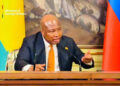
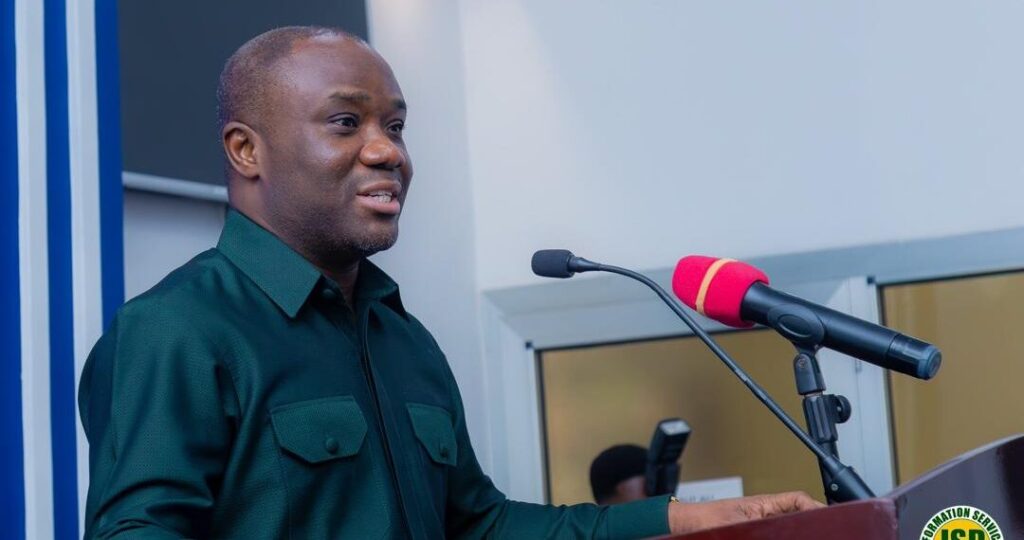
The Minister in charge of government communications and President’s spokesperson, Hon. Felix Kwakye Ofosu, rejected the opposition’s claims that the expenditure is a “misplaced priority,” arguing forcefully that national security is the foundational and non-negotiable duty of any serious government.
“They say we are spending 2.5 billion Ghana Cedis buying aircraft, so it is a misplaced priority – and you can build roads, you can do water projects. It is true, but there’s something called opportunity cost – if you don’t use it (money) for this, you can use it for that.
“At the very least, now it is clear that the claim that we’re spending 1.2 billion dollars to buy a presidential jet is a lie, right?”
Hon. Felix Kwakye Ofosu, Minister in Charge of Government Communications
Hon. Kwakye Ofosu first sought to clarify and dismantle the opposition’s narrative, which he characterized as misleading. He confirmed that the total expenditure is GHS 2.5 billion, but emphasized that this figure covers a broad range of equipment for the entire military structure, not just a single aircraft as the opposition incorrectly alleged.
The Minister asserted that prioritizing national defense and security above all else is a universal principle of governance, necessary to protect citizens against external aggression and internal threats.
To illustrate the scale of necessary security investment, he cited the United States’ decision to spend approximately $13 billion to build the USS Gerald Ford aircraft carrier.
He argued that any political actor who claims security is not a priority “cannot be a serious broker,” as the fundamental duty of the state is to guarantee safety – making the expenditure not a luxury, but a necessity.
“If a government is not able to do anything at all, securing its citizens should be something that you should be able to do. It is the number one priority of every government to secure its citizens”
Hon. Felix Kwakye Ofosu, Minister in Charge of Government Communications
The Full Inventory
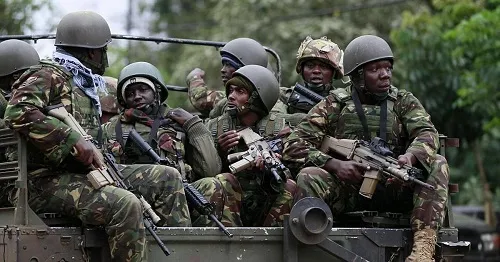
The core of the GHS 2.5 billion allocation is a systematic re-equipment drive for all military branches. The Minister detailed that the crucial assets being acquired included four military helicopters, necessary to replace aging Air Force equipment.
It also included Nineteen Armored Personnel Carriers (APCs) which are “essential ground combat vehicles.” Hon. Kwakye Ofosu revealed the complexity of the acquisition, noting the government had to locate an additional $40 million to resolve a costly legacy contract with a foreign company to secure the already partially paid-for carriers.
He also added that the government was acquiring two high-capacity vessels – critical for the Navy’s mandate to police the nation’s territorial waters and secure its maritime domain against illegal activities.
To provide a poignant justification for the immediate need for new equipment, Hon. Kwakye Ofosu referenced the recent August 6 military helicopter crash that tragically claimed the lives of highly trained military personnel, including the former Minister of Defence, Dr. Omane Boamah.
He revealed that the subsequent investigation found that the lack of advanced avionics equipment in the older aircraft contributed directly to the accident. “If they had it, they would have had greater terrain awareness and be able to avoid the obstacles that led to this crash,” he said, explaining why retooling the military now was imperative.
Hon. Kwakye Ofosu argued that the government has a moral imperative to protect the officials and personnel it invests heavily in training. The decision to retool the forces, therefore, is crucial to avoid “endangering the people we have spent money to train to protect us by air.”
Addressing the most controversial part of the package – the new jet – Hon. Kwakye Ofosu clarified that the aircraft is a military platform for the Air Force, designed for executive travel and other military uses, and will be piloted by the Chief of Air Staff.
He cited the severe maintenance issues plaguing the current 15-year-old Falcon 900EX, which has recently required maintenance periods of up to eight and nine months, rendering it unreliable.
Furthermore, he noted that the alternative – renting suitable executive aircraft, as former President Akufo-Addo was doing – proved to be fiscally imprudent, costing up to $3 million a week when travel itineraries demand continuous access to the aircraft over several days and multiple destinations.

“It is not prudent use of resources,” he declared, concluding that the Air Force’s recommendation for the new platform represented the most financially responsible solution to guarantee the President’s safety and reliability of travel.
The Minister concluded that those who narrowly argue that retooling the Armed Forces is a misplaced priority in favor of only social infrastructure “miss the point,” as the security of the state is the prerequisite for all development.
READ ALSO: UK Sanctions Four RSF Commanders Over Atrocities In Sudan