Prof. Isaac Boadi, Director of Institute of Economic Research and Public Policy (IERPP) has exposed a major fiscal opportunity that the government must strategically harness to stabilize the national budget and reduce the country’s dependency on external aid from institutions like the IMF and World Bank.
Prof. Boadi argued that Ghana’s recent mineral discoveries, particularly lithium, offer a powerful, immediate source of domestic revenue that can directly address the nation’s perennial financial woes.
He highlighted the sheer incongruity of a resource-rich nation rushing to international bodies for support while simultaneously negotiating away significant portions of its mineral wealth.
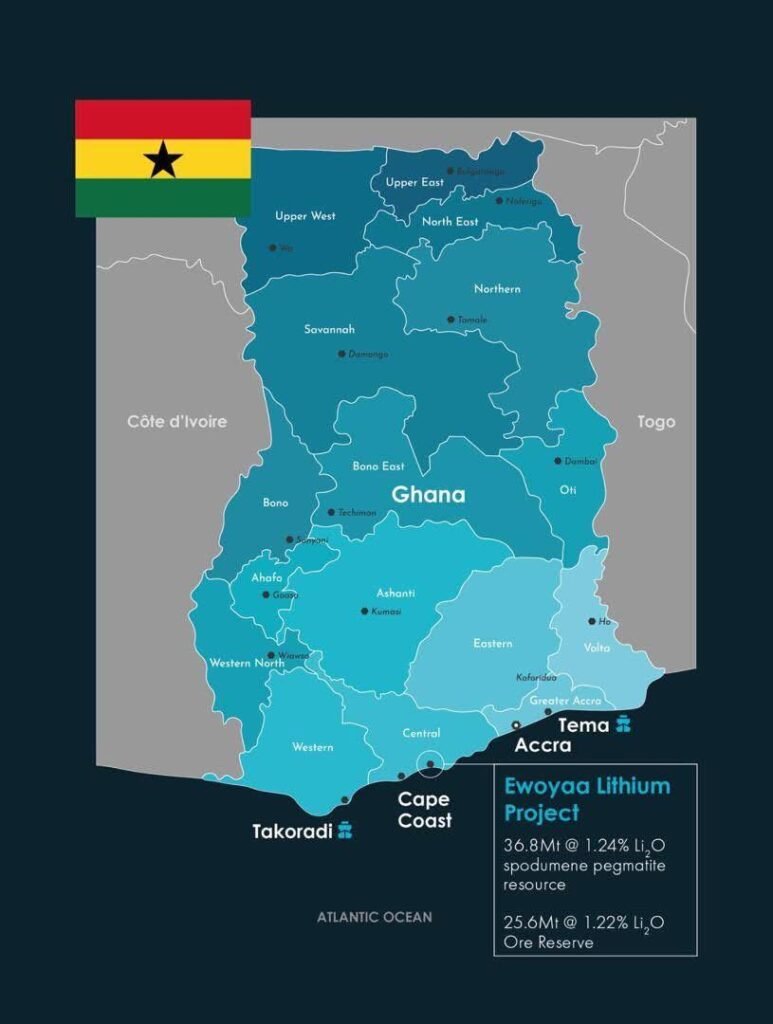
The push to reduce the secured 10% royalty rate on the Barari DV/Atlantic Lithium deal to 5% is seen not only as fiscally irresponsible but as a self-inflicted wound, depriving the budget of substantial, non-debt-creating income.
“A country, when we have problem. We run to the IMF all the time. World Bank, for support. You’ve discovered Lithium. And for me, if the government is looking for a source of revenue to support the budget, that’s another area.”
Prof. Isaac Boad
He also questioned the logic of negotiating down a generous 10% royalty offer, which the mining company itself had not publicly contested, arguing that certain individuals were acting as “PRs” for the firm.
The government’s focus should be on maximizing the fiscal terms of the lithium agreement to lessen the cycle of seeking foreign bailouts.
Imperative of a Sliding Scale Royalty
The current mineral royalty regime in Ghana, which has defaulted to a 5% fixed rate for most minerals, including gold, is fundamentally flawed.
When the price of gold, for instance, dramatically increases on the world market, the royalty payment remains flat, meaning the nation captures only a fraction of the windfall.
This static structure is a primary reason why Ghana, despite being Africa’s leading gold producer, frequently faces acute revenue shortfalls that necessitate IMF support.
The proposed sliding scale mechanism, which is designed to see royalty rates increase automatically as international commodity prices rise, offers a logical and sustainable fix. This system would embed a direct, positive correlation between the value of the nation’s exported resources and the state’s financial receipts, providing a crucial, predictable boost to the budget during commodity booms.
The government’s temporary suspension of the revised lithium deal provides a critical window to finalize and enforce this new progressive royalty structure for this strategic mineral.
This move would address the key issue with the lithium deal, the reduction from 10% to 5% by making the royalty dynamic and allowing it to increase with market recovery.
If the administration succeeds in implementing an effective sliding scale, it would mark a significant legislative achievement, shifting Ghana away from the detrimental fixed-rate model that has historically undervalued its mineral resources.
The fact that the proposed revised lithium deal was pegged at a “scale of 5 percent,” which allows it to increase with global lithium prices, shows the concept is already acknowledged, but it needs to be made robust and applied universally.
The lack of this dynamic pricing system means the country risks losing substantial revenue, as noted by Prof. Boadi, when mineral prices inevitably cycle upwards.
Fiscal Benefits for National Budget

Prof. Boadi believed the lithium deal, if structured correctly, offers immense fiscal benefits that could significantly ease the strain on the national budget.
The Atlantic Lithium (Barari DV) agreement, even in its earlier form, was expected to yield an effective tax rate of about 58% for Ghana.
This composite figure includes corporate income tax (35%), royalties, ground rents, mineral rights fees, and the state’s 13% free carried interest in the project. The revenue streams are substantial and diverse.
Directly maximizing the fiscal terms on the lithium project provides a stable, non-tax revenue stream.
A 10% royalty rate on the projected $\sim\$1.5$ million tonnes of lithium oxide concentrate over the life of the mine, even at a conservative long-term price, would generate significantly more revenue than the proposed 5% rate.
The profitability of Barari DV is robust, with high gross margins, ensuring that the 35% corporate tax rate will be a major, long-term source of income for the central government, potentially generating hundreds of millions of dollars over the mine’s 15-year lease.
Furthermore, the original agreement’s 1% Community Development Fund provision, calculated on gross revenue rather than profit, acts as an additional, mandatory revenue stream, which is ring-fenced for the direct benefit of local communities.
This reduces the pressure on the national budget to fund local development projects in mining areas, freeing up central government funds for other critical sectors.
Crucially, the state’s 13% free carried interest, coupled with the Minerals Income Investment Fund’s (MIIF) potential to acquire an additional equity stake, provides Ghana with direct dividend payments and capital gains.
This transforms the state from a mere tax collector into a business partner, allowing Ghana to benefit from increased profits and global lithium price surges beyond just the royalty rate.
These combined revenue sources tax, royalty, and equity are integral to the government’s revenue mobilization strategy and represent a far more reliable source of funding than continuous borrowing and dependence on the IMF.
READ ALSO: Kwakye Ofosu Defends GHS 2.5 Billion Military Retooling Plan as Essential Priority