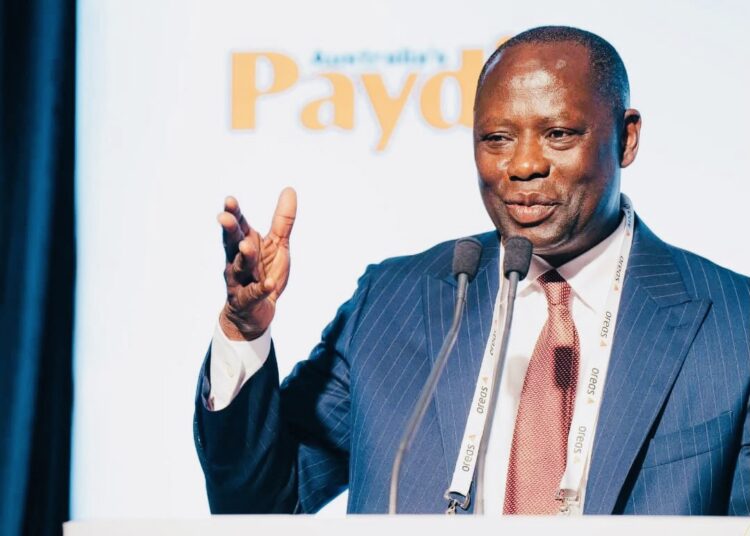
Ghana has positioned itself as a champion of science-led governance on the global environmental stage, with Lands and Natural Resources Minister Emmanuel Armah-Kofi Buah telling world leaders at the United Nations Environment Assembly (UNEA-7) in Nairobi that the country is charting a new path grounded in evidence, responsibility and public accountability.
Speaking at the UNEP headquarters in Nairobi, the minister announced that Ghana had taken a decisive step in environmental governance with the repeal of Legislative Instrument (LI) 2462, a regulation that had faced fierce opposition from scientists, civil society and local communities.
“Ghana has shown that when leadership listens to science, change happens,” he said, explaining that the instrument “could not protect our forests and water bodies.” He added that “science spoke, the people spoke, leadership responded.”
The repeal, which took effect after the LI matured into law but failed to meet scientific and public expectations, has been widely seen as a turning point in Ghana’s natural resource management.
Responsibility Anchored in Science

Minister Buah stressed that the country’s renewed commitment to environmental sustainability is shaped by rigorous scientific assessments and guided by a sense of national responsibility.
He said, “Ghana comes to this assembly with a convention shaped by science and guided by responsibility,” framing Ghana’s policy shift within a broader global context.
Recent UNEA assessments, he noted, have warned that several key planetary boundaries have already been exceeded, with consequences that are acutely felt in Ghana.
“For us in Ghana, this reality is not distant. “Fishermen watch the sea claim their shores, farmers face failing grains, and families breathe polluted air. Our response must rest on evidence, innovation, and firm political will.”
Emmanuel Armah-Kofi Buah, Lands and Natural Resources Minister
The minister highlighted that under President Mahama’s leadership, scientific data and research are now at the centre of national planning, influencing decisions across energy, land management and environmental monitoring.
A key component of Ghana’s renewed environmental strategy is the protection of forest reserves and the restoration of degraded landscapes.
The minister outlined strong measures to prevent mining in ecologically sensitive areas. “We have designated key forest reserves as red zones, where mining cannot be permitted,” he stated.
He added that ongoing reclamation programmes are helping restore damaged ecosystems.
“Across our landscapes, reclamation programs are restoring degraded soils, rebuilding river banks, and bringing life back to damaged lands.”
Emmanuel Armah-Kofi Buah, Lands and Natural Resources Minister
The government is also strengthening coastal resilience through mangrove and lagoon restoration, interventions increasingly crucial as climate impacts accelerate erosion and flooding.
Ghana Pushes for Fair Climate Finance

Ghana used the global platform to call for more equitable and predictable climate financing.
Minister Buah argued that while developing nations are demonstrating ambition, they need reliable international support to accelerate adaptation and mitigation efforts. “We call on this assembly to match national ambition with global responsibility,” he said.
He urged UNEA-7 to advocate for climate finance that is “accessible, predictable, and fair,” and emphasised the importance of technological partnerships that empower developing countries to act “at a speed demanded by science.”
Beyond climate finance, Ghana pressed for stronger global rules to address pollution from plastics, chemicals, e-waste and hazardous waste, issues that disproportionately affect developing economies.
Call for Global Action Beyond Rhetoric

In a powerful closing statement, the minister called for a shift from declarations to measurable action. “The time for declarations without deliveries is over,” he declared.
He urged the international community to let “the clarity of our rivers match the clarity of our resolve,” and for “the green of our forests [to] reflect the prosperity of our people.”
He said UNEA-7 should be remembered “not for the words, but for the systems we change,” as nations work together to protect the natural systems essential for human survival.
Ghana’s message at UNEA-7 was clear: environmental leadership must be grounded in science, strengthened by public accountability and driven by a commitment to global cooperation.
With the repeal of LI 2462 and the rollout of a multi-billion-dollar clean energy plan, the country signaled its intention to align policy with planetary limits and to push the world to do the same.
READ ALSO: NAGRAT Gives Government 14 Days to Act on Kade SHTS Assault Before Strike Action