Minority Caucus in Parliament has intensified its demand for the immediate resignation or dismissal of the Minister for Lands and Natural Resources, Hon. Emmanuel Armah-Kofi Buah, following the controversial withdrawal of the Ewoyaa Lithium mining lease agreement.
This demand centers on the Minister’s alleged “erratic handling” of the strategic mineral resource and the subsequent embarrassment caused to the legislative body after he had previously “forcefully defended” the deal as being in the best interest of the nation.
The opposition argues that the sudden reversal, premised on the need for “further review” and “inadequate consultations,” serves as a tacit admission that Parliament was misled with incomplete information during the initial ratification attempts.
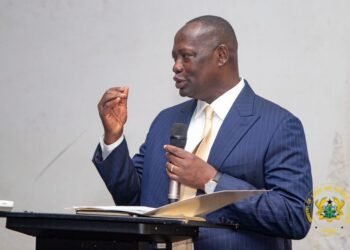
In a press briefing held in Accra, the Minority through Hon. Vincent Ekow Assafuah, Member of Parliament for Old Tafo Constituency, highlighted a significant “inconsistency between what Parliament was told and what has now been conceded.“
“The subsequent withdrawal of the agreement, now explained on grounds of inadequate consultations and the need for further review, represents a direct contradiction of the assurances previously given to Parliament. This sequence of events amounts to an implicit admission that Parliament was asked to proceed on the basis of information that was at best incomplete. The honourable course of action is for the Minister for Lands and Natural Resources to resign, or be relieved of his position.”
Hon. Vincent Ekow Assafuah
The caucus emphasized that for a resource as critical as lithium central to Ghana’s energy transition and industrialization accountability must be non-negotiable for any minister who presides over such “contradictions and uncertainty.”
By retreating from a deal that was previously presented as finalized, the Minister has effectively “wicked Ghana’s negotiating position” and eroded public trust in the transparent management of the country’s extractive wealth.


Fiscal Flip-Flop and Royalty Reductions
The core of the Ewoyaa “brouhaha” stems from a drastic shift in the fiscal terms presented to the state. Initially, the government touted a “landmark” 10% royalty rate and increased state participation as superior to previous mining regimes.
However, the revised agreement recently laid before the House saw the royalty rate slashed to 5%, a move the government defended by citing “declining world market prices” and the need to ensure project viability for the developer, Barari DV Ghana Limited (a subsidiary of Atlantic Lithium).
This 50% reduction in the state’s primary revenue stream sparked immediate outrage from civil society organizations like IMANI Africa, who argued that the project remains highly profitable even at lower price points.
Strategic Missteps and Consultative Failures

Beyond the numbers, the controversy is fueled by what experts describe as a “procedural mess.” While the Minister initially dismissed concerns raised by the Minority and various stakeholders, the administration’s later reliance on “insufficient consultation” as a justification for withdrawing the deal has been labeled as “neither reasonable nor acceptable.”
The Minority maintains that essential stakeholder engagement must occur before an agreement is defended on the floor of Parliament, not as a reactive measure to “public pressure” after the fact.
This perceived lack of foresight has raised questions about the legal stability of the deal, with the Majority even suggesting that the previous 10% royalty rate was “inconsistent with existing law,” further deepening the policy confusion.
Implications for Ghana’s Green Mineral Future

As the global demand for “white gold” surges, the stakes for the Ewoyaa project could not be higher.
The project is expected to produce roughly 350,000 tonnes of spodumene concentrate annually, yet the current stalemate threatens to stall Ghana’s entry into the global electric vehicle (EV) value chain.
The Minority asserts that lithium is a “strategic mineral with far-reaching implications” for intergenerational equity and environmental protection. Without a leadership that offers “clarity, consistency, and foresight,” the opposition fears Ghana will lose its competitive edge, leaving the nation’s industrialization agenda in a state of perpetual uncertainty.
READ ALSO: IMANI Urges President Mahama to Anchor Foreign Policy in West African Stability