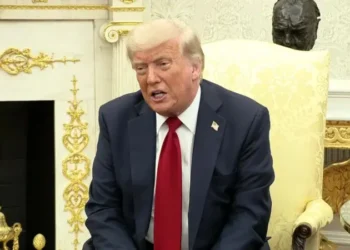
US President Donald Trump has stated that he was ordering a “total and complete blockade” of sanctioned oil tankers coming to and leaving from Venezuela.
In a Truth Social post, Trump pointed to the large collection of US military assets in the region, suggested more could be coming and took aim at Nicolas Maduro’s regime by name.
He also suggested Venezuela give up land, oil and assets to the United States, making clear that one aim of his military campaign is not just about countering the drug trade.
“Venezuela is completely surrounded by the largest Armada ever assembled in the History of South America. It will only get bigger, and the shock to them will be like nothing they have ever seen before — Until such time as they return to the United States of America all of the Oil, Land, and other Assets that they previously stole from us.”
Donald Trump
Combined with Trump’s threat of land strikes on Venezuelan soil, the move ramped up pressure on Caracas by going after its economic lifeline, which had already come under strain after new sanctions on the oil sector earlier this year and last week’s seizure of a tanker full of Venezuelan oil.
In his Truth Social post, Trump accused “the illegitimate Maduro regime” of using stolen oil to “finance themselves, drug terrorism, human trafficking, murder, and kidnapping.”
The Trump administration has launched strikes at suspected drug vessels in the Caribbean, and the President has said repeatedly that strikes on land will come soon.


Trump’s announcement also underscored the US President’s focus on the country’s oil, which he has said that the US should have access to if Maduro is ousted.
State-owned Petróleos de Venezuela controls the country’s petroleum industry. Houston-based Chevron is the only US firm drilling in Venezuela and pays a percentage of its output to PDVSA under a sanctions carve-out.
American companies had a much larger presence in Venezuela’s oil fields until the country put the sector under state control in the 1970s. Trump has made little secret of his desire for the US to return to the country’s oil industry.
Venezuela’s oil reserves are the world’s largest but operate well below capacity due to international sanctions. Much of the country’s oil is sold to China.
The US government has imposed sanctions on Venezuela since 2005, and the first Trump administration in 2019 effectively blocked all crude exports to the United States from PDVSA.
Then-President Joe Biden in 2022 granted Chevron a permit to operate in Venezuela as part of an effort to lower gas prices. Trump revoked that license in March but later reissued on condition that no proceeds go to the Maduro government.
Venezuela Decries Trump’s Move
Venezuela slammed the announcement in a statement, calling it “a reckless and serious threat.”
The statement from Venezuela’s government decried the move, saying that Trump “seeks to impose, in an absolutely irrational manner, a so-called naval military blockade on Venezuela with the aim of stealing the riches that belong to our Homeland.”
The government reaffirmed Venezuela’s sovereignty and asserted that its Ambassador to the United Nations “will immediately proceed to denounce this grave violation of International Law.” Blockades are considered an act of war under some international treaties.
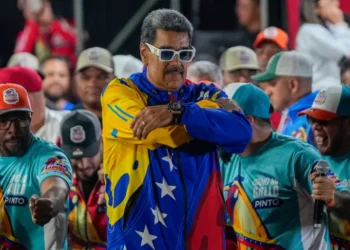
Speaking before Trump’s announcement, Maduro in a state television address praised Venezuela for having “proven to be a strong country” against the US pressure campaign.
“Venezuela has [spent] 25 weeks denouncing, confronting and defeating a campaign of multidimensional aggression, ranging from psychological terrorism to the piracy of the corsairs who assaulted the oil tanker.”
Nicolas Maduro
He added, “We have taken the oath to defend our homeland, and that on this soil, peace and shared happiness triumph.”
READ ALSO: Ghana’s Rapid Economic Rebound Redraws Africa’s Post-Crisis Recovery League Table