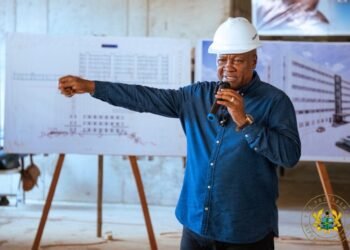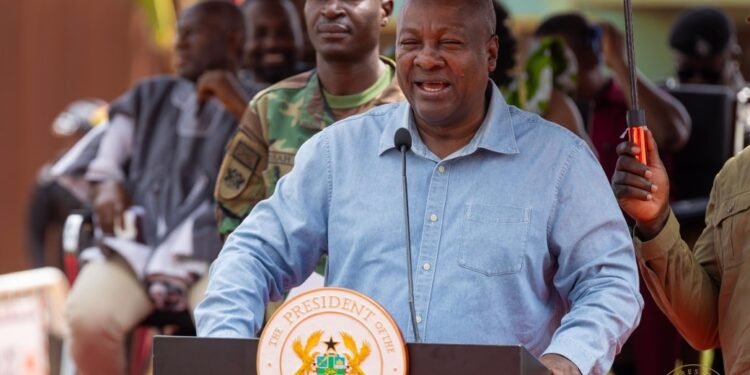
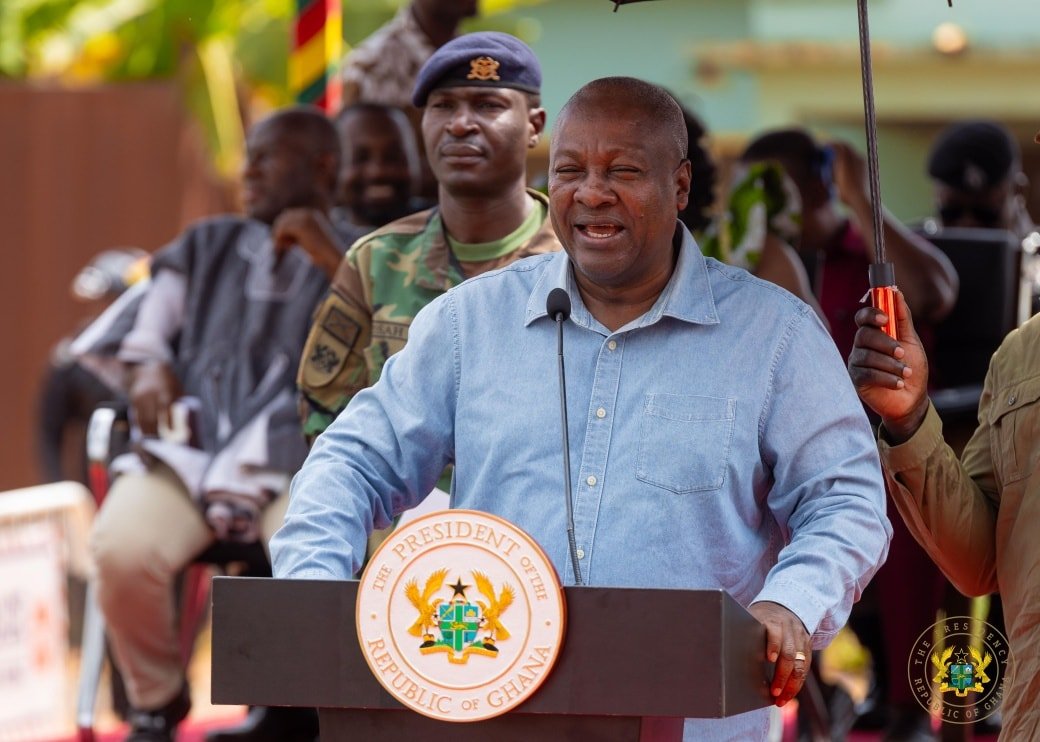
President John Dramani Mahama has cut the sod for the commencement of the Sunyani Outer Ring Road and several auxiliary road projects in the Bono Region, marking a significant expansion of his government’s flagship Big Push infrastructure programme. The projects form part of a broader effort to address long-standing road deficits, improve regional connectivity, and stimulate economic activity across the country.
The sod-cutting ceremony covered a wide range of road works in the region, including the Wenchi–Dambai road, the Sunyani–Atronie–Acherensua road, the Wenchi–Nsawkaw–Debibi–Sampa road, the Techiman–Wa road, the Kyeremasu–Gambia No. 1 and No. 2 roads, the Wenchi–Sawla road, the Berekum–Siekwa road, and the Jinijini–Sampa road.
President Mahama said these projects represent only part of the road infrastructure earmarked for the Bono Region under the Big Push initiative. Addressing chiefs, residents, and contractors, the President assured that road development in the region would continue beyond the current list of projects.
He disclosed that the 2026 national budget had already made provision for additional road works, including the long-awaited Kumasi–Sunyani road project. According to him, the government’s approach is comprehensive and inclusive, ensuring that no part of the country is left out of the national infrastructure drive.
Completion of Project Legacy
President Mahama stressed that his administration is committed to completing all ongoing and stalled road projects, including those initiated by the previous government. He described the continuation of legacy projects as a constitutional and moral obligation, declaring that “the era of abandoned projects is over.”
He said Ghana could no longer afford the waste associated with halted developments, especially in critical sectors such as roads. He revealed that upon returning to office in January 2025, he personally directed all road contractors to remain on their sites and continue work.


He said contractors were assured that while the government would uphold due diligence and demand value for money, it would also honour its payment obligations promptly. “Whenever you raise a certificate of payment, we will pay you,” he said, adding that restoring confidence among contractors was essential to keeping projects on schedule.
Closing Ghana’s Infrastructure Gap
The President linked the Big Push programme to a broader national strategy to close Ghana’s infrastructure gap. He explained that the US$10 billion initiative was informed by a World Bank study which found that Ghana faced an annual infrastructure deficit of about US$1.5 billion.
According to him, without a deliberate and large-scale intervention, the gap would continue to undermine growth, job creation, and service delivery. President Mahama said road conditions emerged as one of the most pressing concerns during his nationwide engagements ahead of the 2024 elections.
He noted that despite claims by the previous administration of having constructed thousands of kilometres of roads, communities across the country continued to grapple with poor road networks.
“Almost every palace I entered, chiefs and traditional leaders raised concerns about their deplorable roads,” he said, explaining that these interactions reinforced the need for a bold and coordinated response. He described the Big Push as that response, designed to tackle infrastructure challenges in a systematic way while also boosting economic activity.
According to him, improved road networks would reduce transportation costs, link farmers to markets, support industrial growth, and create sustainable jobs, particularly for the youth.
Sectorial Commitment
President Mahama commended the Minister for Roads and Highways, Hon. Governs Kwame Agbodza, his Deputy, Hon. Alhassan Suhuyini, and the management and staff of the Roads and Highways Department and its allied agencies for their role in rolling out the programme.
He said their technical input and commitment had been critical to turning the Big Push from a policy concept into projects on the ground. The Big Push programme, launched following the National Democratic Congress’ return to power in 2025, is structured as a five-year, US$10 billion national infrastructure development plan.
It aims to invest about US$2 billion annually in high-impact projects across all 16 regions. For the 2025 fiscal year, GH¢14 billion was allocated, with the government increasing spending to over GH¢30 billion in 2026 Budget.
Funding for the programme is expected to come largely from domestic sources, including petroleum revenues and mineral royalties. The government is also revamping the Ghana Infrastructure Investment Fund to undertake strategic, self-financing projects and attract private capital through public-private partnerships.
While roads and bridges form a major component of the programme, President Mahama noted that the Big Push also covers railways, agriculture, water infrastructure, health, and education.
He said a dedicated monitoring unit at the Presidency has been established to track progress and ensure contractors are paid within two weeks of certified work, with priority given to Ghanaian firms to maximise local job creation.
As construction begins on the Bono Region road projects, President Mahama said the government remains focused on delivery, accountability, and tangible outcomes. He expressed confidence that the Big Push would transform infrastructure development nationwide and restore public trust in the state’s ability to complete major projects.
READ ALSO: Ghana’s Primary Target Crushes Debt Demons