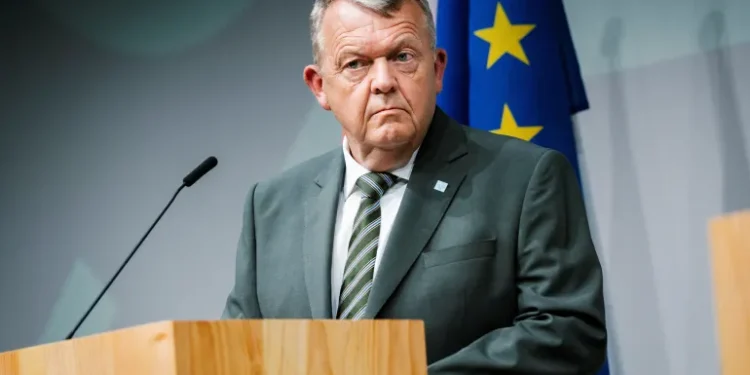
Dr Cassiel Ato Forson, the Minister of Finance, has signaled his preparedness to insist on discipline in all public sector institutions by issuing a compliance notice.
The Finance Minister has published the list of all public sector institutions that have complied and submitted their Fourth Quarterly Commitment Control Reports (CCR) to the Internal Audit Agency (IAA). This followed the directive issued by Dr Forson on May 2, 2025, requiring all Covered Entities to comply.
“Heads of public institutions are hereby reminded that submission of the Fourth Commitment Control Report to the IAA id 10th January 2026. Failure to submit the Report within the stipulated timeframe constitutes a breach of the approved guidelines.”
Compliance Notice, Ministry of Finance
Purpose and Justification
According to Dr Forson, “the Report serves as a key control mechanism for ensuring fiscal discipline, promoting accountability, and transparency in the management of public funds.” This fiscal control is also to enforce commitment and prevent unauthorized expenditures by any public sector institution.
According to the Ministry of Finance, issuance of the list of compliant institutions meets Regulation 230(1)(b) of the Public Financial Management Regulations (PFM), 2019 (L.I. 2378), which empowers the Minister for Finance to publish the names of Principal Spending Officers and/or institutions that do not comply with the provisions of the PFM laws.
With the stated deadline, Dr Forson urged the institutions to treat the notice with the utmost importance and ensure strict compliance. “All institutions are hereby advised to submit their Commitment Control Reports to avoid regulatory and administrative sanctions,” the report stated.
Compliant and Non-Compliant Public Institutions
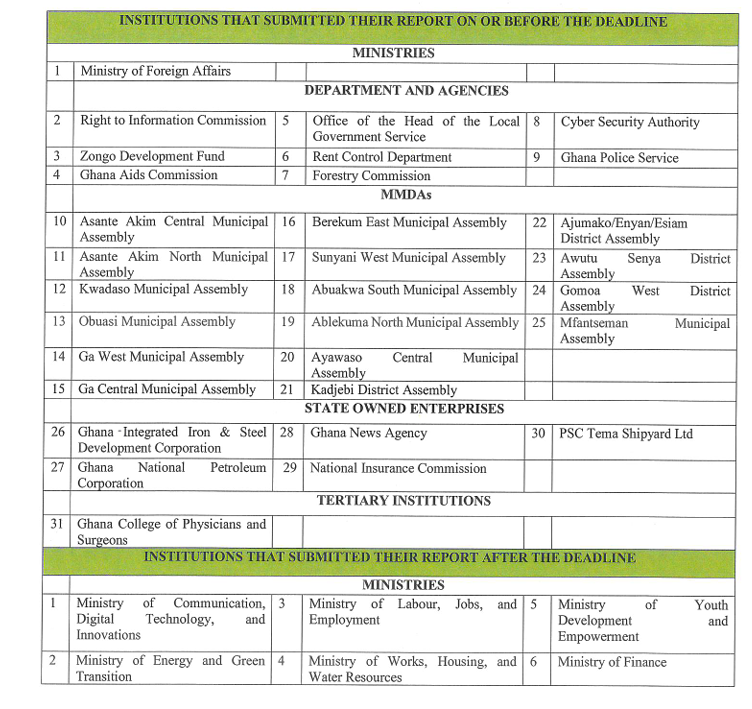
According to the report, the listed names of institutions represent those who have complied; “any institution not appearing on the list has failed to comply and remains in breach.”


From the report, the following institutions submitted their report on or before the deadline, thirty-one in all; only the Foreign Affairs Ministry among the twenty-three Ministries, eight departments and agencies, sixteen MMDAs, five State Owned Enterprises (SOEs), and one Tertiary Institution.
Other notable institutions in this category include the Ghana Police Service, the Cyber Security Authority, the Forestry Commission, the Ghana National Petroleum Corporation, and the Ghana College of Physicians and Surgeons.
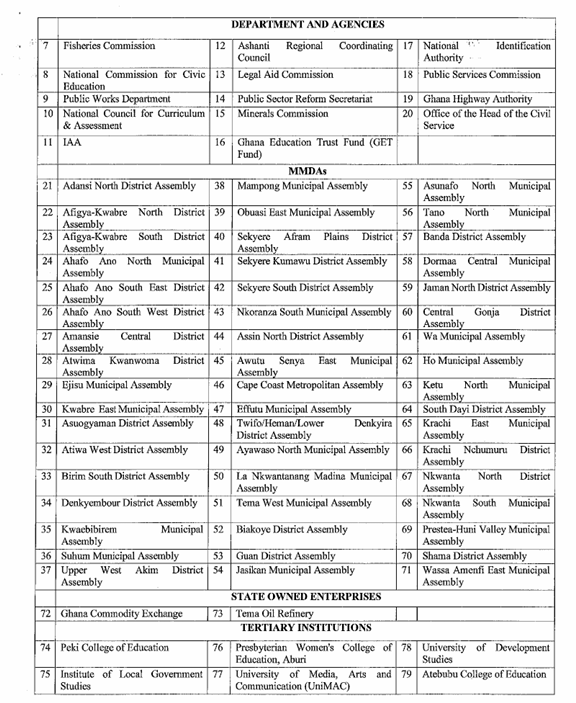
Those who submitted their report after the deadline, seventy-nine in number, also include six Ministries, fourteen departments and agencies, fifty-one MMDAs, two State Owned Enterprises, and six Tertiary Institutions.
Notable institutions that submitted after the deadline include the Ministry of Communication, Digital Technology, and Innovation; the Ministry of Finance, the Internal Audit Agency, the Mineral Commission, the Ghana Commodities Exchange, Tema Oil Refinery, and the University of Development Studies.
Key Ministries like the Ministry of Health, the Ministry of the Interior, the Ministry of Defence, the Ministry of Education, the Ministry of Energy and Green Transition, the Ministry of Roads and Highways, the Office of the Attorney-General and Ministry of Justice, the Ministry of Food and Agriculture, and the Ministry of Trade, Agribusiness, and Industry, have all not submitted their reports.
Reason for the Finance Minister’s Keen Emphasis on Report
Dr Forson is enforcing the Public Financial Management (Amendment) Act, where the compliance form is a critical tool for monitoring adherence to the legal requirements outlined. This allows the Ministry to apply administrative and criminal sanctions against non-compliant public officers.
Another objective is to stop the problem of Ministries, Departments, and Agencies (MDAs) awarding contracts and incurring expenditures without the necessary “commencement authorization” and available funds, which historically led to significant budgetary shortfalls and legacy debts.

Dr Forson aims to ensure that all expenditures have specific allotments and are recorded on the Ghana Electronic Procurement Systems (GHANEPS), promoting probity and openness in government spending.
The forms also provide a mechanism for strict budget commitment control and cash management, ensuring that public resources are utilized effectively and efficiently.
Furthermore, these measures are part of a broader government strategy, supported by the World Bank and the IMF, to restore confidence in Ghana’s fiscal framework, reduce the national debt, restore Macroeconomic Stability, and achieve sustainable economic growth.
READ ALSO: BOG Governor Discloses Ghana’s 2026 Central Economic Question