
Ghana’s Constitutional Review Committee (CRC) has proposed the establishment of an Independent Public Emoluments Commission as part of a broader effort to rein in the country’s rising public wage bill and end what it describes as an unsustainable culture of public sector remuneration.
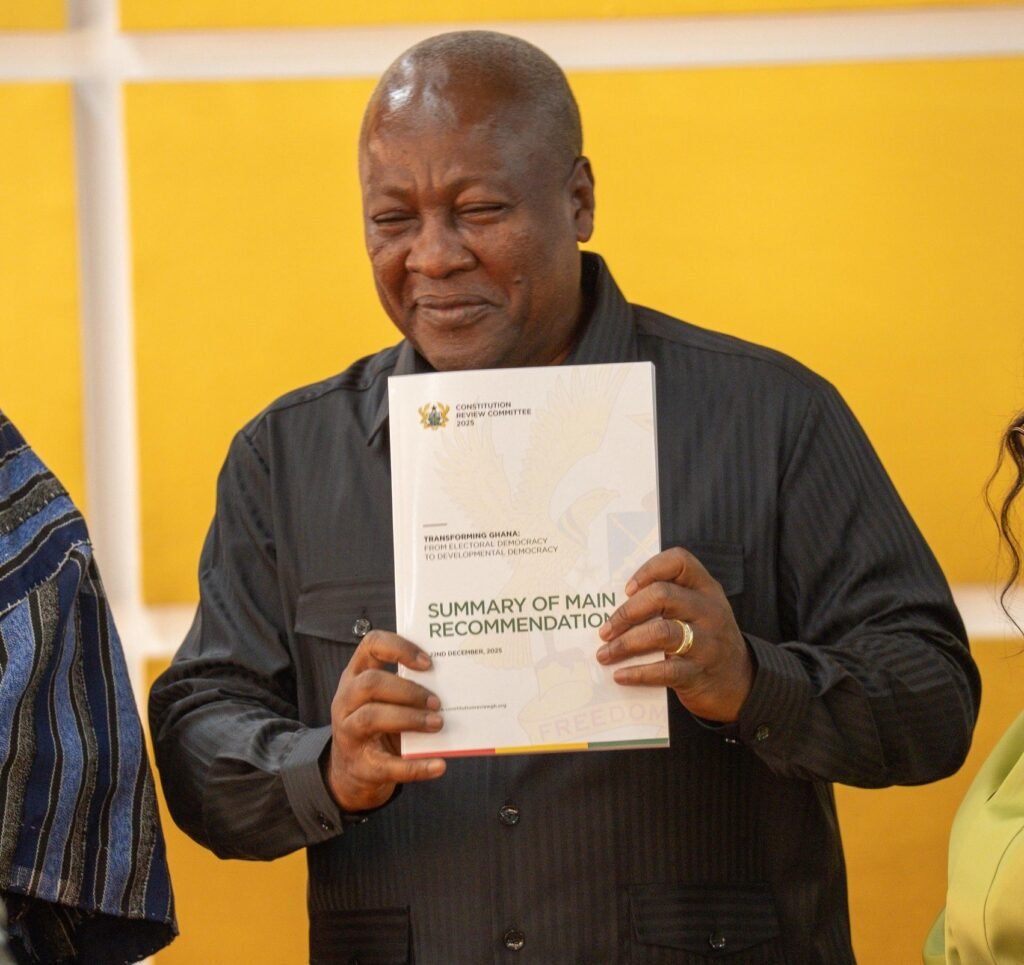
The recommendation forms part of the Committee’s final report submitted to President John Dramani Mahama on December 22, 2025, after nearly eleven months of nationwide consultations and technical review of the 1992 Constitution.
According to the Committee, distortions in public sector pay have grown steadily over the years, driven largely by the widespread practice of cross-service benchmarking of salaries, allowances, and retirement benefits across state institutions.
What began as a limited arrangement for specific offices has, in the Committee’s assessment, expanded into a system that now places an excessive and inequitable burden on the national budget.
At the center of the concern is the phenomenon commonly referred to as “retire on salary,” where certain public officials continue to receive salaries or salary-equivalent benefits after retirement. The CRC notes that this privilege was historically restricted to the judiciary, reflecting the unique constitutional role and tenure protections afforded to judges.

However, the Committee observes that similar retirement arrangements have gradually been extended across other areas of the public service, including the security services and civil administration, without clear constitutional justification.


Trend Fiscally and Politically Unsustainable
The Committee describes this trend as both fiscally and politically unsustainable. It argues that allowing growing numbers of public employees to retire on terms equivalent to active service places long-term pressure on public finances, limits fiscal flexibility, and undermines public confidence in the fairness of state compensation systems.
In its assessment, the current trajectory of the public wage bill poses risks not only to macroeconomic stability but also to social cohesion, particularly at a time when governments are being asked to justify public spending choices to a demanding electorate.
To address these challenges, the CRC is recommending the creation of an Independent Public Emoluments Commission with a broad constitutional mandate to rationalise salaries, allowances, pensions, and retirement benefits across the public sector.
The proposed commission would be tasked with reviewing existing remuneration structures and correcting disparities that have emerged through uncoordinated negotiations, political bargaining, and institutional precedent.

The Committee notes that cross-service benchmarking, where one agency’s salary structure is used to justify increases in another, has become entrenched in the public sector.
While such benchmarking is often defended as a tool for equity, the CRC argues that, in practice, it has fueled an upward spiral in compensation that is disconnected from productivity, fiscal capacity, and the overall structure of the public service. The proposed commission, according to the report, would be empowered to bring coherence and discipline to this process.
Free from Executive and Political Actors
Under the CRC’s proposal, the Independent Public Emoluments Commission would operate at arm’s length from the executive and political actors, allowing it to make objective assessments based on economic realities and public interest considerations.
The Committee believes that insulating decisions on emoluments from short-term political pressures is essential to restoring credibility to the management of public sector pay.
The report emphasizes that the aim is not to punish public servants or diminish the value of their work, but rather to ensure fairness, sustainability, and transparency.
By rationalising distortions in the wage bill, the Committee argues, the state would be better positioned to allocate resources toward development priorities such as infrastructure, health, education, and job creation, while still honoring legitimate compensation obligations.
The CRC also links the proposed reforms to broader concerns about governance and democratic accountability. It warns that unchecked growth in public sector benefits, especially retirement packages perceived as excessive, can erode public trust in institutions and fuel perceptions of elite privilege.
Addressing these issues through a transparent and constitutionally grounded mechanism, the Committee argues, would strengthen confidence in the state and its stewardship of public resources.
President Mahama, upon receiving the CRC’s final report, announced that a dedicated Implementation Committee would be established in early 2026 to begin the process of translating the recommendations into constitutional amendments.
The proposed Emoluments Commission is expected to feature prominently in that process, given the central role of public sector compensation in Ghana’s fiscal challenges.
Reform Unavoidable
While the recommendations are likely to generate debate among public sector unions, professional bodies, and political stakeholders, the CRC maintains that reform is unavoidable. In the Committee’s view, continuing with the current system would deepen fiscal strain and make future adjustments more painful.
If adopted, the establishment of an Independent Public Emoluments Commission would mark a significant shift in how Ghana manages public sector pay and retirement benefits.
By confronting the issue of “retire on salary” and related practices, the CRC says the country has an opportunity to reset its approach to compensation in a way that is fairer, more transparent, and aligned with long-term economic sustainability.
READ ALSO: US Ex-envoy To NATO Casts Doubt On Likelihood Of Putin Accepting Peace Deal