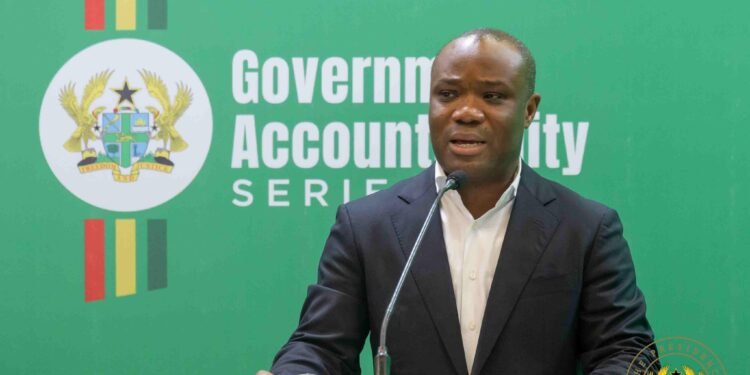
Chief Executive Officer of the Ghana Gold Board (GoldBod), Sammy Gyamfi, Esq., has signaled a definitive shift in the nation’s extractive industry by pledging that every single gram of gold acquired by the state will soon be fully traceable to its specific mine of origin.
This ambitious commitment, articulated, underscores a strategic pivot toward total transparency within the gold value chain, aimed specifically at purging the sector of “galamsey” influences.
By integrating advanced tracking protocols, the GoldBod seeks to ensure that only gold produced under strict environmental and ethical standards finds its way into the national reserve, effectively choking the financial lifelines of illegal operators who have long exploited the lack of oversight.
“We have given timelines for the traceability program to be fully operational. Every gram of gold bought by the state will be traceable to its mine of origin, and it must come from a sustainable mine.”
Sammy Gyamfi, Esq
Building on this vision, the CEO clarified that the state’s procurement strategy is being fundamentally re-engineered to prioritize ecological integrity alongside economic gain.
Mr. Sammy Gyamfi noted that the institution is moving away from the historical “status quo” where gold was often purchased without rigorous vetting of its environmental footprint.
To facilitate this, GoldBod has established a clear roadmap for a national traceability program, which is designed to monitor the journey of the precious metal from the moment it is extracted to its final delivery at the refinery.


This initiative is complemented by the enforcement of Section 59 of the GoldBod Act, which criminalizes the purchase of gold from unauthorized or illegal sources, thereby creating a legal barrier that protects the state from becoming an unwitting accomplice to environmental degradation.
Strengthening the Regulatory Shield and Forest Protection

A cornerstone of GoldBod’s new enforcement strategy is the absolute prohibition of mining within protected ecological zones, a move bolstered by the recent revocation of Legislative Instrument (L.I.) 2462.
Under the previous legal framework, certain provisions allowed for discretionary mining activities in forest reserves, a loophole that Mr. Sammy Gyamfi asserted has been firmly closed.
The CEO highlighted that “mining is no longer permissible in forest reserves,” marking a significant victory for environmental advocates.
This policy shift is being enforced on the ground by the National Anti-Illegal Mining Operations Secretariat (NAIMOS), which has intensified its crackdown on rogue sites across the country.
By removing the legal cover once provided by L.I. 2462, the government has simplified the mandate for security agencies to intervene and dismantle illegal setups that threaten Ghana’s primary water bodies and biodiversity hotspots.
Economic Transformation Through Ethical Traceability

From an expert extractive perspective, the introduction of a national traceability program is not merely a monitoring tool but a sophisticated mechanism for economic and environmental survival.
Traceability utilizes data-driven systems often involving digital certificates and unique batches—to verify that gold is not “conflict gold” or the product of mercury-heavy galamsey operations.
By ensuring that every gram is accounted for, Ghana can better align with international ESG (Environmental, Social, and Governance) standards, which are increasingly required by global bullion markets and refineries.
This level of transparency makes it virtually impossible for illegally mined gold to be laundered into the formal economy, as the absence of a “sustainable mine” certificate would immediately flag the material as illicit.
Consequently, this system incentivizes miners to adopt eco-friendly practices, such as mercury-free processing and land reclamation, to remain eligible for state purchase.
Overcoming Decades of Smuggling and Institutional Inertia

Addressing the critics who point to the pace of these reforms, Mr. Sammy Gyamfi reminded stakeholders that GoldBod is a relatively young institution, having been operational for only eight months.
He argued that it is “unfair to expect such a system to have existed overnight” when previous administrations failed to implement similar traceability measures over several decades.
The current leadership is tasked with dismantling deeply entrenched smuggling networks and unregulated trading routes that have historically undermined the national economy.
By institutionalizing these reforms, the CEO believes Ghana is finally building a resilient framework that balances the urgent need for foreign exchange with the non-negotiable duty to preserve natural heritage. This “landmark initiative” seeks to replace a legacy of opacity with a future where the gold sector serves as a beacon of sustainable development for future generations.
READ MORE: From Agyapa to TOR: OSP’s Preventive Hand Saves State Millions – Sammy Darko