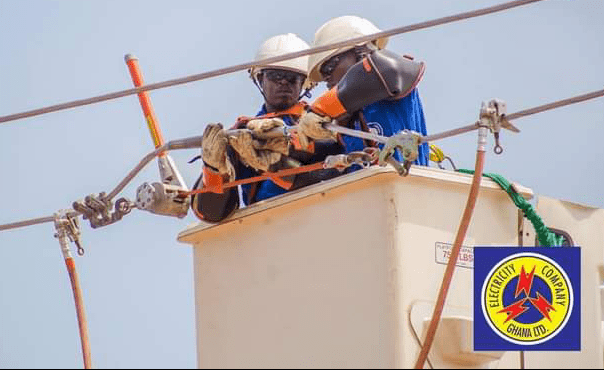
The Government of Ghana has disclosed sweeping reforms aimed at restoring financial discipline within state-owned utility companies, particularly the Electricity Company of Ghana (ECG), after uncovering what it describes as alarming budget overruns and procurement irregularities.
The Presidential Spokesperson and Minister for Government Communications, Hon. Felix Ofosu Kwakye, said the issues came to light shortly after the government assumed office, revealing a pattern of spending that was inconsistent with approved budgets and long-term sector needs.
“In 2024, ECG budgeted about GH¢800 million for procurement, yet we discovered that it had spent up to GH¢7 billion, overshooting the budget by hundreds of percentage points.”
Hon. Felix Ofosu Kwakye, Presidential Spokesperson and Minister for Government Communications

According to Hon. Ofosu Kwakye, some of the equipment procured during the period would not be required for as long as 15 years, raising serious concerns about planning, value for money and financial oversight.
He said such practices have now been brought to an end through direct ministerial intervention.
“All of that has been nipped in the bud. The Energy Minister is now stamping his authority to ensure ECG and other utility companies adhere strictly to approved budgets and exhibit financial discipline.”
Hon. Felix Ofosu Kwakye, Presidential Spokesperson and Minister for Government Communications
The government, he stressed, is determined to ensure that utility companies operate within realistic financial frameworks to prevent the accumulation of avoidable liabilities that ultimately burden the taxpayer.


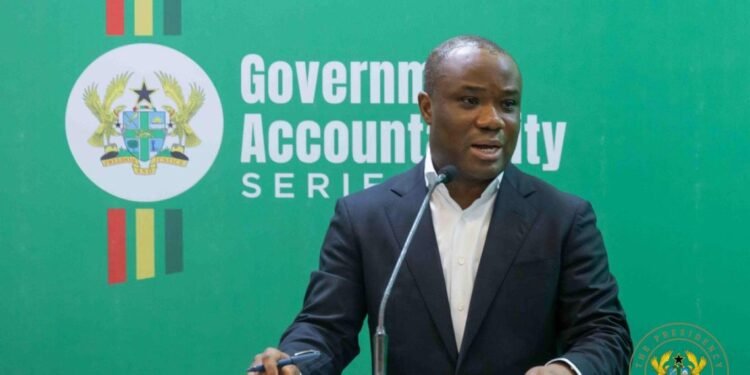
Disclosure at Accountability Series
Hon. Ofosu Kwakye, who is also the Member of Parliament for Abura Asebu Kwamankese, made the disclosure on Wednesday, January 14, 2026, when he took his turn at the Government’s Accountability Series at the Jubilee House in Accra.
He used the platform to provide broader context on the state of the energy sector inherited by the current administration, recalling remarks made by President John Dramani Mahama in his first State of the Nation Address.
“We inherited monumental mammoth debts in the energy sector. Up to about GH¢80 billion was owed to various players, including some state entities.”
Hon. Felix Ofosu Kwakye, Presidential Spokesperson and Minister for Government Communications
The Minister explained that government’s strategy since taking office has been to aggressively reduce the stock of energy sector debt, even though clearing all obligations at once may not be feasible.
According to him, significant progress has already been made, with assurances that the effort will continue.
“The commitment that the government and the Finance Minister have shown to pay substantial amounts will continue this year, and more payments will be made.”
Hon. Felix Ofosu Kwakye, Presidential Spokesperson and Minister for Government Communications
He acknowledged that while some arrears may remain in the short term, the administration is focused on preventing further debt accumulation by addressing the root causes of the sector’s financial distress.
Structural Financing Gap
Hon. Ofosu Kwakye attributed much of the sector’s difficulties to a persistent financing shortfall, where the cost of generating electricity consistently exceeds the revenue collected from consumer tariffs.
“If you break it down, the amount of money it costs to generate electricity is far more than what is collected,” he explained, noting that even though tariffs may appear high, they still fall short of covering the full cost of production due to inefficiencies and structural challenges.
As a result, government has been forced to step in annually to keep the system afloat. He revealed that in 2025 alone, government paid GH¢27 billion to support the energy sector, with an additional GH¢15 billion allocated this year following adjustments aimed at improving efficiency.
“When you put GH¢27 billion together with GH¢15 billion, that is GH¢42 billion.
“You can imagine what that amount could have done in other sectors, but we had to commit it to the energy sector to keep the system running.”
Hon. Felix Ofosu Kwakye, Presidential Spokesperson and Minister for Government Communications
These fiscal pressures, he explained, informed government’s decision announced in the 2026 Budget to establish up to 1,200 megawatts of additional generation capacity. The move is intended to reduce the cost of power production and ease the financial strain on public finances.
“The intention is to reduce the cost of generating power so that it becomes cheaper for consumers and to eliminate the need for continuous public funding to support the sector, which is not sustainable in the long run.”
Hon. Felix Ofosu Kwakye, Presidential Spokesperson and Minister for Government Communications
The Minister emphasised that the reforms underway are not limited to ECG but extend across the energy sector, with a focus on efficiency, accountability and long-term sustainability.
According to him, the ultimate goal is to build a resilient, fit-for-purpose energy sector capable of meeting Ghana’s growing power needs without imposing an unsustainable burden on the national budget.
He assured Ghanaians that government remains committed to reforms that will strengthen governance in the sector, protect public resources and deliver reliable and affordable electricity for households and businesses alike.
READ ALSO: Ghana’s Maize Among World’s Cheapest, But Farmers Pay the Price – Prof Kanton