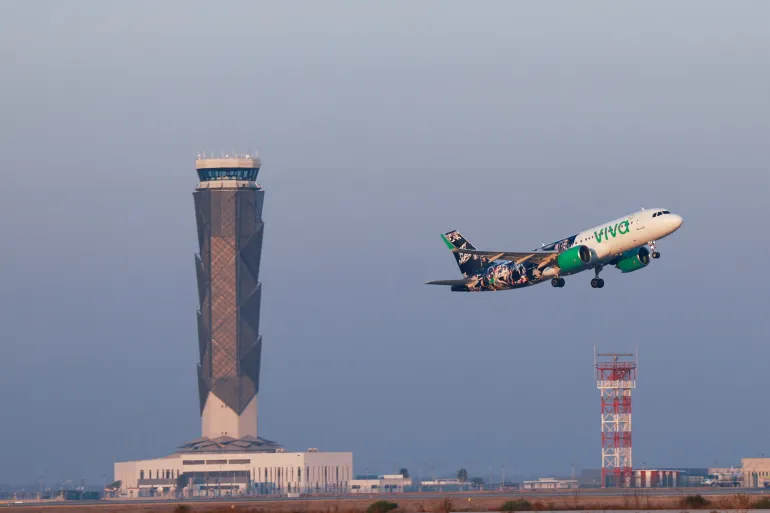
The US Federal Aviation Administration (FAA) has issued notices to airlines, urging them to “exercise caution” over Mexico and other Central American countries, as well as Ecuador and Colombia.
The FAA released a series of advisories that come amid an ongoing US military buildup in the Latin America region, including US military attacks on Venezuela, and US President Donald Trump’s warning to Cuba and threats of strikes against drug cartels in Mexico and Colombia, leaving many in the region on edge.
The FAA issued warnings of a “potentially hazardous situation” in a number of areas, including above parts of the Pacific Ocean and the Gulf of California, also known as the Sea of Cortes.
It urged US aircraft operators to “exercise caution” when flying over the eastern Pacific Ocean near Mexico, Central America and parts of South America, citing “military activities” and possible satellite navigation interference.
The warning was issued in a series of Notices to Airmen (NOTAMs) issued by the FAA. They say, “Potential risks exist for aircraft at all altitudes, including during overflight and the arrival and departure phases of flight.” According to the FAA, the warnings issued will last 60 days.
The notices come after nearly four months of US military strikes against boats in the Caribbean Sea and the eastern Pacific that the US alleged were trafficking drugs. That campaign included 35 known strikes that killed at least 115 people, according to the Trump administration.


In November, the FAA warned all pilots to exercise caution when flying in the airspace over Venezuela “due to the worsening security situation and heightened military activity.”
Last month, a JetBlue passenger jet bound for New York took evasive action to avoid a midair collision with a US Air Force tanker plane near Venezuela.
JetBlue Flight 1112 had departed the Caribbean nation of Curacao and was flying about 64km (40 miles) off the coast of Venezuela when the Airbus plane reported encountering the Air Force jet, which did not have its transponder activated.
Following the US military’s January 3 attack on Caracas and the abduction of Venezuelan President Nicolas Maduro and his wife, Trump has raised the possibility of other military actions in the area, including against Colombia.
Trump said last week that cartels were running Mexico and that the US “will now start hitting land” to combat them, in one of a series of threats to deploy US military force against drug traffickers.
After the attack on Venezuela, the FAA restricted flights throughout the Caribbean, which forced the cancellation of hundreds of flights by major airlines.
Mexico Sees Results In Drug Cartels Crackdown

Mexican President Claudia Sheinbaum said that efforts to crack down on Mexico’s drug cartels and slow migration north were showing “compelling results” following Trump’s recent threats of strikes targeting drug cartels inside Mexico.
Sheinbaum has sought to placate Trump and has worked to build a strong relationship between the Mexican and US administrations.
On Thursday, US Secretary of State Marco Rubio and Mexican Foreign Secretary Juan Ramon de la Fuente released a joint statement after a phone call, saying they agreed “more must be done to confront shared threats.”
Sheinbaum, mentioning the call in her morning news briefing, said that Mexico’s government had made significant progress, citing a steep drop in the homicide rate, much lower fentanyl seizures by US authorities at the border and sparse migration.
She also reiterated her call for Washington to stop the trafficking of weapons into Mexico from the US and highlighted drug use in the US as a key factor heightening cartel violence in Mexico.
“The other side also has to do its part. This consumption crisis they have over there also has to be addressed from a public health perspective, through education campaigns.’
Claudia Sheinbaum
Sheinbaum and Trump also spoke by phone last week, with the Mexican leader telling her counterpart that US intervention in Mexico was unnecessary.
READ ALSO: Energy Analyst Attributes Fuel Price Relief to Regulation, Strong Cedi and NPA Coordination