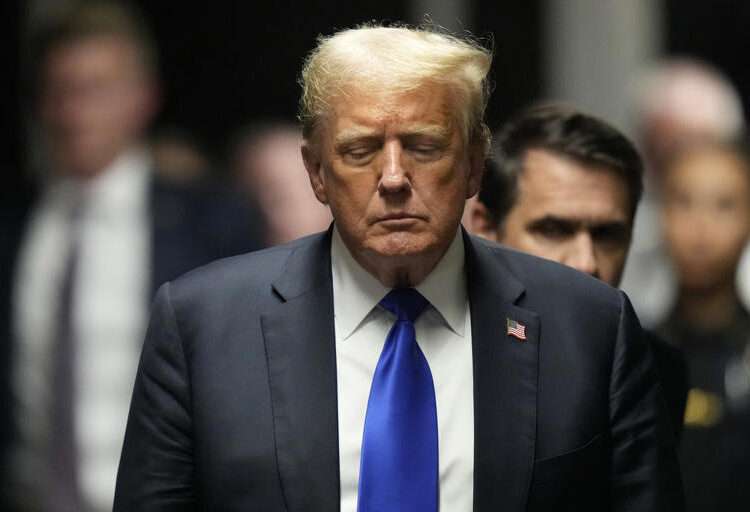
US President Donald Trump has threatened to invoke the rarely used Insurrection Act to deploy troops to the state of Minnesota in response to mounting protests in Minneapolis tied to his administration’s immigration enforcement actions.
Protests are being held against two shootings in the city of Minneapolis within a week related to his immigration crackdown.
“If the corrupt politicians of Minnesota don’t obey the law and stop the professional agitators and insurrectionists from attacking the Patriots of I.C.E., who are only trying to do their job, I will institute the INSURRECTION ACT, which many Presidents have done before me, and quickly put an end to the travesty that is taking place in that once great State.”
Donald Trump
Trump made the post a day after a federal agent shot and wounded a Venezuelan man in Minneapolis. The federal agent said that two people attacked him with a shovel and broom handle as he wrestled with the Venezuelan, who the Trump administration said was in the US illegally.
The incident further stoked tensions a week after an ICE agent fatally shot 37-year-old Renee Good, a US citizen, in her car in Minneapolis. The killing of the mother of three and the Trump administration’s depiction of her as a “domestic terrorist” sparked global outrage, leading to demonstrations across the US.
Smoke filled the streets of Minneapolis yesterday night near the site of the latest shooting as federal officers wearing gas masks and helmets fired tear gas into a small crowd while protesters threw rocks and shot fireworks.

The US President has repeatedly threatened to use the Insurrection Act to deploy the US military or federalise the National Guard for domestic law enforcement over the objections of state Governors.
Trump blamed Minnesota officials for failing to control what he described as violent disruptions targeting ICE officers. In his statement, he referred to the protesters as “professional agitators and insurrectionists,” and urged local politicians to enforce the law more strictly. Trump’s post not only criticized the protests themselves but also suggested that local inaction was enabling continued unrest.
The situation in Minneapolis has drawn national scrutiny not only because of the violence and protests themselves but also due to broader legal challenges.
Minnesota, along with the cities of Minneapolis and Saint Paul, has filed a lawsuit against the federal government seeking to halt the aggressive immigration enforcement operations, arguing that the actions of ICE and other federal agents violate constitutional rights and civil liberties.
The litigation alleges that federal agents have engaged in stops and arrests that exceed legal boundaries and infringe on community protections.
Minneapolis Mayor Calls Situation “Impossible”
Minneapolis Mayor Jacob Frey described the situation as not “sustainable.”
“This is an impossible situation that our city is presently being put in, and at the same time, we are trying to find a way forward to keep people safe, to protect our neighbours, to maintain order.”
Jacob Frey
Frey described a federal force that is five times bigger than the city’s 600-officer police force as having “invaded” the city, scaring and angering residents, some of whom want the local officers to “fight ICE agents.”
At the same time, the police force is still responsible for their day-to-day work to keep the public safe.
The Department of Homeland Security (DHS) said that it has made more than 2,000 arrests in Minnesota since early December and is promising to not back down.
The DHS accused Frey and Minnesota Governor Tim Walz, both Democrats, of encouraging resistance to ICE with “hateful rhetoric”, a contention Frey rejected.
Disputing accusations of misconduct, DHS has said that its agents have increasingly been subjected to assaults while trying to find and detain immigration violators.
Speaking at a news conference alongside Frey, Minneapolis Police Chief Brian O’Hara urged crowds he described as “engaging in unlawful acts” near the shooting scenes to disperse. “We do not need this to escalate any further,” O’Hara said.
The legal and political debate over the Insurrection Act’s use is expected to intensify. Constitutional scholars, lawmakers, and civil liberties advocates are likely to scrutinize any move to deploy military forces domestically, given the potential implications for civil rights and federal–state relations.
The unfolding developments in Minnesota have thus become a focal point in broader discussions about immigration policy, federal authority, and the balance between security and civil liberties in the United States.
READ ALSO: NAIMOS Hunts Illegal Miners along River Ankobrah, Apprehends 7 Operators