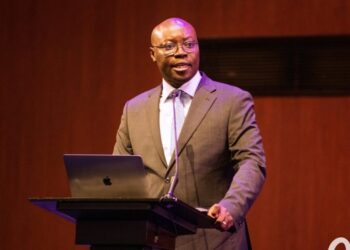
Government’s Mid-Year Budget Review has come under intense scrutiny after Deloitte Partner Yaw Appiah Lartey revealed that capital expenditure recorded an alarming underspend of more than 40 percent, raising concerns about the pace of infrastructure development and the delivery of major public projects across the country.
Speaking during an analysis of the Mid-Year Budget Review, Mr. Lartey acknowledged that the government had made notable progress in reducing spending in some areas. However, he warned that the significant shortfall in capital expenditure could undermine the ambitious development agenda announced by the government and delay projects that citizens are expecting to see completed.
While savings on compensation and interest payments paint a positive picture of improved fiscal management, he argued that these achievements should not overshadow the worrying decline in investment spending.
Capital Spending Falls Far Below Expectations
According to Mr. Lartey, the government had allocated substantial resources for capital projects in the budget but failed to spend the expected amounts during the period under review.
He disclosed that programme expenditure had been projected at GH¢158 billion for the first quarter. However, actual expenditure resulted in an underspend of approximately 20 percent, with capital expenditure emerging as the weakest performing component.
The most striking concern, he noted, was the more than 40 percent underspend recorded in capital expenditure.
“On capital expenditure, we have an underspend of about 40 per cent. The question is how far we have progressed with the ambitious capital programme announced last year.”
Yaw Appiah Lartey
His remarks have reignited debate over whether major infrastructure projects promised by the government are progressing at the expected pace or facing implementation bottlenecks.
Infrastructure investment remains one of the key drivers of economic growth, creating jobs while improving transportation, healthcare, education and industrial development.
A prolonged slowdown in project execution could therefore have significant implications for Ghana’s broader economic transformation agenda.
Billions Saved Through Payroll Reforms
Despite concerns over capital spending, Mr. Lartey praised government’s efforts to tighten expenditure controls, particularly in the area of compensation.
He attributed the lower-than-expected compensation expenditure partly to improvements in payroll administration and the continued elimination of ghost names from the public sector payroll.
According to him, these reforms generated savings of approximately GH¢3.4 billion.
The achievement reflects ongoing efforts to improve public financial management and ensure that government resources are directed toward legitimate spending priorities.
Efficient payroll management has remained one of the key recommendations from financial experts seeking to reduce waste and improve fiscal discipline.
Lower Interest Costs Deliver Additional Relief
Another major positive highlighted by Mr. Lartey was the significant reduction in interest payments.
He explained that the government saved approximately GH¢6.9 billion because borrowing costs have declined considerably following lower policy rates and improved financing conditions.
“The government is borrowing at a much cheaper rate than it used to in the past, and that presents a positive development.”
Yaw Appiah Lartey
The lower financing costs provide the government with greater fiscal flexibility and create opportunities to redirect resources toward productive investments.
Financial analysts believe sustained improvements in borrowing conditions could strengthen Ghana’s public finances if accompanied by disciplined expenditure management.

Infrastructure Delivery Faces Growing Questions
While welcoming the savings achieved in other expenditure categories, Mr. Lartey stressed that delayed capital spending remains the biggest concern emerging from the Mid-Year Budget Review.
He questioned the extent to which the government has advanced the ambitious infrastructure programme announced last year, especially projects requiring substantial public investment.
Road construction, schools, hospitals, water systems and other essential infrastructure depend heavily on consistent capital expenditure.
When spending falls significantly below planned levels, project completion timelines can be affected, increasing costs and delaying the economic benefits expected from those investments.
The latest figures have therefore raised fresh questions about implementation capacity and whether government agencies are executing projects according to schedule.
Funding First Strategy Wins Praise
Although he expressed concern over the pace of capital spending, Mr. Lartey welcomed the government’s decision to secure financing before launching major infrastructure projects.
According to him, this represents a significant improvement over previous practices where projects sometimes commenced without guaranteed funding.
“Starting projects with funding secured means we do not have situations where projects begin and later get stuck because there is no money to continue.”
Yaw Appiah Lartey
Historically, several public projects have experienced prolonged delays after construction began without adequate financing, resulting in abandoned sites, rising costs and unfinished infrastructure.
Ensuring that funding arrangements are secured beforehand could help minimize these risks and improve project completion rates over the long term.
The approach may also strengthen investor confidence by demonstrating greater fiscal discipline in public investment planning.
Revenue Mobilisation Still Needs Attention
Beyond expenditure management, Mr. Lartey also identified revenue mobilisation as another critical challenge facing the government.
He observed that while expenditure controls have produced encouraging results in certain areas, the government must significantly improve revenue collection if it intends to finance development programmes sustainably.
According to him, stronger domestic revenue generation will be essential to supporting infrastructure investment while maintaining fiscal stability.
Without improved revenue performance, financing future development projects could become increasingly difficult despite lower borrowing costs.
His assessment underscores the importance of broadening the tax base, improving compliance and strengthening revenue administration as the government pursues its broader economic recovery agenda.
Balancing Fiscal Discipline With Development
The Mid-Year Budget Review presents a mixed picture of Ghana’s public finances.
On one hand, the government has demonstrated commendable fiscal discipline by reducing payroll leakages and benefiting from lower interest costs that together generated savings exceeding GH¢10 billion.
On the other hand, the sharp underspend in capital expenditure raises legitimate concerns about whether planned infrastructure projects are advancing quickly enough to support economic growth and improve living standards.
As the government enters the second half of the fiscal year, attention will increasingly focus on whether ministries and agencies can accelerate project execution while maintaining prudent financial management.
For many observers, the challenge now is not simply saving money but ensuring that those savings translate into visible development outcomes that citizens can experience across the country.
READ ALSO: GSE Finishes Unstoppable Week with Stunning Market Explosion