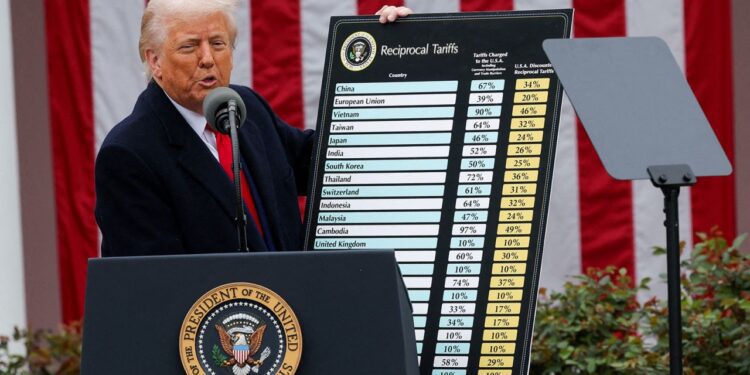
President Donald Trump has imposed tariffs on imports from 60 trading partners, charging that they have inadequately enforced bans on goods produced by forced labor.
The tariffs of 10% to 12.5% on trading partners accounting for 99.4% of U.S. imports, went into effect Friday morning. The timing coincides with the lapse of a 10% near-blanket duty President Donald Trump imposed earlier this year that was deemed unlawful by the Supreme Court.
The new tariffs take effect just as temporary 10% worldwide tariffs expire at 12:01 a.m. Friday. Trump had turned to those temporary levies after the Supreme Court struck down his biggest and boldest tariffs in February.
Administration officials said that the timing of the rollout was intended to “avoid complexity” that would come from layering the new levies on top of the existing 10% duties. They added that business leaders have been seeking more continuity and predictability around tariffs.
Some products, including oil and gas and fertilizer, are exempted from the new tariffs. Also being spared are products that qualify for duty-free status under the US-Mexico-Canada Agreement, the North American trade pact Trump negotiated in his first term.
The latest action follows a monthslong investigation by the US Trade Representative into the alleged use of forced labor to produce goods exported to the US and the failure by various countries to address the practice.
U.S. Trade Representative Jamieson Greer asserted that the United States “has had a forced labor import ban for nearly a century, and rigorously enforces it; it’s well past time for our trading partners to do the same.”
After the Supreme Court struck down his biggest and boldest tariffs in February, Trump has turned to imposing tariffs under Section 301 of the Trade Act of 1974, which permits the President to impose import taxes and other sanctions against countries found to engage in “unjustifiable,” “unreasonable” or “discriminatory” trade practices.
Tariffs Draw Immediate Criticism
The European Union questioned the new tariff, with its foreign policy chief Kaja Kallas calling it a “negative surprise” and rejecting the forced labor claims as unfounded. Switzerland also opposed the allegations, while Norway said it does not plan to retaliate by imposing tariffs on American goods.

Brazil rejected the 12.5% tariff on its goods, calling the U.S. move “arbitrary and unjustified” in a statement. It plans to trigger its reciprocity law, which could call for retaliatory tariffs on the United States, and take a complaint to the World Trade Organization. The Brazilian government said that the United States “chose to manipulate an issue of great importance to human rights and the struggles of workers worldwide in order to accuse 59 countries and the European Union of unfair practices.”
Australia, subject to a 12.5% tariff, also voiced opposition to the new tariffs. Trade Minister Don Farrell told reporters that Washington’s move is “completely unjustified,” adding that Canberra would continue to lobby the US to remove all tariffs on Australian goods.
Chile’s Undersecretary for International Economic Relations Paula Estévez said that the country has “solid labor institutions, a robust regulatory framework and a firm commitment to the prevention and eradication of forced labor.” Chile faces a 12.5% rate. “The Government of Chile considers that the application of this measure to our country is inconsistent with these standards, as well as with the technical, political, and legal background presented throughout the investigation process,” she said.
Meanwhile, more Section 301 tariffs are likely to be imposed. There are several other pending investigations that rely on the same trade law, Section 301 of the Trade Act of 1974, being used to enact the new rates.
One focuses on allegations that major trading partners — including China, Mexico and the European Union — are contributing to global manufacturing overcapacity. The U.S. Trade Representative’s office launched a probe into whether 16 countries, accounting for 70% of U.S. imports, have overproduced goods, pushing down prices and putting U.S. companies at a disadvantage in global markets. The administration has yet to complete that investigation.
Section 301 tariffs are viewed by trade experts as a more legally durable option because they have survived previous court challenges, unlike the emergency authority Trump last April used for his “Liberation Day” broader tariff regime. They can also remain in place indefinitely.
The administration is exploring additional ways to raise border taxes. Earlier this week the White House announced a 50% tariff on certain Canadian goods set to take effect next month under a never-before-used provision of the Smoot-Hawley Trade Act.
READ ALSO: Supreme Court Must Work to Sustain Public Trust In Rule Of Law – Rt Hon. Bagbin