

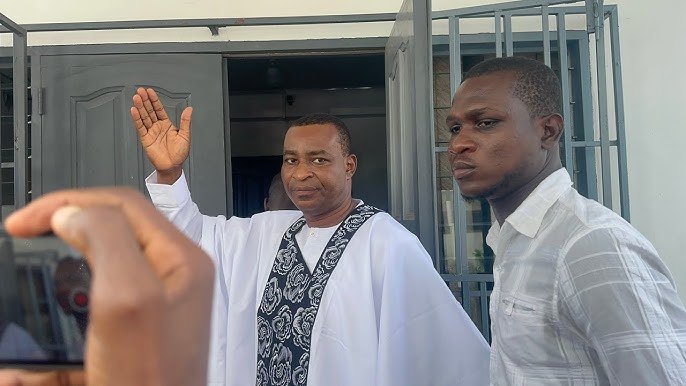
Lawyer Samuel Atta Akyea, counsel for the New Patriotic Party Ashanti Regional Chairman Bernard Antwi Boasiako, popularly known as Chairman Wontumi, has accused Ghana’s courts of rushing politically sensitive criminal cases through the justice system at an unusually accelerated pace, describing the approach as an “ambulance mode” reserved for politically exposed persons.
Atta Akyea made the remarks in an interview addressing his client’s recent conviction and 20-year sentence handed down by the Accra High Court, Criminal Division, over the Samreboi galamsey trial.
Asked whether the judgment, despite his criticism of the judge’s approach, was nonetheless sound and appealable, Atta Akyea opened by acknowledging the sensitivity of commenting on judicial matters before outlining his central concern about how politically connected cases move through the courts compared to ordinary matters.
He argued that an honest audit of court proceedings would reveal a stark contrast in pace between typical cases, where adjournments of two months or more are common, and politically charged prosecutions, which he said proceed with unusual urgency.

“This is a special case; they take it to a special court, and the judge will tell you, that look, you can’t go to another court and then maybe do a case while I’m waiting. You need to come to this court, and then we proceed with the case”.
Lawyer Samuel Atta Akyea, counsel for the New Patriotic Party Ashanti Regional Chairman Bernard Antwi Boasiako,
Civil Cases Treated Differently, Lawyer Claims
Atta Akyea contrasted this urgency with how he said judges typically handle civil matters, particularly land disputes, arguing that the same energy applied to political criminal cases is rarely extended elsewhere.
“Are the judges giving their energies to the criminal political cases, or to the rest of the cases that are not so, or to other criminal cases? They won’t give them the attention. So there is a good grounding for the position that it is as if the judges are in an ambulance mood to jail people”.
Lawyer Samuel Atta Akyea, counsel for the New Patriotic Party Ashanti Regional Chairman Bernard Antwi Boasiako
He went further, describing what he saw as a troubling political dimension shaping the pace of these prosecutions, suggesting that pressure from the ruling government risked distorting the judicial process.
“Justice hasn’t got a political term of four years, and when some people are saying that let’s run an ambulance justice delivery system, then we are saying that we are trying to please Jubilee House. That kind of frenzy in NDC and in Jubilee House should not find expression in the court of competent jurisdiction”.
Lawyer Samuel Atta Akyea, counsel for the New Patriotic Party Ashanti Regional Chairman Bernard Antwi Boasiako
Disputed Constitutional Referral Request
Atta Akyea also raised concerns about how the trial judge handled a request from the defence to refer certain constitutional questions to the Supreme Court for interpretation, arguing that the judge appeared to have already reached her conclusions before formally addressing the motion.
He cited a case and related authorities to argue that a lower court should not readily assume a constitutional provision is plain and unambiguous when rival interpretations exist, contending that this principle applied directly to how penal provisions under the Minerals Act were interpreted in relation to Article 91 of the Constitution.
When pressed on whether he was suggesting the judge had no discretion to decide the constitutional referral question herself, Atta Akyea clarified that his argument centred on how that discretion was exercised rather than whether it existed at all, maintaining that the depth of the issues raised warranted Supreme Court input regardless of the judge’s own interpretation.
No Fixed Political Term for Justice
Responding to the suggestion that swift trials should generally be welcomed as an improvement over Ghana’s history of prolonged court delays, Atta Akyea reiterated his central concern, distinguishing between legitimate efficiency and prosecutions accelerated for political convenience.
He pointed to the judge’s decision to discourage the defence from pressing the constitutional referral motion as evidence that the outcome had already been predetermined.
“The judge said, ‘Don’t. Please don’t move this motion, as I’ve already captured your thinking and it is embedded in the judgment. Do you know what that means? I have made up my mind. Don’t disturb me with the law”.
Lawyer Samuel Atta Akyea, counsel for the New Patriotic Party Ashanti Regional Chairman Bernard Antwi Boasiako
Atta Akyea also referenced previous politically connected cases that lingered in Ghana’s courts for years without resolution, arguing that public awareness of such patterns undermines confidence in claims of judicial urgency.
He cited a set of prior proceedings, describing how a change in the Attorney General’s office ultimately led to those cases being discontinued after roughly seven years without conclusion, suggesting that Ghanaians remain sceptical of assurances that political considerations play no role in how swiftly, or slowly, cases move through the courts.

A Broader Warning About Judicial Independence
Atta Akyea closed his remarks by cautioning against allowing political pressure from the governing party to influence judicial timelines, framing this as a fundamental threat to the rule of law regardless of which government is in power.
“If the judges are in an ambulance mood because they want to appease the political government to achieve their political ends, then I’m afraid to say the law is undermined,” he said.
Atta Akyea’s remarks signal that Wontumi’s legal team intends to challenge both the conviction and the judicial process that produced it before the Court of Appeal, with the disputed constitutional referral forming a central pillar of the anticipated appeal.
His comments add a pointed defence perspective to a case that has already drawn significant public attention, given his client’s prominent standing within the New Patriotic Party’s Ashanti Regional leadership.
Whether these arguments succeed on appeal remains to be seen, but Atta Akyea’s characterisation of the trial’s pace as unusually accelerated adds a fresh dimension to broader public debate over how Ghana’s courts handle politically sensitive prosecutions involving figures connected to the country’s major political parties.
READ ALSO: Government Spending At Right Places, Deputy Finance Minister Insists