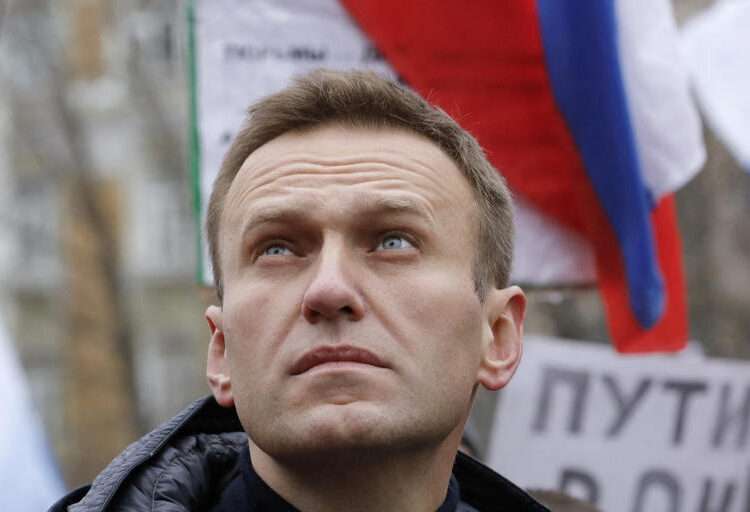
The Kremlin has “strongly” rejected an assessment by five European countries that the Russian state killed jailed opposition leader Alexei Navalny by poisoning him.
Kremlin Spokesman Dmitry Peskov told reporters during a daily briefing call, “We naturally do not accept such accusations.”
“We disagree with them. We consider them biased and baseless. In fact, we strongly reject them.”
Dmitry Peskov

Navalny, President Vladimir Putin’s fiercest domestic opponent for years, died in an Arctic prison colony on February 16, 2024 while serving a 19-year sentence for “extremism,” a charge he and his supporters said was punishment for his opposition work.
Russia’s prison service said that the Yale-educated lawyer died after going for a walk and falling ill. Since Navalny’s death, Russia’s opposition has remained largely exiled and fragmented.
The United Kingdom, France, Germany, the Netherlands and Sweden issued a joint statement on Saturday saying that they believed he had been poisoned with epibatidine, a toxin found in poison dart frogs.
They stated that analysis in European labs of samples taken from Navalny’s body “conclusively confirmed the presence of epibatidine” and that the Russian state had the “means, motive and opportunity” to administer it.
The poison works on the body in a similar way to nerve agents, causing shortness of breath, convulsions, seizures, a slowed heart rate and ultimately death.
Epibatidine is found naturally in the small and brightly coloured dart frogs, which typically live in rainforests in South America. It can also be manufactured in a lab, something European scientists suspect was the case in the alleged poisoning of Navalny.
Russian authorities designated Navalny and his organisation “extremist” before his death at the age of 47, and anyone who mentions him or his exiled anticorruption foundation is liable for prosecution.
Navalny had already survived a suspected poisoning with the Novichok nerve agent in 2020.
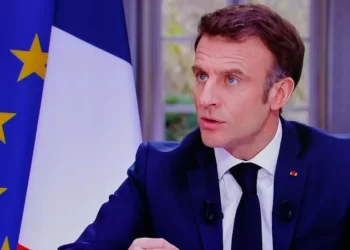
In a written tribute to Navalny today, French President Emmanuel Macron also linked the Kremlin with the opposition leader’s death.
“Two years ago, the world learned of the death of Alexei Navalny. I pay tribute to his memory. I said then that I believed his death said everything about the Kremlin’s weakness and its fear of any opponent. It is now clear that this death was premeditated. Truth always prevails, while we await justice to do the same.”
Emmanuel Macron
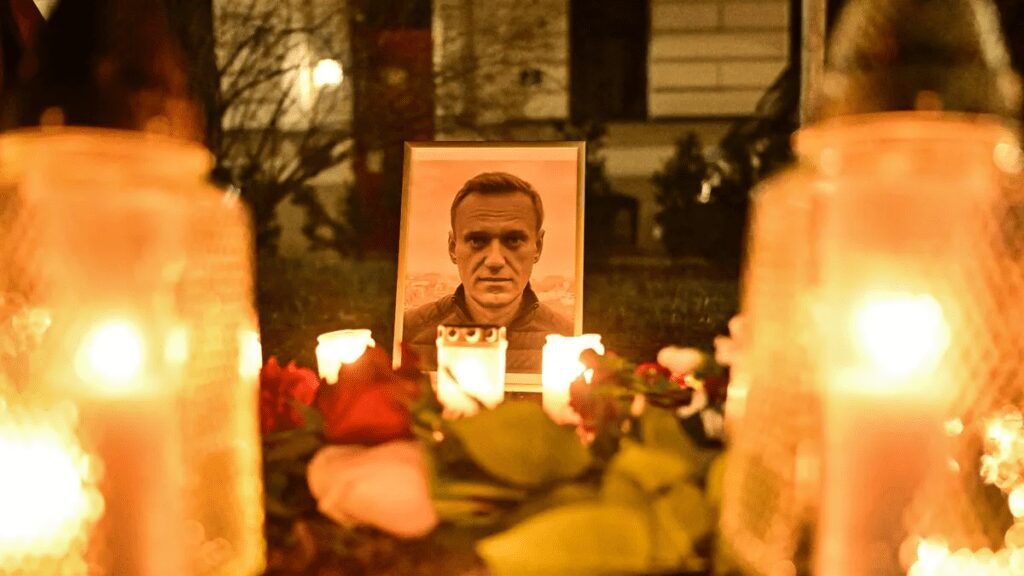
Mourners Gather To Mark Two Years Since Navalny’s Death
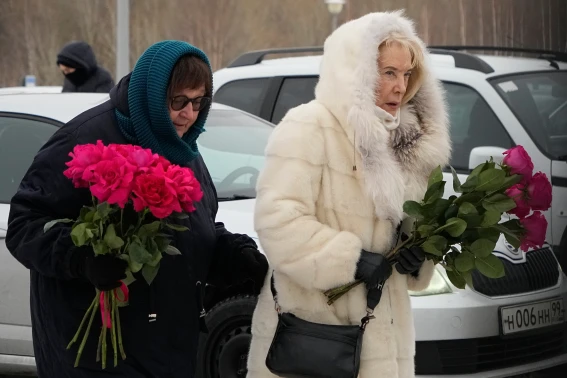
Peskov’s comments came as dozens of Navalny’s supporters and some foreign diplomats visited his grave in Moscow to mark the second anniversary of his death. Some of those who attended wore masks or scarves over their faces.
Navalny’s mother, Lyudmila Navalnaya, and his mother-in-law, Alla Abrosimova, were among the mourners laying flowers on his grave.
Addressing the crowd, Lyudmila Navalnaya reiterated her belief that her son was killed by the Russian authorities, a scenario which has also been backed by several European countries in recent days. “We knew that our son did not simply die in prison,” she said. “He was murdered,” he added.
Navalny’s widow, Yulia Navalnaya, pledged to take the mantle of Russia’s opposition in the wake of his death but has struggled to galvanise widespread support.
Navalny’s closest allies, as well as other key members of Russia’s opposition, now continue their fight from exile. Many have been handed lengthy prison sentences in absentia in Russia and are unable to return home.
Some have been designated “terrorists and extremists” by the authorities, a designation that was also applied to Navalny in January 2022.
Yet Russia’s opposition has failed to form a united front and a clear plan of action against the Kremlin. Instead, rival groups have traded accusations that some see as efforts to discredit each other and vie for influence.
READ ALSO: Israel To Register West Bank Lands As State Property