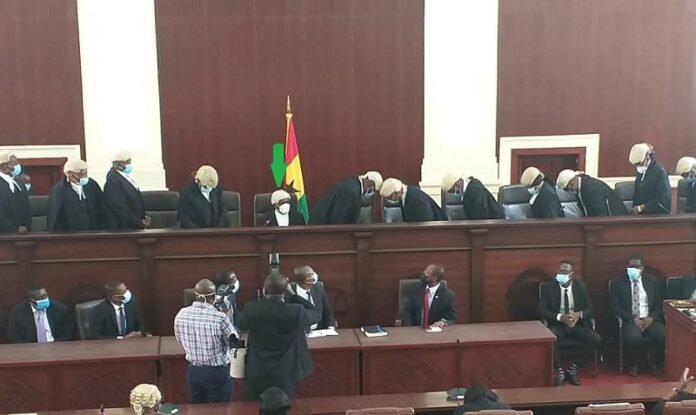
The Supreme Court of Ghana has ruled that public office holders must declare their assets before assuming office by striking down the six-month grace period under the Public Office Holders (Declaration of Assets and Disqualification) Act, 1998 (Act 550).
The landmark judgment, delivered on March 18, 2026, reinforces constitutional provisions on transparency and accountability, marking a significant shift in Ghana’s anti-corruption framework.
The Supreme Court held that the grace period is inconsistent with the 1992 Constitution and therefore unconstitutional. At the centre of the ruling is Article 286 of the Constitution, which mandates asset declaration before taking office.
The provision requires that: “A person who holds a public office… shall submit to the Auditor-General a written declaration of all property or assets owned by, or liabilities owed by, him… before taking office.”
However, the Public Office Holders (Declaration of Assets and Disqualification) Act, 1998, Act 550 had allowed public officials to delay compliance for up to six months after assuming office, creating a legal contradiction that has long been criticised.
By striking down this provision, the Supreme Court reaffirmed the principle that the Constitution remains the supreme law of Ghana and overrides any conflicting legislation.
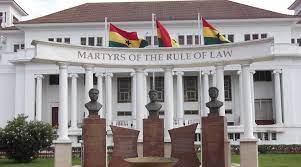
Legal Challenge That Triggered the Decision
The case was brought before the court by anti-corruption campaigner Mensah Thompson, who challenged the legality of the six-month window.
Represented by lawyer Ismael Andani Abdulai of Renaissance Law Chambers, Thompson argued that the provision defeats the purpose of asset declaration by allowing officials time to alter their financial positions after assuming office.
He maintained that asset declarations must reflect a public officer’s true financial standing before entering office, not months into their tenure. Legal analysts have long shared this concern, noting that delayed declarations weaken oversight and create loopholes for potential abuse.
The now-nullified Section 1(4) of Act 550 required that declarations be made before taking office, but also allowed submission “not later than six months” after the occurrence of that event. This contradiction effectively diluted enforcement, as many public officials relied on the extended timeline rather than complying immediately.
Past reports have shown widespread non-compliance with asset declaration laws, with some officials delaying submissions well beyond the expected period. Critics argue that such delays undermine efforts to track unexplained wealth and weaken Ghana’s anti-corruption institutions.

Immediate Implications for Public Office Holders
Following the ruling, all public officials are now required to declare their assets strictly before assuming office, without exception. The decision applies to a broad category of office holders, including the President, ministers, Members of Parliament, judges, and heads of public institutions.
Failure to comply could attract sanctions, including investigations by oversight bodies such as the Commission on Human Rights and Administrative Justice (CHRAJ).
The ruling is also expected to compel stricter enforcement by the Auditor-General’s office. Legal experts say the judgment closes a critical loophole in Ghana’s asset declaration regime.
By eliminating the grace period, the ruling ensures that a clear and verifiable baseline of a public official’s assets is established before they assume office.
This, analysts argue, will make it easier to detect illicit enrichment and promote accountability in public service. The decision also aligns with growing calls for reforms to make Ghana’s asset declaration system more transparent and effective.
A Turning Point for Public Accountability
The Supreme Court’s March 18 ruling is being described as a major milestone in Ghana’s governance and anti-corruption efforts. It sends a strong signal that constitutional requirements on integrity and transparency cannot be diluted by statutory provisions.

Going forward, the effectiveness of the ruling will depend on strict enforcement and the willingness of public officials to comply fully with the law. For many, the judgment marks a decisive step toward strengthening public trust and safeguarding the integrity of public office in Ghana.