
Ghana’s Minister for Food and Agriculture, Hon. Eric Opoku, has warned that Africa will remain trapped in a cycle of economic dependency unless it moves beyond raw commodity exports and captures a meaningful share of the $129 billion global chocolate industry.
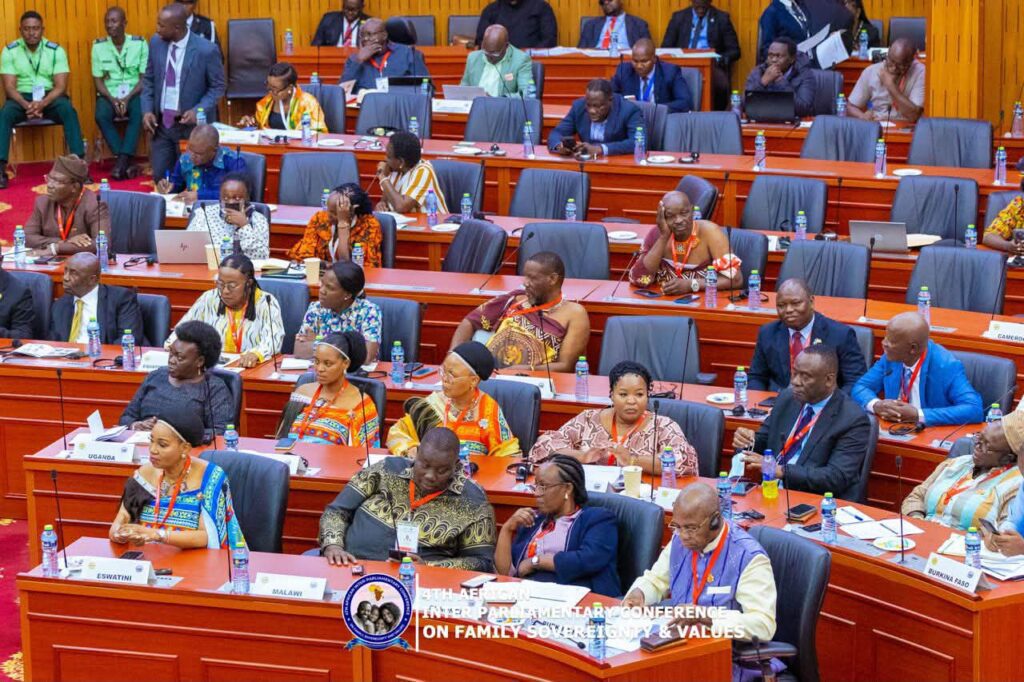
Speaking recently at the 4th African Inter-Parliamentary Conference on Family, Sovereignty and Values, Hon. Opoku pointed out that while Africa produces approximately 70 percent of the world’s cocoa beans, its total share of the global chocolate market remains below 5 percent.
He stressed that 21st-century “food sovereignty can never be achieved through primary food production alone,” calling for an immediate, state-backed transformation of continental agricultural models.
“The global chocolate industry is estimated at $129 billion, and Africa’s share is less than 5 percent. This imbalance exists across numerous agricultural commodities. We export raw materials and import finished products. We export value and import dependency”
Hon. Eric Opoku, Minister for Food and Agriculture
The address targeted a long-standing structural defect in the Economic Community of West African States (ECOWAS). For decades, sovereign nations across the sub-region have relied on the raw volume of agricultural outputs to drive national revenue, leaving local economies highly vulnerable to international market speculation and price volatility.
Framing the discussion around industrial value capture rather than simple crop yield increases, Hon. Opoku provided a clear roadmap for dismantling the asymmetric trade relationships that systematically transfer African wealth to Western manufacturing centers.

The economic data presented at the Accra summit highlights a profound structural imbalance in the global confectionery trade. The math of the current supply chain reveals that the real wealth of agricultural commodities is generated during the secondary refining and consumer branding phases, both of which take place almost entirely outside of Africa.
While millions of smallholder farmers across Ghana, Côte d’Ivoire, and neighboring states bear the environmental and logistical costs of cultivation, the financial returns are overwhelmingly captured by foreign multinationals.
This extreme imbalance severely limits the domestic revenue potential of cocoa-producing nations, as state treasuries are forced to watch the vast majority of the profits generated by their own natural resources escape to overseas capital markets.
The macroeconomic consequences of remaining a primary commodity exporter extend far beyond lost processing profits. Hon. Opoku explained that when a country relies almost exclusively on the sale of raw materials, its national budget becomes highly vulnerable to international commodity price shocks and currency fluctuations.
Furthermore, this dynamic creates a continuous, unsustainable drain on foreign exchange reserves, as the hard currency earned from raw exports is quickly spent to import processed foods and finished consumer goods.
Local Agro-Processing
To establish true economic independence, African governments must implement aggressive import-substitution strategies, with a coordinated shift in trade and industrial policy, moving away from simple crop volume targets toward a model where agricultural outputs serve as direct resource inputs for domestic factories.
Real economic sovereignty can only be secured when the continuous outflow of raw materials and the subsequent inflow of expensive finished imports are permanently halted. Transitioning from primary production to advanced manufacturing requires substantial, long-term capital investment in physical infrastructure and logistics networks.

Yet domestic processing across West Africa has been restricted by severe deficits in secondary infrastructure, including unstable power grids, inadequate transport networks, and a lack of specialized storage. Without these foundational elements, local processing facilities face high operating costs that make it difficult to compete with established overseas factories.
The Minister’s framework calls for a deliberate realignment of public expenditures and private capital toward building high-capacity agro-processing zones.
This infrastructure push includes constructing modern, climate-controlled storage facilities to eliminate post-harvest losses, expanding regional irrigation networks to reduce dependence on unpredictable seasonal rainfall, and optimizing transportation corridors to lower the cost of moving goods from farms to industrial centers.
Additionally, sustained funding must be directed toward agricultural research institutions to ensure local processors can maintain strict international quality and compliance standards.
For Hon. Opoku, the final phase of this agricultural transformation depends on the widespread deployment of next-generation technology and the purposeful support of the core demographics driving the agricultural workforce.
Since local farming has suffered from low productivity due to outdated cultivation methods and limited access to formal banking systems, overcoming these historical challenges requires a comprehensive shift toward digital agronomy and modern financial tools.
The Agricultural Minister’s modernization agenda emphasized integrating advanced technologies directly into daily supply chain operations, including utilizing mobile finance platforms to bring unbanked rural populations into formal financial networks, deploying satellite mapping and artificial intelligence to monitor crop health, and adopting climate-smart farming techniques to maximize land yields.
More importantly, these modern tools must be directly accessible to women and young people, who carry the physical weight of the sector but frequently face the highest structural barriers to securing credit and land rights.
For regional lawmakers and economic planners, the directive from the Accra summit is to secure long-term economic stability and permanent food sovereignty by moving past raw commodity exports and investing heavily in domestic industrial refining.
Only by capturing a significant share of the $129 billion global market can the continent create stable, high-value jobs and build a resilient economy for future generations.
READ ALSO: Somali Security Forces, Opposition-Aligned Militias Trade Fire as Protests Loom