United Nations has sounded an alarm over a sharp rise in conflict-related sexual violence across the globe, revealing that nearly 10,000 cases were verified in 2025 alone while warning that the true scale of the crisis is likely many times greater because countless survivors remain unable or unwilling to report the abuse.
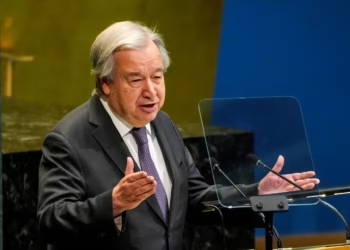
Presenting the latest annual report of the UN Secretary-General to the Security Council, the Special Representative of the Secretary-General on Sexual Violence in Conflict, Pramila Patten, revealed that the organization had verified 9,788 cases of conflict-related sexual violence during 2025 more than double the number recorded the previous year.
“However, the true toll is far higher, with humanitarians in the field estimating that for every case that reaches a clinic, 10 to 20 go unreported and unaddressed.”
Pramila Patten
A troubling pattern of rape, gang rape, sexual slavery, forced marriage, and human trafficking by both State and non-State actors is documented in the paper, which looks at 21 conflict situations around the world.
United Nations claims that rather than being accidental or incidental acts carried out during armed conflict, these crimes are increasingly being utilised on purpose as tactics of war, political repression, terror, and torture.
The Democratic Republic of the Congo, Haiti, Sudan, and the Central African Republic nations that still struggle with protracted insecurity, armed conflict, and humanitarian crises recorded the greatest number of confirmed cases.
According to Pramila Patten “every case tells two stories: One of the failure of systems to protect civilians at risk, and another of the climate of impunity that emboldens the perpetrators.”
According to the UN report, women and girls continued to be disproportionately affected, making up around 90% of all confirmed victims.
Patten noted significant advancements in bolstering international efforts to prevent sexual assault associated to conflict, despite the depressing results. She added that, over two billion women and girls globally are currently covered by 117 National Action Plans and 13 regional plans on women, peace, and security.
Moreover, she emphasised that significant change is still achievable when governments, communities, and international partners invest in justice and survivor-centered care, drawing on her personal experiences working directly with survivors.
“The UN Charter and the women, peace and security agenda are our last, best hope for a better world, where bodies are no longer used and abused as battlefields, and innocent civilians can sleep, not under the shadow of violence, but under the cover of justice.”
Pramila Patten
Conflict-Related Sexual Violence Devastates Lives in Haiti and DR Congo
Also, the Security Council heard particularly urgent appeals from officials from Haiti and the Democratic Republic of the Congo, where intensifying conflict has made women and girls more vulnerable to sexual exploitation.
Carine Jocelyn, Founder and Director of the Haitian Women’s Collective, stated that sexual violence has increased drastically as criminal gangs strengthened their grip over broad portions of Haiti.
According to United Nations data, cases of sexual violence in Haiti increased by 163 % during 2025.
“The real numbers are likely even higher. Women and girls are systematically raped, trafficked and sexually exploited by gangs they are being targeted in their homes, at displacement sites and as they go about their daily lives.”
Carine Jocelyn
She cautioned that the destruction and looting of health institutions has deprived millions of women and girls of reproductive healthcare and critical post-rape medical services, while widespread displacement has exacerbated vulnerability.
Violence between competing gangs and the Haitian National Police has contributed to what she described as a complete breakdown in law and order, with over 1.4 million people displaced from their homes.
Jocelyn also blamed the deteriorating crisis on the continuous supply of military-grade weapons into Haiti, claiming that illegal arms trafficking has fuelled gang violence despite the Security Council’s current arms ban.
“Attempts to improve security through militarized and privately funded means, while ignoring the concerns of our communities, will not bring peace to Haiti.”
Carine Jocelyn,
Furthermore, Judith Suminwa Tuluka, Prime Minister of the Democratic Republic of the Congo and President of the Security Council for July, stated that her country’s sad experience qualifies it to emphasise the severe consequences of conflict-related sexual violence.
“Conflict-related sexual violence is not just an individual tragedy; it is the language of war itself there to terrorize, humiliate, displace, dominate, break families and destroy communities.”
Judith Suminwa Tuluka
She explained that such violence frequently accompanies battles for territorial control, mineral-rich areas and strategic communities, taking the form of rape, abduction, sexual slavery and trafficking.
“They are not always a collateral effect of the war. Far too frequently, they are a method of war,” she said, adding: “we are painfully familiar with that” in regions of her country affected by occupation by foreign forces, including Rwanda.
Tuluka described steps taken by the Congolese government to improve accountability, such as establishing a national reparations fund for survivors and increasing access to medical, legal, and socioeconomic support services.
She emphasised, however, that these efforts require ongoing international financial support to be effective, noting that, “these children cannot be dealt with simply an indirect consequence of violence inflicted on their mothers.“
“When these rights are not guaranteed, conflict-related violence continues in the lives of these children who did not choose their circumstances of their births or the silence surrounding these circumstances.”
Judith Suminwa Tuluka
READ ALSO: Ghana’s Politics Driven by Personality, Not Policy, IMANI Study Shows