The Ghana Gold Board (GoldBod) has extended life-saving financial support to two Ghanaian citizens battling critical brain tumours, demonstrating its corporate social responsibility through its Special Intervention Programme.
This corporate initiative marks a significant milestone in resource sector philanthropy, directly translating state-regulated commodity gains into emergency medical relief for vulnerable populations.
By stepping beyond its primary regulatory boundaries, the state institution highlights the profound national impact that extractive sector agencies can achieve when aligning corporate goals with the immediate healthcare needs of local communities.
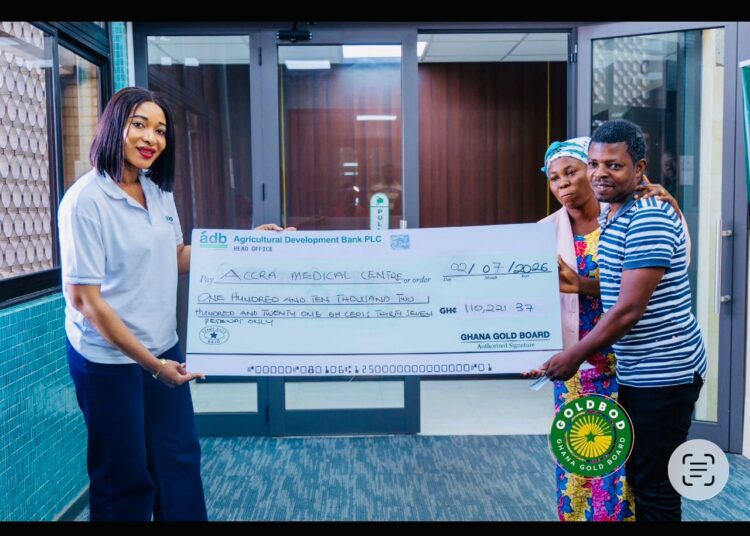
“In a separate intervention, GoldBod provided GH¢110,221.37 to support the treatment of Abraham Hayford, a carpenter from Mamfe-Akuapem, who was diagnosed with pituitary macroadenoma after years of deteriorating health.”
The Ghana Gold Board (GoldBod)
Expanding on this life-saving initiative, the state gold regulator disbursed a combined total of GH¢170,721.37 to fund critical neurosurgical procedures for the two affected individuals after comprehensive assessments proved their conditions were life-threatening.
The first beneficiary, 56-year-old Rebecca Ntsiful, received GH¢60,500 to cover the full cost of a craniotomy and tumor excision at the Cape Coast Teaching Hospital to treat a right frontal primary brain tumour.

The second beneficiary, Abraham Hayford a carpenter from Mamfe-Akuapem who had been battling a misdiagnosed pituitary macroadenoma since 2023 was granted GH¢110,221.37 to undergo a vital Endonasal Excision of Macroadenoma at the Accra Medical Centre.
Extractive Sector Wealth and the Urgent Need for Healthcare Interventions
it is clear that the mandate of resource-governing bodies must increasingly intersect with social sustainability.
In Ghana, specialized neurosurgical care remains financially prohibitive for a significant portion of the population, meaning that diagnoses like brain tumours often carry devastating economic and medical consequences for average families.
Without the strategic intervention of financially liquid state agencies, vulnerable citizens like carpenters and senior community members would face insurmountable barriers to accessing advanced healthcare facilities.

The high cost of specialized equipment, specialized surgical theater fees, and post-operative care frequently means that life-saving surgeries remain out of reach.
By deploying its resource-backed revenue toward emergency health interventions, the board bridges a critical funding gap in the national health architecture.
This intervention establishes a benchmark for how state-led extractive organizations can actively mitigate local healthcare deficits, proving that the true value of national gold reserves lies in safeguarding human capital.
Corporate Accountability and Rigorous Medical Verification Systems
To ensure that these substantial financial disbursements directly reached those facing true medical emergencies, the board instituted a tight, multi-tiered screening framework.
Head of GoldBod’s Special Intervention Programme Unit, Mrs. Gloria Precious Ankomah, undertook a comprehensive verification process to ensure the authenticity and urgency of both requests before any funds were released.
This dual-layered strategy effectively protected public funds while maintaining a rapid and empathetic response to the patients’ medical teams.

According to institutional briefs, “the verification exercise included a thorough review of medical reports and supporting documentation, cross-checking of information submitted by the applicants, and direct engagement with the attending neurosurgeons.”
This active dialogue allowed the unit to verify the necessity of the recommended surgical procedures while confirming the diagnoses with utmost accuracy.
Such precise vetting protocols demonstrate that corporate social interventions can remain highly transparent, accountable, and strictly data-driven even when operating under tight timelines.
Redefining Institutional Mandates Beyond the Gold Trading Sector
This intervention signals a progressive shift in how national commodity boards view their corporate identity within the broader macroeconomy.
While the organization remains focused on its “statutory mandate of regulating and formalising Ghana’s gold trading sector,” its leadership recognizes that sustainable resource management cannot be decoupled from community welfare. Investing in the health of everyday citizens ensures that the wealth generated from national resources yields tangible, human-centered returns.
READ ALSO:Ghana’s Politics Driven by Personality, Not Policy, IMANI Study Shows