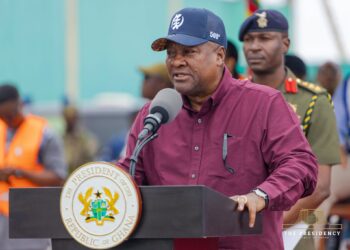
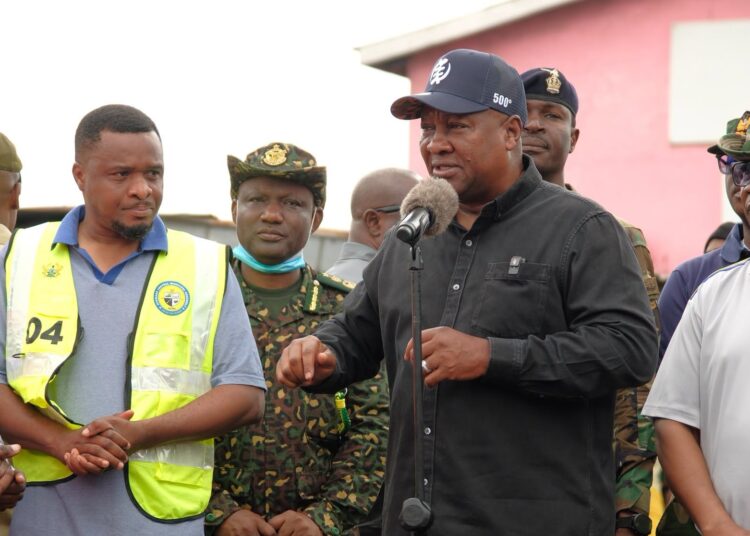
President John Dramani Mahama assured residents that Accra would recover from the recent flooding and emerge stronger, as he joined citizens on day two of the national clean-up exercise across the city.
Speaking at the exercise, the President praised the turnout from the previous day and encouraged more citizens to participate. He noted that the response on day one had been strong, with residents actively clearing debris from their neighbourhoods.
“I want all of us to remember that today is day two of the national cleaning exercise. Yesterday, the turnout was fantastic, very good. People came out and helped to clean their neighbourhoods”.
President John Dramani Mahama
Shift in Focus to Garbage Removal
President Mahama explained that the exercise had moved into a new phase focused on removing garbage that had been pulled out of gutters during the initial clean-up. He pointed to a recurring problem in past exercises, where waste extracted from drains was left by the roadside and eventually washed back in when it rained.

To address this, he directed that trucks be deployed to scoop up the collected waste and transport it to designated dump sites. He acknowledged, however, that the scale of the task meant it could not be completed within a single day.
“We cannot do it in one day. So we’ll all have to do it today, but tomorrow the Army and the other agencies will continue to help to clear all the garbage that was taken out of the drains”.
President John Dramani Mahama
Reopening of Transfer Stations
The President also announced steps to improve waste logistics across the city. He revealed that six transfer stations, built more than nine years ago, had remained unused since construction.
He said he had instructed the contractor to hand these stations over to Zoomlion so they could be brought back into operation. The President explained that reopening the stations would reduce the distance refuse tricycles, locally known as Aboboyaa, need to travel to dispose of waste.

Instead of making the long trip to Amasaman or directly to the Accra Integrated Recycling and Compost Plant, operators can now offload at the nearest transfer station. “If they dump at the transfer stations, we’ll use these big trucks and load the garbage and take them to the Accra Integrated Recycling and Compost Plant,” he said.
President Mahama closed his remarks by thanking those who had already participated and renewing his appeal to residents still at home to join the effort. He framed the clean-up as a shared responsibility that required the involvement of the entire city.
“So I want to thank everybody who’s come out. And those who are still at home, all of you come out. We are doing this together, Ghana is a resilient country. Accra is a resilient city. And we’ll bounce back better than before”.
President John Dramani Mahama
The clean-up exercise forms part of the government’s broader response to the flooding that recently affected parts of Accra, with authorities working to clear debris, restore drainage systems, and improve long-term waste management infrastructure across the city.

What This Could Mean for Accra’s Waste Management
If carried through, the measures the President outlined point to a more structured approach to waste management in Accra than the city has seen in recent years. The decision to reopen the six transfer stations addresses a specific and long-standing gap.
Infrastructure that sat idle for nearly a decade represents lost capacity that, once activated, could ease pressure on collection routes and cut down the distance waste haulers travel to dispose of refuse.
Directing tricycle operators to nearer transfer stations rather than sending them all the way to Amasaman or the recycling plant could also make daily collection more efficient. Shorter trips mean operators can complete more rounds, which may translate into cleaner streets and gutters on a more consistent basis.
The instruction to follow up on cleared gutters, rather than leaving scooped waste by the roadside, also targets a recurring failure identified in past exercises. Waste that washes back into drains after clean-ups undermines the purpose of the exercise itself.
Assigning the Army and other agencies to continue the follow-up work suggests an attempt to close that gap. Whether these steps produce lasting change will depend on consistent implementation beyond the clean-up exercise itself.

Reopening transfer stations and issuing directives mark a starting point, but sustained results will require regular monitoring, functioning logistics between collection points and disposal sites, and continued cooperation between government agencies, contractors, and residents.
The President’s remarks reflect intent and a plan of action, but their full impact on Accra’s waste management system will become clearer only as these measures are put into practice over time.
READ ALSO: Mahama Donates Flood Relief Items to 37 Military Hospital