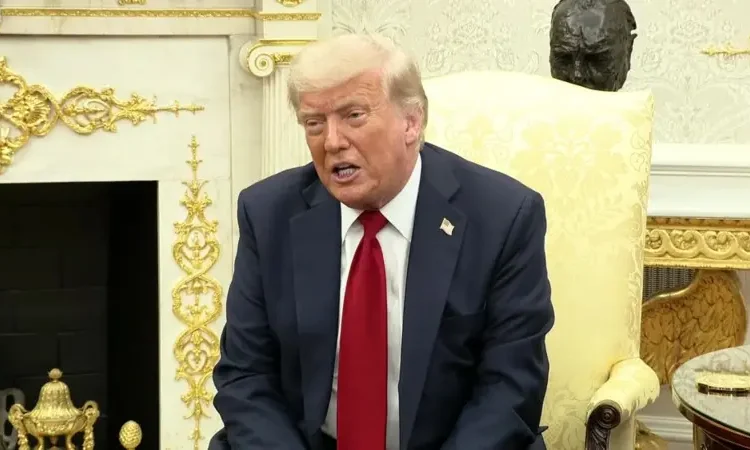
President Donald Trump has said that the United States is “reinstating” a blockade on the Strait of Hormuz and said the US will “get paid a lot of money” for guarding the strategic waterway.
In a social media post, the US President asserted, “We are reinstating the THE IRANIAN BLOCKADE, so named because it is only stopping Iran’s ships or customers from entering or leaving…”
“The U.S.A. will be, from this point forward, known as ‘THE GUARDIAN OF THE HORMUZ STRAIT,’ but as such, and as a matter of FAIRNESS, will be reimbursed, at the rate of 20% on all cargo shipped, for any and all costs necessary to do the job of providing safety and security to this very volatile section of the World. The process and formation will begin immediately.”
Donald Trump
A White House statement quoted Trump as accusing Iran of violating the interim agreement and vowing more powerful attacks against the country.
“It was a done deal and then they broke it. They always break it. We’ve had 10 deals with these people – and so we’re just going to hit them very hard. They’re a bad group of people. They’ve been this way for a long time.”
Donald Trump
The announcement is likely to draw close attention from Gulf states, international shipping companies and global energy markets, given the strategic importance of the Strait of Hormuz. Any disruption to maritime traffic through the waterway could affect global oil supplies and increase shipping costs.

Trump had previously threatened to maintain US influence over the strait, through which 20 percent of oil and gas exports to the world normally transits, and to potentially charge tolls if ceasefire negotiations break down.
Attacks between the US military and Iran’s Revolutionary Guard have surged in recent days as both aim to control the strait. Iran said that it again struck US military sites in Bahrain, Kuwait, Oman and Jordan, while US forces have been primarily targeting port cities along Iran’s coast.
The US relaunching its naval blockade represents another key provision of the initial agreement dissolving. Last month, both sides signed an initial memorandum of understanding (MoU) agreeing to end the fighting, lift the US naval blockade and open the Strait of Hormuz to shipping.
More intractable issues, including the future of Iran’s nuclear programme, its access to frozen assets and future administration of the strait, were meant to be negotiated over 60 days following the initial signing of the MoU.
The current fighting is largely rooted in disagreement over language in the MoU signed in June. Some officials in Iran have maintained that the agreement allows Tehran to still assert control of passage through the strait, even as it pledges to ensure the safety of that passage. Iranian officials have maintained that attacks on ships that do not comply are therefore justified, with Iranian forces repeatedly targeting vessels using the southern side of the strait close to the Omani coast.
The Trump administration has maintained that the agreement should open the strait to all traffic, at least during the 60 days of negotiations, and warned that the Iranian attacks are a violation of the MoU.
Iran Warns Against US Control Of Hormuz Strait

Iran has repeatedly rejected the prospect of the US taking control of the strait. It iterated same stance today as Ebrahim Zolfaghari, a Spokesperson for the Khatam al-Anbiya Central Headquarters, Iran’s joint military command, warned Washington and any of its allies against moving forward with such a plan.
“As previously warned, we will not, under any circumstances, allow the US to interfere in the management of the Strait of Hormuz. Iran’s Armed Forces will respond forcefully to any disruption to the passage of commercial vessels and oil tankers by the invading US military outside Iran’s designated shipping route and without authorisation from Iran’s armed forces.
“Regional leaders are warned that any cooperation with the US or logistical support for its invading military will be regarded as an act of war against Iran’s sovereignty and national security.”
Ebrahim Zolfaghar
Zolfaghari added that the war could “engulf all the countries in the region.”
Also, he said that the United States has “seriously jeopardised” the security of energy supplies by interfering in the Strait of Hormuz. Ebrahim Zolfaghari, Spokesman for the Khatam al-Anbiya Central Headquarters, noted that Tehran continues to assert its authority and control over the strait. “Regrettably, the cooperation of certain countries in the region has also increased the risk of the conflict spreading throughout the region,” Zolfaghari warned.
READ ALSO: EU Issues Sanctions Over Alleged Russian Cyber-spying Campaign