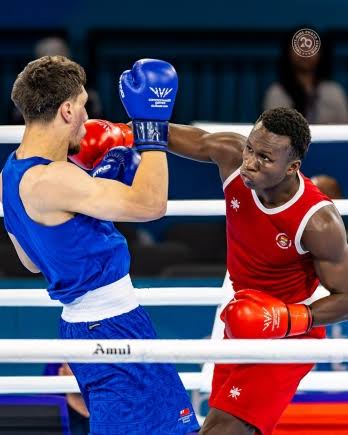
Ghana’s hopes of securing a boxing medal at the Glasgow 2026 Commonwealth Games have suffered a significant setback after Desmond Pappoe was forced to withdraw from the men’s 80kg competition due to a shoulder injury.
The Commonwealth Games Association of Ghana (CGA Ghana) confirmed the development in a statement, revealing that the Black Bombers boxer has been declared medically unfit to continue after sustaining the injury during the ongoing games in Glasgow, Scotland.
Pappoe had been scheduled to face Ghanaian-born Canadian boxer Joshua Ofori in the quarter-finals, with victory guaranteeing a place on the podium. His withdrawal, however, hands Ofori automatic qualification to the semi-finals without a contest.
According to the CGA Ghana, the decision followed a comprehensive medical examination by Team Ghana’s medical personnel. After consultations involving the medical team, coaching staff and Games officials, it was agreed that the athlete’s health and long-term well-being should take precedence over competition.
The withdrawal ends what had been an encouraging campaign for the highly-rated boxer, who arrived in Glasgow as one of Ghana’s strongest medal prospects following his impressive performances in recent months.
Impressive Campaign Ends Prematurely
Pappoe booked his place in the quarter-finals after a determined display against Tonga’s Josh Tonga in the round of 16. The Ghanaian edged a closely fought contest by a 3-2 split decision, demonstrating composure and resilience to progress into the last eight.

The victory placed him within one win of securing at least a bronze medal under the Commonwealth Games boxing format, where all losing semi-finalists receive bronze medals. His quarter-final clash against Ofori was therefore seen as one of Ghana’s biggest opportunities to add to its medal tally.
Pappoe had entered the Games in excellent form, having established himself as one of the country’s brightest young boxing talents. His aggressive style, strong work rate and recent international performances had made him a genuine contender in the 80kg division, with many expecting him to challenge for gold.
Instead, injury has brought his campaign to an abrupt conclusion, denying him the chance to continue his impressive run in Glasgow and leaving Team Ghana to regroup without one of its leading medal hopefuls.
Team Ghana Backs Injured Boxer
In its statement, the Commonwealth Games Association of Ghana expressed full support for Pappoe during his recovery, describing his withdrawal as an unfortunate setback for both the athlete and the national team.
The Association commended his dedication throughout the qualification process and his commitment during preparations for the Games, while also praising the professionalism of Team Ghana’s medical staff for acting swiftly in assessing and managing the injury.
Officials stressed that protecting the athlete’s long-term health remained the overriding priority, even though the decision meant sacrificing Ghana’s chances in one of its strongest boxing categories.
Pappoe’s withdrawal is also a disappointment for Ghana’s boxing contingent, which has produced several encouraging performances in Glasgow. The Black Bombers have once again demonstrated their competitiveness on the Commonwealth stage, with multiple boxers advancing to the latter rounds of their respective weight divisions.
Although losing one of their leading contenders is a significant blow, Team Ghana insists its focus remains firmly on the remainder of the Games. The delegation remains optimistic that the country’s other athletes can continue delivering strong performances across various disciplines and keep Ghana in contention for more medals before the curtain falls on Glasgow 2026.
For Pappoe, the immediate priority will be recovery. While his Commonwealth Games journey has ended earlier than expected, the talented boxer still has time on his side, and Ghanaian boxing will hope he returns fully fit to continue the promising career that was gathering momentum before injury struck in Glasgow.
READ ALSO : PwC Flags Lending Rates as Recovery’s Biggest Test