Fidelity Bank Ghana has intensified calls for a major transformation of Ghana’s pension system, urging policymakers and industry stakeholders to introduce reforms that will extend retirement security to millions of informal sector workers currently excluded from formal pension arrangements.
The bank believes the future of Ghana’s pension system depends on creating solutions that reflect the realities of traders, artisans, farmers, commercial drivers and other workers whose incomes are often irregular but whose need for financial security in old age remains critical.
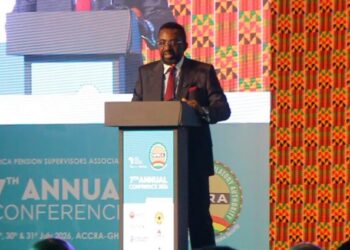
Speaking at a gathering of policymakers, regulators, pension professionals and financial industry leaders across Africa, Mr Atta Yeboah Gyan, a representative of Fidelity Bank, highlighted what he described as Ghana’s “pension coverage paradox.”
According to him, while the country’s informal sector represents more than 80 per cent of the workforce, participation in the Tier 1 pension scheme remains extremely low.
“For every 100 Ghanaians working outside the formal sector, whether as market traders, artisans, smallholder farmers, kayayei or commercial drivers, only one is contributing to a formal pension.”
Mr Atta Yeboah Gyan
He argued that the low participation rate does not reflect a lack of interest among informal workers but rather points to a pension structure that has historically been designed around formal employment patterns.
Millions Left Outside Retirement Protection
Fidelity Bank warned that Ghana’s growing workforce risks entering retirement without adequate financial protection unless urgent steps are taken to redesign pension products.
Although Ghana’s pension industry has recorded significant growth in recent years, with total assets across the three pension tiers estimated at GH¢114 billion, the expansion of pension funds has not matched the size of the working population.
Mr Gyan said the focus must shift from simply increasing pension assets to ensuring that ordinary Ghanaians can participate meaningfully in the system.
“The work before us is no longer simply about growing pension assets. It is about ensuring that millions of hardworking Ghanaians who currently remain outside the system have access to retirement security through solutions designed around the way they earn, save and live.”
Mr Atta Yeboah Gyan
The bank believes flexible pension models could become a major breakthrough in attracting informal workers who often struggle with fixed monthly contribution requirements.
Unlike salaried employees who receive predictable incomes, many informal sector workers earn daily, seasonally or through fluctuating business activities.
Fidelity is therefore advocating for pension products that allow contributions to be made daily, weekly, seasonally or through occasional lump sums.
Diaspora Remittances Could Unlock Billions
Beyond Ghana’s informal sector, Fidelity Bank has identified the diaspora community as another major opportunity for pension mobilisation.
The bank noted that Ghana received approximately $7.79 billion in remittances in 2025, making diaspora inflows one of the country’s most important sources of foreign exchange.
Mr Gyan argued that directing a portion of these funds into structured pension products could create billions of dollars in long-term investment capital.
“If we channelled even 10 per cent of Ghana’s annual remittance flows into a structured diaspora pension mechanism, that is nearly US$780 million per year flowing into long-term capital for Ghana.”
Mr Atta Yeboah Gyan
He added that over a five-year period, such a strategy could generate close to US$4 billion in patient capital that could support national development.
The bank believes digital payment platforms provide the perfect foundation for diaspora pension participation, allowing contributors abroad to seamlessly add pension payments to existing remittance transactions.
Digital Platforms Key to Pension Expansion
Fidelity Bank stressed that technology will play a central role in expanding pension coverage.
The bank proposed the use of mobile money platforms to test flexible pension contribution models for informal sector workers.
With millions of Ghanaians already using mobile financial services, Fidelity believes digital channels can remove many barriers that have historically prevented informal workers from joining pension schemes.
The bank also recommended integrating pension enrolment into Ghana Card registration processes to make retirement planning more accessible to citizens.
According to Fidelity, combining identification systems, digital payments and financial education could significantly increase pension participation nationwide.
Learning From African Success Stories
Fidelity Bank pointed to successful pension inclusion programmes in other African countries as evidence that Ghana can achieve similar progress.
Mr Gyan referenced Rwanda’s Ejo Heza voluntary savings programme and Kenya’s mobile-enabled pension solutions as examples of innovative approaches that have expanded retirement savings among previously excluded groups.
He stressed that Ghana must develop policies that recognise the unique financial realities of its citizens rather than relying solely on traditional pension models.
Fidelity Commits to Closing the Pension Gap
Fidelity Bank said financial institutions have a crucial role to play in bridging the gap between existing pension systems and the millions of workers currently outside formal retirement arrangements.
The bank highlighted its extensive customer network and digital banking capabilities as key tools that could support pension expansion.
“At Fidelity Bank, we currently serve over 2.2 million inclusive banking customers. Many of them are informal sector workers. We see an opportunity and a responsibility to bridge the gap between where the pension system ends and where these customers’ needs begin.”
Mr Atta Yeboah Gyan
The bank reaffirmed its commitment to supporting pension inclusion through innovative financial solutions, stronger digital platforms and partnerships aimed at bringing more Ghanaians into retirement planning.
As Ghana’s workforce continues to grow, Fidelity Bank believes pension reform is no longer an option but an urgent national priority. Expanding coverage to informal workers and diaspora communities could reshape retirement security while unlocking billions of cedis in long-term capital for economic development.
READ ALSO: Governor Calls for Confidence in Business Restructuring