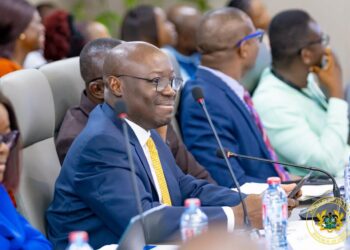
The Governor of the Bank of Ghana (BoG), Dr Johnson Asiama, has made a passionate appeal to banks to rethink how they deal with financially distressed companies, urging the financial sector to place greater confidence in business restructuring rather than rushing toward liquidation.
His remarks come at a time when many businesses continue to face liquidity pressures despite showing strong operational potential. According to the Governor, many companies struggling today are not beyond recovery and could return to profitability if they receive timely financial support.
Speaking at a forum organised in collaboration with the Chartered Institute of Restructuring and Insolvency Practitioners on non-performing loans and financing for companies undergoing restructuring, Dr Asiama challenged banks to find practical ways of supporting viable firms without compromising sound credit practices.
Distress Does Not Always Mean Failure
Dr Asiama stressed that financial distress should not automatically be interpreted as business failure. He explained that many companies continue to maintain healthy customer relationships, active contracts and committed employees but are unable to access the working capital needed to complete projects and generate revenue.
According to him, these temporary liquidity constraints often become the difference between survival and collapse.
“The question we put to the room was a hard one: how do banks lend to a distressed but viable company without weakening credit discipline or concealing losses?”
He noted that businesses can experience financial challenges for reasons beyond poor management or weak business models. External economic pressures, delayed payments and short-term cash flow shortages can create temporary setbacks even for fundamentally strong companies.
“Because a business in difficulty is not always a business that has failed. Sometimes the orders are still there. The customers have not left. The staff turns up. What is missing is the working capital to finish contracts already signed, and without it a company that could have recovered goes under.”
Dr Johnson Asiama

Banks Face Difficult Lending Decisions
One of the biggest challenges facing financial institutions, according to the BoG Governor, is balancing the need to support businesses while protecting depositors’ funds and maintaining prudent lending standards.
Banks have traditionally become more cautious when dealing with distressed companies because of concerns over rising non-performing loans and the possibility of financial losses. However, Dr Asiama believes this cautious approach should not prevent institutions from supporting businesses that demonstrate genuine recovery potential.
He acknowledged that the decision to finance distressed firms is complex and requires stronger risk assessment tools, better restructuring frameworks and greater collaboration among financial institutions, regulators and insolvency professionals.
Act 1015 Offers a Path to Recovery
Dr Asiama pointed to Ghana’s Corporate Insolvency and Restructuring Act, 2020 (Act 1015) as an important legal foundation for corporate rescue.
The legislation was introduced to encourage the rehabilitation of viable businesses instead of allowing them to collapse through liquidation. The law provides mechanisms for restructuring companies experiencing financial difficulties while protecting the interests of creditors and other stakeholders.
Despite the existence of the law, the Governor believes more work remains to ensure banks have the confidence to provide financing during restructuring processes.
“Act 1015 gave us a framework for rescuing viable businesses instead of liquidating them. The work now is to make that framework something a bank can actually lend into.”
Dr Johnson Asiama
His comments suggest that legal reforms alone may not be enough unless financial institutions are equipped with practical guidelines that reduce uncertainty and encourage responsible lending during restructuring.
Stronger Confidence Could Save Jobs
The Governor’s appeal carries significant implications for employment and economic growth.
When viable companies fail due to temporary cash shortages, the effects often spread beyond business owners. Employees lose jobs, suppliers lose customers and government revenue declines through reduced tax collections.
Supporting business restructuring could therefore help preserve productive enterprises, maintain employment and strengthen confidence across the wider economy.
Dr Asiama believes that financial institutions have an important role to play in preventing avoidable corporate failures, particularly where businesses still possess the assets, customers and contracts needed for recovery. “A company worth saving should not close for want of a decision nobody was sure how to make,” he said.
His statement reflects growing recognition that timely financial intervention can sometimes produce better outcomes than forcing companies into liquidation.
A New Direction for Ghana’s Banking Sector
The Governor’s remarks also signal a broader shift in thinking within Ghana’s financial sector.
Rather than viewing distressed companies solely as credit risks, the BoG is encouraging banks to identify businesses that remain fundamentally viable and develop financing solutions that support restructuring efforts while maintaining strong governance and credit discipline.
Such an approach could reduce unnecessary business closures, preserve valuable economic activity and improve long-term financial stability.
As Ghana continues to strengthen its financial sector and reduce non-performing loans, greater cooperation between banks, regulators, insolvency practitioners and corporate borrowers could become essential in creating a more resilient business environment.
The challenge now is translating existing legal frameworks into practical financial solutions that allow viable businesses to survive temporary setbacks and emerge stronger.
If successfully implemented, the Governor’s vision could reshape how distressed businesses are treated in Ghana, replacing fear of failure with confidence in recovery and giving struggling companies a genuine second chance to succeed.
READ ALSO: GH¢13.79bn BoG Bill Sale Shakes Money Market