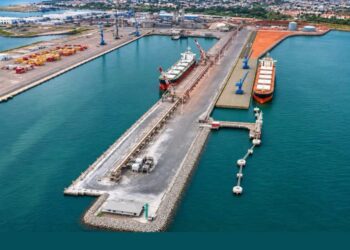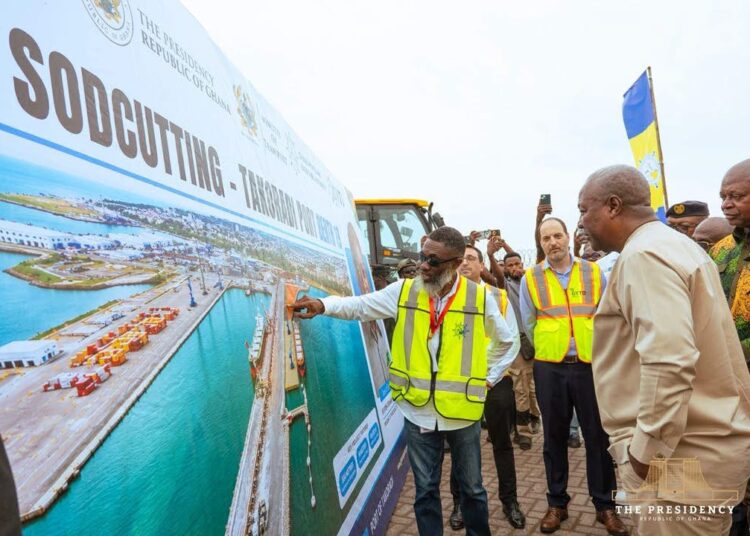
The construction of a US$98.41 million Berth 19 facility at the Port of Takoradi marks another significant step in Ghana’s efforts to modernise its maritime infrastructure, expand cargo-handling capacity and strengthen its position in regional and international trade.
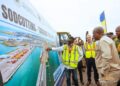
President John Dramani Mahama has broken ground for the 300-metre facility, which is expected to address capacity constraints at the port’s dry bulk terminal and improve the handling of mineral exports and imported industrial materials, particularly clinker used by cement manufacturing companies.
The project, financed entirely through the Ghana Ports and Harbours Authority’s (GPHA) internally generated resources, is designed to accommodate vessels of up to 75,000 deadweight tonnes (DWT) and is expected to be completed within 26 months.
Speaking at the groundbreaking ceremony, President Mahama highlighted the transformation of Takoradi Port since the expansion programme began in 2012, describing its changing role in Ghana’s economic and industrial development.
“When Takoradi was built in the colonial period, it was just meant for extraction, for taking timber, cocoa, bauxite, manganese and things out to processing factories in other locations. Today, it is both an import port.”
President of Ghana, John Dramani Mahama
From Colonial Extraction to Industrial Gateway
Takoradi Port established in 1928, was originally developed to facilitate the export of Ghana’s natural resources, particularly timber, cocoa and mineral commodities. Its historical function was largely centred on transporting raw materials to international markets, with limited emphasis on supporting the country’s domestic industrial supply chains.
However, successive investments in port infrastructure have gradually transformed the facility into a multipurpose maritime centre serving the mining, manufacturing, oil and gas, and commercial sectors.
The expansion programme initiated in 2012 introduced significant improvements, including the development of container-handling facilities, an oil and gas services terminal, additional berths and improvements to the port’s marine infrastructure.
The dredging of the harbour has also increased its ability to receive larger vessels, with the port now having a draft of up to 16 metres, compared with significantly shallower depths before the modernisation programme.
These developments have strengthened Takoradi’s capacity to handle different categories of cargo while improving its attractiveness to shipping operators and industrial businesses.
Its major export commodities include manganese, bauxite and cocoa, while imports include clinker, petroleum products, wheat, ammonium nitrate, gypsum, quicklime, coal and limestone.
The figures demonstrate why continued investment in the port’s infrastructure is necessary to sustain export growth and support the country’s expanding industrial requirements.
Berth 19 to Strengthen Bulk Cargo Operations
The Berth 19 project is specifically intended to address limitations in the existing dry bulk terminal, which handles mineral ores for export and industrial materials imported for domestic production.
The new berth is therefore expected to improve the port’s ability to accommodate larger cargo volumes, reduce operational constraints and provide additional capacity for businesses that depend on maritime transportation.
President Mahama explained that although significant investments had already been made in Takoradi, the dry bulk terminal remained constrained, making further expansion necessary.
“Berth 19 is very important. The dry bulk terminal has been constrained, and so there’s been the need to expand the dry bulk terminal so that we can handle more of the ores that are being exported and also handle more of the dry bulk products that are coming in.”
President of Ghana, John Dramani Mahaa
The Authority’s capacity to undertake major infrastructure investments has been strengthened by improved revenue generation from its port operations, including the expanded Meridian Port Services (MPS) terminal at Tema.
Maritime Infrastructure and Regional Trade
Government and GPHA are considering additional terminal capacity and the use of inland container facilities at Kpong to improve the movement and storage of empty and unaccompanied containers.
The proposed arrangements would utilise the Tema-Mpakadan railway infrastructure, alongside an extension to Kpong, to move containers away from the congested port environment.
The President noted that the growth in shipping volumes demonstrated the need to build transportation infrastructure with future demand in mind rather than focusing exclusively on immediate requirements.
“In today’s world, the logistics value chain is very important, so expanding your ports, building your railways, and reconstructing your roads are all things that are necessary to give the economy that oomph so that it can take off.”
President Ghana, John Dramani Mahama
President Mahama expressed satisfaction that the Shiprite project, which was the first project under the Ghana-United Kingdom Growth Partnership, had progressed to implementation after years of preparation.
“I’m happy that today we’re able to break ground for this ship and dry dock facility. It’s unfortunate that it’s taking 14 long years, but they say better late than never.”
With Berth 19 expected to be completed within 26 months, the expansion represents a further transition in Takoradi’s maritime development. Beyond its traditional role as an export point for primary commodities, the port is increasingly positioned to support industrial production, mineral trade, shipping services and regional logistics.
The success of the investment will ultimately depend on efficient project delivery, effective terminal operations and complementary transport infrastructure capable of connecting production centres to international markets.
READ ALSO:World Bank Uncovers Gaps in Ghana’s $5.4bn Debt Restructuring Progress