

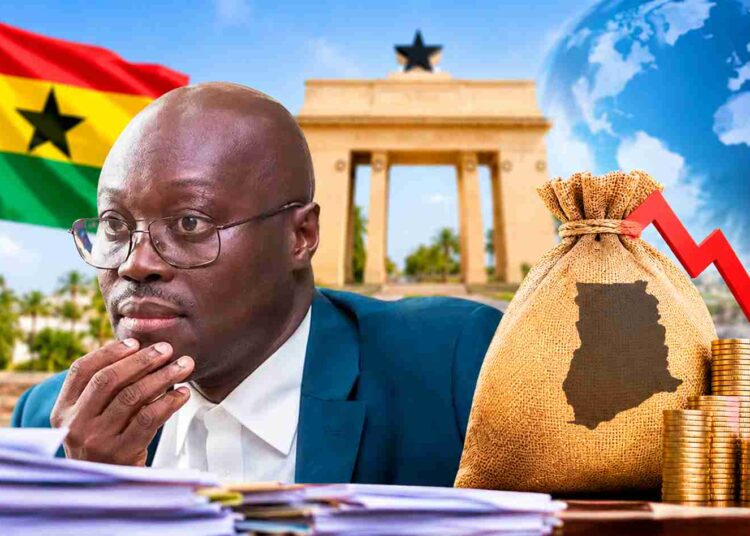
Ghana’s efforts to close one of the most consequential chapters of its debt crisis have encountered another setback, with the World Bank revealing that the country had signed bilateral debt restructuring agreements with only seven of its 25 official creditors by the end of 2025.
The disclosure, contained in the World Bank’s International Debt Report 2025, raises fresh questions about the pace of implementation of Ghana’s $5.4 billion debt restructuring agreement and the extent to which the country has secured the full benefits of the relief arrangement.
Although Ghana reached a Memorandum of Understanding (MoU) with 25 bilateral creditors in 2024, the World Bank’s assessment shows that the process of translating that broad agreement into individual bilateral arrangements remained incomplete nearly two years later.
The seven countries that had signed bilateral agreements with Ghana were France, China, Finland, the United Kingdom, Spain, Germany and Czechia.
The development is significant because the restructuring was designed to ease the government’s debt repayment obligations, create fiscal breathing space and support the country’s efforts to restore debt sustainability following its financial crisis.
However, the limited number of completed bilateral agreements highlights the administrative and diplomatic work still required to fully implement the restructuring arrangements.
Only Seven of 25 Creditors Have Signed
According to the World Bank, Ghana’s 2024 agreement with its 25 bilateral creditors covered approximately $5.4 billion in outstanding debt.
Under the arrangement, $2.8 billion in principal and interest payments falling due between December 2022 and the end of December 2026 were consolidated into a new loan.
The restructured obligation carries a 15-year grace period, with repayments scheduled between 2039 and 2043. Interest rates were also capped at 3 percent, while the agreement delivered a 37 percent reduction in net present value.
These terms represented substantial relief for a government struggling to manage mounting debt obligations and restore confidence in public finances.
Yet, the World Bank’s latest assessment reveals that only seven of the 25 creditors that signed the original MoU had concluded individual bilateral agreements with Ghana by December 2025.
The report identifies France, China, Finland, the United Kingdom, Spain, Germany and Czechia as the seven countries that had completed their agreements.
This leaves 18 creditors whose individual bilateral agreements were not recorded as signed by the end of the reporting period.
The World Bank also disclosed that the amounts covered by the seven bilateral agreements had not been disclosed.
Debt Relief Figures Remain Outside 2025 Debt Data
Another important revelation concerns the treatment of the bilateral restructuring agreements in Ghana’s reported debt statistics.
The World Bank indicates that the restructuring was not reflected in the 2025 debt data submitted to the Debtor Reporting System.
This is particularly important because accurate and timely debt reporting helps investors, creditors and international financial institutions assess a country’s debt position and determine the extent of progress made under restructuring arrangements.
The absence of the restructuring details from the reported data also means that the amounts covered by the seven individual agreements could not be established from the information presented in the report.
While the original MoU established the broad framework for restructuring, the completion and documentation of individual agreements remain important elements of the implementation process.
The disclosure therefore introduces another dimension to Ghana’s debt recovery debate, particularly regarding transparency, reporting and the speed at which restructuring commitments are being translated into measurable outcomes.
Domestic Borrowing Could Create Another Financial Burden
Beyond the bilateral restructuring process, the World Bank’s wider assessment raises concerns about the growing reliance on domestic borrowing among developing economies.
The report explains that increased financing needs have encouraged governments to depend more heavily on domestic debt, particularly when access to international capital markets becomes difficult or expensive.
Although domestic borrowing provides an alternative source of financing, it can create significant refinancing and liquidity risks.
Domestic banks may also become increasingly exposed to government securities, strengthening the relationship between sovereign financial conditions and banking sector stability.
This presents an important consideration for Ghana, whose domestic financial sector experienced significant disruption during the Domestic Debt Exchange Programme.
The World Bank warns that domestic debt amortisation has become a dominant component of gross financing needs in many low-income countries, largely because domestic debt instruments often have relatively short maturities.
Consequently, governments must continually refinance maturing obligations, placing pressure on liquidity and increasing their exposure to changing market conditions.
The report further observes that higher debt service costs absorb fiscal resources, reduce the government’s capacity to finance productive investment and potentially crowd out private sector activity.
Ghana’s Recovery Requires Stronger Debt Management
The implications of these findings extend beyond the number of creditors that have completed bilateral agreements with Ghana.
The country must also ensure that the relief obtained through restructuring translates into lasting improvements in fiscal sustainability.
The World Bank highlights weak debt management, limited transparency, foreign currency exposure and contingent liabilities as factors that can intensify debt vulnerabilities.
These risks are particularly important when governments face rising financing requirements and limited fiscal space.
Higher debt servicing costs can restrict public investment, while insufficient infrastructure and productive investment can weaken the conditions necessary to attract long-term private capital.
Ghana therefore faces the challenge of balancing its remaining debt obligations with the need to finance economic transformation, strengthen public infrastructure and support private sector growth.
The completion of outstanding bilateral agreements will remain an important part of consolidating the country’s restructuring efforts.
However, the broader challenge is ensuring that the financial relief does not create room for another cycle of excessive borrowing and unsustainable fiscal commitments.
$5.4bn Restructuring Faces an Important Implementation Test
Ghana’s debt restructuring represented a major step towards addressing the financial difficulties that culminated in its sovereign debt crisis.
The 37 percent net present value reduction, extended repayment period and capped interest rates offered significant relief from immediate debt obligations.
Nevertheless, the World Bank’s latest findings reveal that the implementation process had not been fully completed by the end of 2025.
With only seven of the 25 bilateral creditors having signed individual agreements, questions remain about the outstanding arrangements, the amounts covered and the pace of implementation.
Ghana’s recovery will ultimately depend not only on securing debt relief but also on strengthening transparency, managing refinancing risks and maintaining fiscal discipline.
The country has gained valuable breathing space through restructuring. Protecting those gains will require ensuring that the unfinished agreements and broader debt management challenges do not undermine the progress already achieved.
READ ALSO: SHINE Builds Women’s Shea Businesses to Strengthen Women Led Enterprises