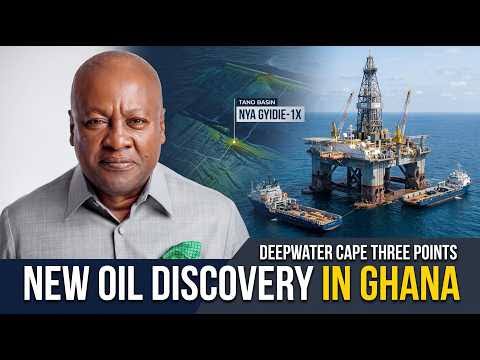
The announcement of Ghana’s latest offshore hydrocarbon discovery has opened a fresh debate about the role successive governments play in sustaining petroleum exploration, after the Deputy Ranking Member of Parliament’s Energy Committee, Collins Adomako-Mensah, credited the previous administration with completing key processes that enabled the project to reach the drilling stage.
The Afigya Kwabre North Member of Parliament argues that the contractual, administrative and regulatory decisions that facilitated the entry of Planet One Oil and Gas Limited into the Deepwater Tano Cape Three Points (DWTCTP) block were largely concluded under the administration of former President Nana Addo Dankwa Akufo-Addo.
His comments follow President John Dramani Mahama’s announcement at the 2026 Local Content Conference and Exhibition in Takoradi on November 10 that Planet One, GOIL Upstream Limited and the Ghana National Petroleum Corporation (GNPC) had encountered hydrocarbons at the Nya Gyidie-1X exploration well.
The development places renewed attention on a part of Ghana’s petroleum investment process that is often less visible than the eventual discovery: the transfer of interests, approval of strategic partnerships, appointment of operators and regulatory extensions required to keep exploration programmes moving.
For Ghana, the issue extends beyond political credit. The country’s ability to attract exploration capital and replace declining reserves depends partly on whether petroleum projects can survive changes in government without losing momentum through regulatory uncertainty or administrative delays.
From ExxonMobil’s Exit To Planet One’s Entry
In outlining the history of the project, Mr Adomako-Mensah traced the process to May 2021, when ExxonMobil, then the operator of the DWTCTP contract area, communicated its intention to relinquish its interest in the block.
The development created the need for a new arrangement that could preserve exploration activity in the area rather than allow the departure of the international oil company to leave the project without a viable path forward.

According to the MP, the Ministry of Energy approved the transfer of ExxonMobil’s 80 per cent participating interest to GOIL Offshore in May 2022. GOIL Offshore already held a five per cent stake in the block, and the transfer increased its interest to 85 per cent, while GNPC retained 15 per cent.
The next stage involved securing a strategic partner capable of supporting GOIL Offshore in meeting its obligations under the petroleum agreement.
Mr Adomako-Mensah said the Ministry subsequently directed GOIL Offshore to identify such a partner, a process that eventually led to the involvement of Planet One.
On February 14, 2024, the Ministry approved GOIL Offshore’s request to transfer 75 per cent of its participating interest to Planet One. The partners subsequently nominated Planet One as operator, with the Ministry also approving the nomination.
These decisions were important in establishing the commercial and operational structure under which the exploration campaign could proceed.
They also placed a Ghanaian state-linked company, GOIL Offshore, alongside a strategic partner in the development of the block.
However, the transfer of participating interests and appointment of an operator should not be confused with the discovery itself.
They created the conditions for exploration to advance; the eventual drilling programme was required to establish whether hydrocarbons could be encountered.
Exploration Extension And The Road To Drilling
Another significant part of the timeline highlighted by the MP concerns the extension of the Initial Exploration Period.
Mr Adomako-Mensah said the Petroleum Commission approved a two-year extension, consisting of an initial six-month extension followed by a further 18 months, ending on January 2, 2026.

The extension, he explained, “was intended to give the companies additional time to complete outstanding studies and prepare for an exploration well.”
This aspect of the process is particularly relevant because exploration projects are governed by work programmes and contractual timelines.
Companies must undertake agreed technical activities within specified periods, while regulators assess requests for extensions and determine whether the conditions for continued exploration have been met.
Ghana’s Petroleum (Exploration and Production) Act, 2016 (Act 919), provides for exploration periods and extensions, including provisions governing the fulfilment of work and expenditure obligations.
The regulatory process is therefore not simply an administrative formality; it forms part of the framework through which the state supervises petroleum operations and protects its interests.
In the MP’s account, the approvals and extension meant that the principal state-side groundwork for the project had been completed before the change of government in January 2025.
He wrote:
“Thus, by January 7, 2025, when the Akufo-Addo-Bawumia administration handed over to President Mahama, all the background work from the side of the state culminating in the just announced discovery had been sealed.”
He also called for recognition of former Energy Minister Matthew Opoku Prempeh’s contribution, writing: “Let us give credit when necessary!!!!”
The comments introduce a political dimension to the discovery, but they also raise a broader question about how Ghana records and recognises institutional work that spans different administrations.
Discovery Still Requires Technical Evaluation
While the approvals outlined by the MP help explain the project’s progression, the significance of Nya Gyidie will ultimately depend on what further technical evaluation establishes.
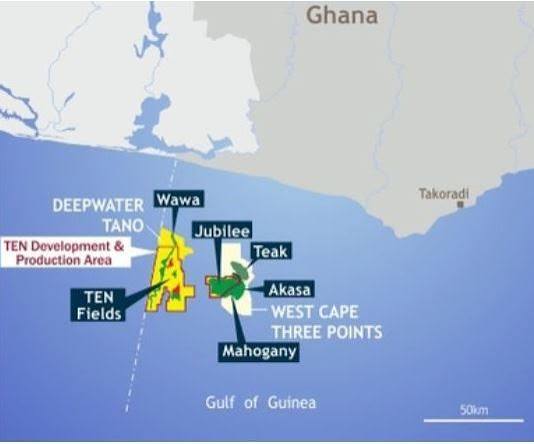
GNPC has confirmed that hydrocarbons were encountered at the exploration well in the Deepwater Cape Three Points Block, approximately 148 kilometres offshore Ghana, in water depths of about 2,289 metres.
The Corporation described the result as Ghana’s first successful test of a carbonate reservoir system, opening a geological target beyond the sandstone reservoirs associated with the country’s existing commercial oil and gas fields.
That distinction could have implications for future exploration. A successful result in a different reservoir system may encourage further geological assessment of similar formations, potentially broadening the range of prospects available to companies exploring Ghana’s offshore basins.
Nevertheless, GNPC has cautioned that further technical work is required to establish the discovery’s size, characteristics and commercial viability.
The presence of hydrocarbons does not automatically mean that a field can be developed profitably or that production can begin immediately.
The next stages of evaluation will therefore be critical in determining whether Nya Gyidie can progress from an exploration success to a commercially viable development.
For the government, the discovery also arrives at a time when replacing depleted reserves has become a central concern for the upstream petroleum sector.
President Mahama has previously highlighted the decline in Ghana’s crude oil production from its 2019 peak and the need to attract fresh investment and accelerate exploration.
Continuity Must Extend Beyond Political Credit
The Nya Gyidie timeline offers a reminder that petroleum exploration is a long-term undertaking. Projects can pass through several administrations before drilling results become known, making continuity in policy, regulation and institutional decision-making essential.
The approvals described by Mr Adomako-Mensah demonstrate the importance of decisions taken before a discovery is announced.
Equally, the subsequent drilling campaign and technical evaluation show that administrative groundwork alone cannot guarantee a successful outcome.
Ghana must therefore ensure that the institutional arrangements that enable exploration are maintained, while regulators remain capable of enforcing contractual obligations and protecting the country’s interests.
This is particularly important as the government seeks to attract new investors into prospective offshore and onshore areas.
Companies considering long-term commitments need confidence that agreements will be administered consistently and that legitimate project decisions will not become vulnerable to political changes.
The discovery should consequently be viewed as an outcome of a process involving decisions across different periods, rather than as an achievement belonging exclusively to one political administration.
Ultimately, the more important measure of success will be whether the discovery can be appraised, developed where commercially viable, and translated into sustainable production, revenue, jobs and opportunities for Ghanaian companies.
READ ALSO: Strengthening Ghana’s Trade Through Takoradi Berth Expansion