North Korea has warned that it is prepared to adopt “additional military options” in response to Japan’s recent test-firing of a United States-made Tomahawk cruise missile, escalating tensions in Northeast Asia amid growing regional military cooperation between Tokyo and Washington.
Kim Yo Jong, the influential sister of North Korean leader Kim Jong Un, accused Japan of abandoning its traditionally defensive military posture and transforming into a force capable of carrying out preemptive strikes.
Her remarks were carried by North Korea’s state media and represent some of Pyongyang’s strongest rhetoric directed at Japan in recent months. In her statement, Kim cited Japan’s recent test-launch of a Tomahawk cruise missile from the Aegis destroyer Chokai in the Pacific Ocean as evidence of what she described as Tokyo’s expanding military ambitions. She also referred to Japan’s testing of other missile systems and its participation in a U.S.-led multinational military exercise held in the Philippines in May.
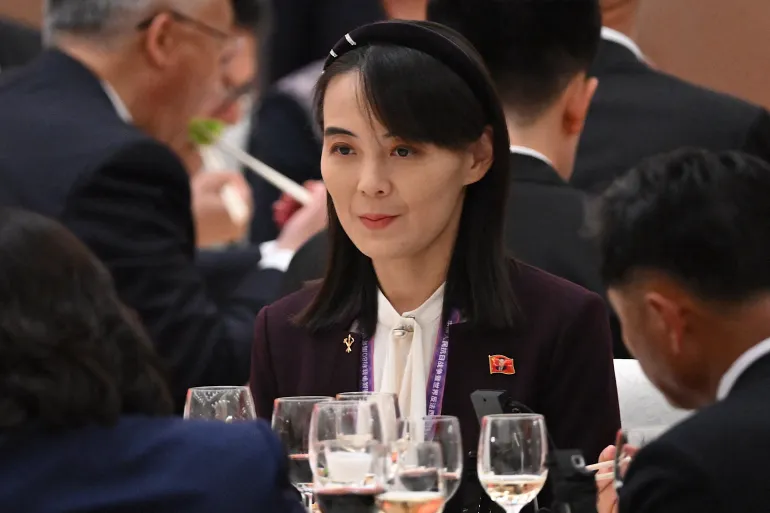
According to Kim, these developments demonstrate that Japan is moving beyond a purely defensive military strategy, a shift that North Korea says threatens regional security. She warned that Pyongyang would respond in ways that would leave Japan feeling increasingly vulnerable. “We should make it regret,” Kim said.
Although she did not specify what measures North Korea might take, her comments suggest Pyongyang is prepared to strengthen its military posture if it believes Japan continues expanding its offensive capabilities.
The statement is the latest in a series of North Korean commentary criticising security cooperation among the US, South Korea and Japan. Since July, KCNA has published at least six editorials and commentaries denouncing these joint military activities as threatening regional security and raising tensions on the Korean Peninsula.
Kim’s latest statement comes as military cooperation among the United States and its allies in the Indo-Pacific continues to deepen. Joint military exercises involving the United States, Japan, South Korea, Australia and the Philippines have increased in frequency over the past two years, with participating governments saying the drills are intended to improve readiness and promote regional stability.
Pyongyang has regularly condemned those exercises, describing them as rehearsals for military aggression against North Korea. In response, the country has continued to develop and test its own missile systems, arguing that its weapons programmes are necessary for national self-defence.
Relations between North Korea and Japan have remained strained for decades because of historical disputes, Pyongyang’s missile and nuclear programmes and the unresolved issue of Japanese citizens abducted by North Korean agents in the 1970s and 1980s.
The latest exchange of rhetoric adds to existing tensions at a time when governments across the region are closely monitoring military developments. Analysts say North Korea frequently responds strongly to changes in Japan’s defence policy, particularly when they involve cooperation with the United States.
US Military Support For Japan Criticised
Kim also directed criticism at the United States, accusing Washington of encouraging Japan’s military buildup through arms sales and operational support. “The US is behind such dangerous military moves of Japan,” she said.
She argued that the United States had enabled Japan’s growing military capabilities by supplying Tomahawk cruise missiles, modifying Japanese naval vessels to operate the weapons and supporting the missile testing programme.The Tomahawk is a long-range cruise missile widely used by the U.S. military for precision strikes against land targets. Japan has acquired the missiles as part of a broader effort to strengthen its defence capabilities amid growing security concerns in East Asia.
Tokyo has increasingly expanded its defence spending and military capabilities in recent years, citing an increasingly complex security environment that includes North Korea’s advancing missile and nuclear programmes, China’s military expansion and broader regional instability.
Japanese officials have maintained that the country’s military modernisation remains consistent with its post-World War II constitution and is intended solely to strengthen national defence and deterrence. The government has repeatedly stated that enhanced strike capabilities are designed to respond to evolving security threats rather than support offensive military operations.
North Korea, however, has consistently criticised those changes, arguing that Japan is abandoning its pacifist principles and increasing the risk of military confrontation in the region.
Neither the Japanese government nor the U.S. Department of Defense immediately responded publicly to Kim’s remarks. Both countries have previously defended their security cooperation as essential to maintaining peace and stability in the Indo-Pacific region.
As regional military activity continues to increase, diplomatic observers say the latest warning from Pyongyang highlights the fragile security environment in Northeast Asia. While Kim’s comments do not indicate an imminent confrontation, they reinforce the deep mistrust that continues to shape relations among North Korea, Japan and the United States
READ ALSO: Sedina Tamakloe In Custody Despite Acquittal Ruling— Government Communications Minister