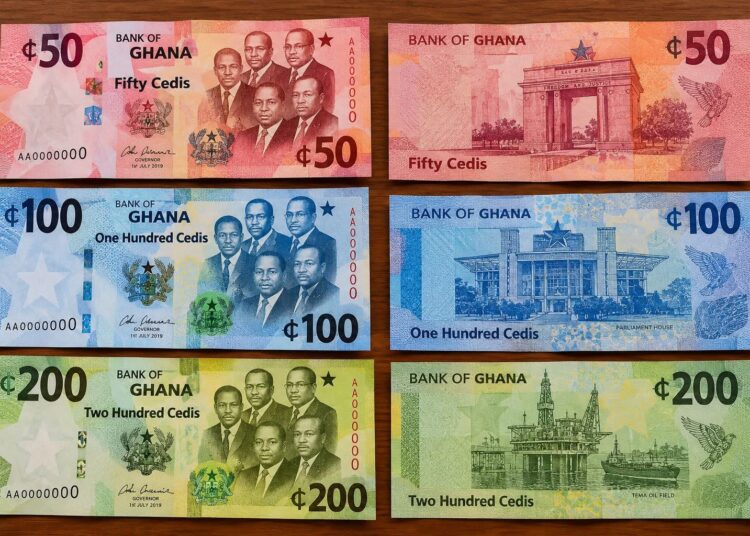
President John Dramani Mahama has officially launched the Bank of Ghana’s Heritage Series banknotes, introducing an upgraded currency expected to strengthen cash transactions, improve the security of payments and support more efficient currency management across Ghana’s business sector.
The new banknotes, scheduled to enter circulation on December 1, 2026, represent an upgrade to the existing Ghana cedi notes, with improvements in durability, physical design and security features.
Speaking at the launch in Accra on Thursday, November 12, President Mahama said the new currency would also provide an opportunity to connect Ghana’s national history with younger generations through the historical figures, landmarks and cultural symbols represented on the notes.
“These notes will also help bring our history closer to our children. The national figures, the historic places, and the cultural symbols featured on the Heritage Series can prompt questions, encourage learning, and deepen understanding of the country that our children are growing in.”
President of Ghana, H.E John Dramani Mahama
Beyond their historical and cultural significance, the changes have potential implications for businesses that depend heavily on physical cash to receive payments, settle daily transactions and manage working capital.
Improved Durability to Support Business Transactions
One of the significant considerations in the introduction of the Heritage Series is the potential economic benefit of producing banknotes that can withstand the demands of everyday commercial transactions.
Physical currency remains an important payment instrument for Ghanaian businesses, particularly market traders, retailers, transport operators, food vendors, small-scale manufacturers and informal sector enterprises that frequently receive cash payments from customers.
The Heritage Series retains the cotton-based material used in Ghana’s existing banknotes but introduces reinforced cotton paper designed to improve durability and extend the notes’ lifespan.
This improvement could help reduce the rate at which banknotes become worn out, potentially lowering the frequency of currency replacement by the central bank.
For the wider economy, longer-lasting banknotes could contribute to more efficient currency management by reducing the resources required to print and distribute replacement notes.
Although the Bank of Ghana has not announced a specific projected reduction in currency replacement expenditure, improved durability provides an opportunity to manage these costs more effectively over time.
The President also indicated that the new notes would be smaller and easier to handle, an adjustment that could improve convenience for individuals and businesses dealing with cash regularly.
The expected benefits, however, will depend on how effectively the improved banknotes withstand actual circulation conditions and how responsibly the public handles them.
Stronger Security and Confidence in Payments
The security of physical currency is another important consideration for businesses, particularly those operating in environments where cash remains a major means of payment.
Counterfeit currency presents financial risks to traders and service providers because businesses that unknowingly accept fake notes may suffer direct losses when the money is rejected during subsequent transactions or deposits at financial institutions.
The Heritage Series incorporates enhanced security features intended to strengthen the integrity of the cedi and make counterfeiting more difficult.
The Bank of Ghana has previously emphasised the importance of protecting the integrity of the cedi through responsible handling and public cooperation.
“History belongs to our classrooms and museums, and it also deserves a place in our everyday lives. The Heritage Series helps bridge those settings, placing reminders of our national journey in the hands of the new generation.”
Bank of Ghana
The President further paid tribute to the national figures whose contributions are recognised on the banknotes, urging young Ghanaians to draw inspiration from their achievements and contribute to national development through education, entrepreneurship and public service.
“To our young people, I say that you too have a place in this story. Through your learning, enterprise, and service, you will shape what Ghana becomes.”
President of Ghana, H.E John Dramani Mahama
Gradual Transition to Protect Business Continuity
Governor of the Bank of Ghana, Dr. Johnson Pandit Asiama, has indicated that the December 1 circulation date will allow the public and businesses to adjust without unnecessary disruption to economic activity.
“The Heritage Series will be introduced into circulation from 1 December 2026, and will circulate alongside the existing series, which remains legal tender. This approach will allow the public and businesses to adjust smoothly to the Heritage banknotes without unnecessary disruption to economic activity.”
Governor of Bank of Ghana, Dr. Johnson Pandit Asiama
The commercial value of the Heritage Series will be measured not only by its improved appearance and historical representation but also by its performance in everyday transactions.
READ ALSO:Mahama Cuts Sod for $98.41m Takoradi Port Expansion