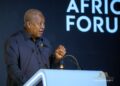

President John Dramani Mahama has said his personal mission is to prove that democracy can deliver prosperity for ordinary citizens, not just political freedom, in a wide-ranging interview with veteran broadcaster Ghida Fakhry on TRT World’s Bigger Than Five programme.
Reflecting on Ghana’s record of peaceful transitions under the 1992 Constitution, President Mahama credited the country’s two dominant political forces with a shared acceptance that democracy is the way to go, describing the pattern in plain terms.
“So, we lose elections, we hand over. They lose elections, they hand over. It is like two puppies playing,” the President said. Pressed on the weight of that comparison, he was quick to add, “It is serious business.”
Asked why Ghana has managed that seamless transfer of power while much of the rest of West Africa has struggled to do the same, President Mahama framed the answer as a deliberate project rather than an accident of history.
“For me, my mission is to show the rest of the world and the rest of Africa that democracy works and that you can create prosperity for people in a democratic atmosphere. Whatever progress you make is more sustainable than if we were in a dictatorship. Both parties understand that, and so far, we are doing well.”
President John Dramani Mahama
That framing, prosperity as the proof rather than elections alone, ran through the rest of the conversation, as President Mahama returned repeatedly to the economic dimension of Africa’s democratic project.

Revisiting Nkrumah’s Unfinished Vision
President Mahama was pressed on whether Ghana and Africa have achieved the economic independence Kwame Nkrumah envisioned when he argued, after Ghana’s 1957 independence, that political freedom would remain incomplete without it.
His answer was direct. “No, we haven’t,” he said, calling Nkrumah “a visionary of excellence” who could see far into the future. He identified two concerns Nkrumah raised that remain unresolved nearly seventy years later.
The first was African unity and integration, a project President Mahama said Africa’s earlier generation of leaders failed to carry far enough. “Now, we are 54 countries, each with its own flag, national anthem, economy, central bank and currency,” he said, describing that fragmentation as the first unfinished piece of Nkrumah’s vision.
The second was Nkrumah’s warning that the end of the liberation struggle would give way to a fight against neocolonialism. President Mahama said that fight continues today in economic form. “That is exactly the new colonial economic order that we are currently trying to shake off,” he said
He arguied that the task facing African leaders now is no longer liberation but economic emancipation, building the conditions for education, jobs and opportunity so that African youth are not forced to risk their lives crossing the desert and the Mediterranean in search of a better future elsewhere.
Prosperity, in his account, is what makes the democratic system worth defending in the first place.
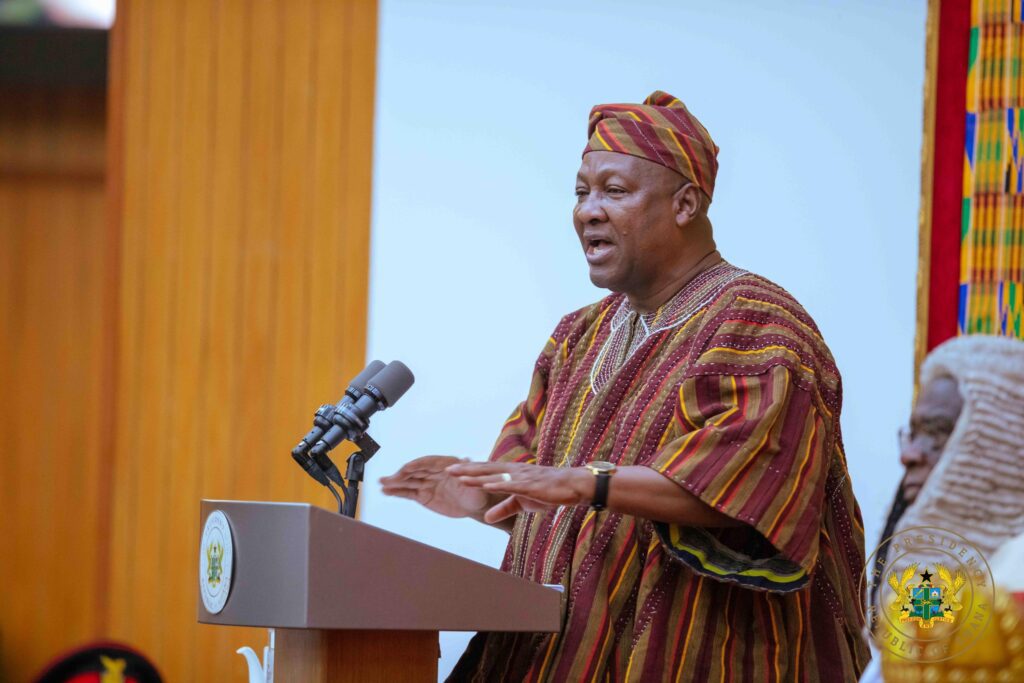
Young Africans Are Not Waiting
Asked whether Nkrumah and Nelson Mandela would be proud of the continent’s progress or frustrated by its pace if they were alive today, President Mahama acknowledged that progress has been slow but pointed to Africa’s demographic weight as a source of momentum toward the prosperity he says democracy must deliver.
He noted that 60 percent of Africa’s population is under 25, a generation he said has access to knowledge and tools far beyond what his own generation could have imagined.
He singled out technology and financial services as areas where Ghana is already struggling to keep pace with its own innovation. “The fintech space is changing so much that regulation cannot even keep up,” he said. “Every day, something else is coming up, and we have to recast the regulations to factor it in.”
He said he expects the pace of change to accelerate further as artificial intelligence and digital services mature, giving Africa’s youth the tools to leapfrog stages of economic development that took other regions decades to complete, shortening the distance between political freedom and the prosperity he says must follow it.
The Baton He Hopes to Hand Over
Asked how he hopes history will judge his presidency and Ghana’s role in Africa’s rise, President Mahama reached for a relay metaphor that returned once more to the same idea. “For me, leadership is a baton,” he said. “I believe that every person runs their share of the race and hands the baton over to another person.”
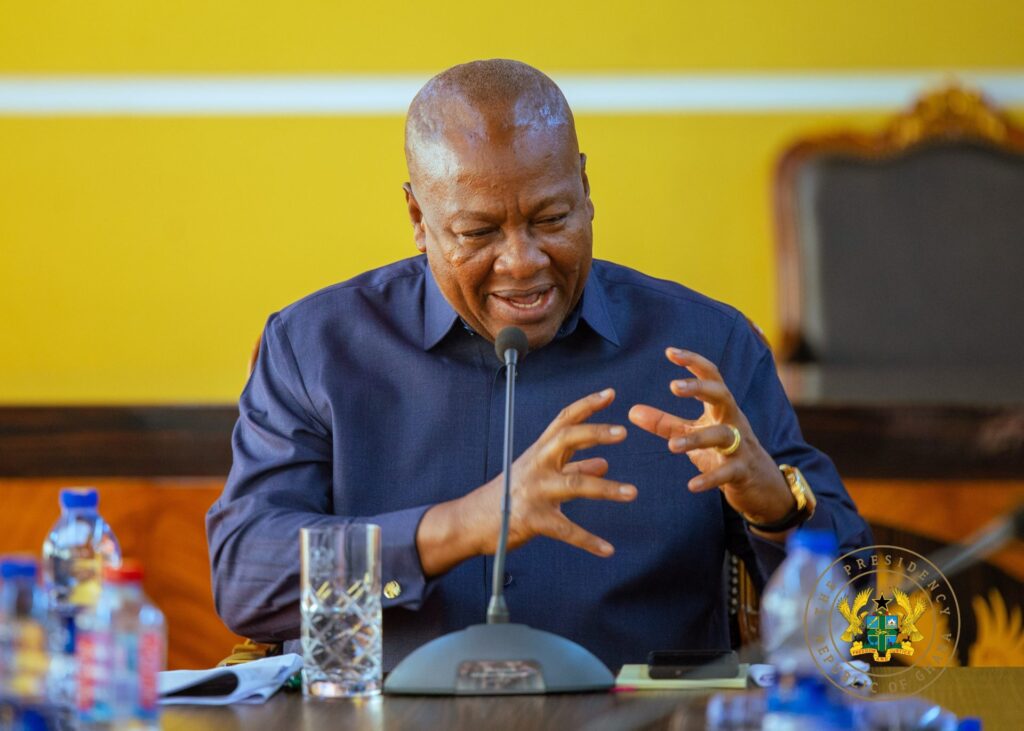
He described his current term as his portion of that race, intended to move the continent’s economic agenda forward far enough that someone else can pick it up and continue.
He pointed to a cluster of ideas he believes have gained lasting traction on his watch, all aimed at the prosperity side of the democratic equation: the Accra Reset, natural resource sovereignty, value addition and continental economic integration.
“I believe that we have ignited the flame,” he said, adding that these are conversations whose time has come and that he intends to keep advocating for them for as long as he remains in office, in the hope that his successors continue delivering on the promise that democracy, properly run, produces a better life for the people who vote for it.
READ ALSO: Revoking Adamus Mining Lease Undermines Local Indigenization Policy – IMANI VEEP