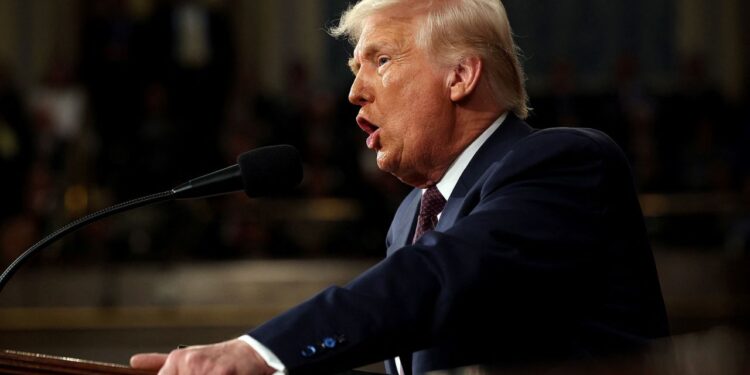
United States President Donald Trump has announced plans to sharply increase tariffs on Canadian cars and trucks and impose new levies on auto parts, escalating pressure on Ottawa after trade negotiations between the two countries collapsed.
Trump said that tariffs on Canadian automobiles and steel would be doubled to 50 percent from January 1, while a new 50 percent tariff on Canadian auto parts would also be introduced.
The announcement came just days after the United States imposed tariffs on about $20bn worth of Canadian goods following the failure of last-minute negotiations aimed at preventing a further deterioration in trade relations.
The latest tariff threats follow the collapse of trade negotiations between Washington and Ottawa last week.Trump had initially agreed to delay the introduction of new tariffs for several days to allow negotiators more time to reach an agreement. However, the talks ended without a deal after Canada sought concessions on existing U.S. tariffs affecting steel, aluminium, automobiles and lumber.Washington was unwilling to agree to those demands, according to officials involved in the negotiations.The United States subsequently imposed a 50 percent tariff on approximately $20bn worth of Canadian exports, affecting products including electronics, industrial machinery and dairy goods. Canadian Prime Minister Mark Carney responded by accusing Washington of changing the terms of the proposed agreement at the last minute.Carney said Canada had made progress in negotiations but that the U.S. proposals ultimately failed to meet Ottawa’s objectives.“Last-minute changes in the U.S. proposed terms were unfair, uneconomic, and called into question the reliability of any deal,” Carney said.Canada has also promised to introduce measures to protect workers and businesses affected by the escalating trade dispute.
Trump presented the proposed tariffs today as part of a broader effort to encourage manufacturers to move production to the United States. “Build in the U.S. and there are ZERO TARIFFS,” Trump wrote on his Truth Social platform. “Canada will be treated like a State no longer!” he added.
The U.S. President also criticised Canada’s approach to trade, writing that the country was among the most difficult nations for Washington to deal with. “They feel entitled, and yet, WE DON’T NEED CANADA, THEY NEED US!” Trump said.
The latest announcement marks a significant escalation in the trade dispute between the two neighbours, whose economies and manufacturing industries have been closely connected for decades. Canada has consistently ranked among the United States’ largest trading partners. Total goods and services trade between the two countries reached $872.3bn last year, despite a 4.6 percent decline from the previous year.
Canada sends more than three-quarters of its goods exports to the United States and relies heavily on its southern neighbour for imports, while the U.S. also depends on Canadian markets and supply chains. The proposed tariffs could have particularly serious consequences for the automobile industry, where manufacturing operations in the United States, Canada and Mexico are deeply interconnected.
Cars and trucks assembled in North America often cross the U.S.-Canada border multiple times during the production process as components are manufactured, processed and installed at different facilities.
New Tariffs To Hurt American Manufacturers
Industry representatives have warned that tariffs on Canadian auto parts could therefore raise costs for American manufacturers rather than simply shifting production into the United States. Flavio Volpe, President of Canada’s Automotive Parts Manufacturers’ Association, said that the proposed tariffs could directly affect U.S. vehicle assembly plants.
“A threatened U.S. tariff on Canadian auto parts will be paid by [the] U.S. auto assembly. Without those specific parts, auto assembly throughout the U.S. would halt.”
Flavio Volpe
The warning highlights one of the main challenges facing Trump’s tariff strategy. While the administration argues that higher duties will encourage companies to manufacture more products inside the United States, industries that depend on integrated international supply chains may face increased costs and production disruptions.
The prospect of additional tariffs on automobiles and auto parts could now place further pressure on Canadian manufacturers and exporters, particularly in Ontario, where much of Canada’s automotive industry is concentrated. However, the consequences may not be limited to Canada.
U.S. automakers depend heavily on parts produced by Canadian suppliers, and replacing those supply chains could take years and require significant new investment. Higher tariffs could also raise production costs, which may eventually be passed on to American consumers through higher vehicle prices.
The dispute represents another test for the United States-Mexico-Canada Agreement, the regional trade pact negotiated during Trump’s first administration. While the agreement has allowed much of North American trade to remain tariff-free, Trump’s administration has increasingly used tariffs as leverage in disputes with Canada.
The latest measures suggest that Washington is prepared to continue using trade restrictions to pressure Ottawa into accepting broader economic concessions.
READ ALSO: Iran Tightens Hormuz Control As Economic Pressure Mounts