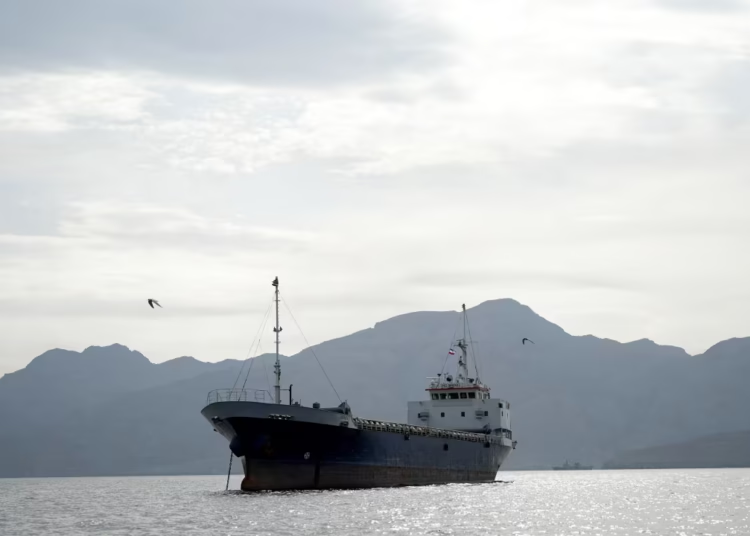
Iran has moved to tighten its control over shipping through the Strait of Hormuz as the country faces growing economic pressure from a plunging currency, renewed U.S. sanctions and the suspension of trade by one of its most important regional partners.
Iranian authorities announced that vessels violating Tehran’s arrangements for transiting the Strait of Hormuz could face restrictions, including fines, detention and confiscation.
Officials said that Iran blacklisted 45 tankers accused of violating its rules for crossing the strategic waterway and warned that action could also be taken against vessels involved in future violations or ships transferring cargo with blacklisted tankers.

The move highlights Iran’s efforts to maintain strategic leverage over one of the world’s most important shipping routes even as the country’s economy comes under increasing strain.
The Strait of Hormuz has become a central point of confrontation in the conflict between Iran and the United States. Before the war disrupted shipping, around one-fifth of the world’s traded oil passed through the narrow waterway connecting the Persian Gulf to international markets.
Iran and Oman, which sits on the opposite side of the Strait of Hormuz, are reportedly close to reaching an agreement on a framework for managing transit through the waterway.
The latest Iranian measures came as the administration of U.S. President Donald Trump prepared to announce what it has described as an expanded campaign of economic warfare against Tehran.
Washington is expected to introduce further sanctions, including possible secondary sanctions against countries and entities that continue to maintain commercial or financial ties with Iran.
Trump signalled the administration’s approach in a social media post which said, “IRAN IS COMPLETELY COLLAPSING!!!”
The new sanctions would add to existing restrictions targeting Iran’s oil exports, shipping networks and financial sector.
Iran’s Foreign Ministry and state media have previously dismissed Trump’s economic threats as a continuation of policies that Tehran says have failed to force the country into changing its position. Nevertheless, the pressure on Iran’s economy has continued to grow.
The Iranian rial fell to a record low of around 2.02 million to the U.S. dollar today, extending a sharp decline that has seen the currency lose nearly 10 percent of its value over the past two weeks.
The official Central Bank exchange rate stood at around 1.5 million rials to the dollar, although the market rate is more widely used by businesses and ordinary Iranians.
Central Bank Seeks to Calm Fears
Central Bank of Iran Governor Abdolnaser Hemmati sought to reassure the public, describing the latest depreciation as temporary. “These increases are temporary, meaning they fluctuate,” Hemmati said, according to footage of his remarks aired on state television.
He blamed U.S. “political propaganda” for much of the economic pressure facing Iran and said he believed conditions would eventually improve. “The situation will improve and the problems will be resolved,” Hemmati said.
Iran’s economy had already been struggling with double-digit inflation and negative growth before the United States and Israel launched attacks on the country on February 28.
Nearly six months of conflict have since placed further pressure on the economy, with the rial repeatedly reaching new lows and the cost of imported goods rising.
Iran has also suffered a fresh economic setback after the United Arab Emirates announced last week that it was suspending all trade with Tehran.
The UAE has historically been one of Iran’s largest trading partners and an important source of imports, making the decision another potential blow to Iranian businesses already struggling with sanctions and wartime disruptions.
Despite the deteriorating economic situation, Iran’s financial difficulties have not yet translated into the political concessions Washington has been seeking.
Instead, Tehran has continued to rely on its strategic position around the Strait of Hormuz to exert pressure beyond its borders.
If the United States proceeds with stronger sanctions while Iran expands its restrictions on shipping, the economic confrontation could intensify further.
At the same time, a potential agreement between Iran and Oman on transit through the Strait of Hormuz could offer a pathway towards restoring some shipping activity, although it remains unclear how such an arrangement would affect the broader conflict with Washington.
For now, Iran is facing a rapidly weakening currency and increasing international isolation while continuing to demonstrate that it retains a powerful strategic tool in the Strait of Hormuz.
The battle between Washington and Tehran is increasingly being fought on two fronts: through economic pressure on Iran’s struggling economy and through control of one of the world’s most important maritime gateways.
READ ALSO: Energy Costs Stay Elevated Despite Ghana’s Inflation Drop