The Council for Scientific and Industrial Research, CSIR and the Savanna Agricultural Research Institute, SARI, has started field trials on maize, soybean and groundnut using KANEKA, a seed treatment bio stimulant developed by KANEKA Corporation of Japan.
Nyankpala in the Northern Region has become the testing ground for a new farming input that could help Ghanaian farmers grow more with less fertilizer and better withstand drought. The event was organised by Tachibana International Ghana Company Limited, TBIG, the importer and distributor of the product, in partnership with KANEKA Corporation and CSIR-SARI.
The goal is to see whether the product, which is not a fertilizer, can work under Ghana’s Savanna conditions to improve crop establishment, enhance nutrient uptake and help crops tolerate environmental stress such as low soil fertility and dry spells.
The trials were showcased during a field day at the CSIR-SARI experimental field at Nyankpala, near Tamale. About 60 farmers from Kpalsogu, Tingoli and Cheshegu communities attended, inspected the growing crops and were taken through practical demonstrations on how to treat and coat seeds with the product before planting.
Speaking at the field day, Dr Michael Asante, a Soil Scientist at CSIR-SARI, explained that although the manufacturer had provided data and recommendations on KANEKA, it had not been sufficiently tested under local conditions. “We want to test it and see if it will help the farmer improve their yields,” Dr Asante said.
He disclosed that the trials involve three improved varieties – maize (Sanzal-sima), groundnut (SARINUT) and soybean (Favor) – with harvest expected in October this year. That harvest will determine how the product performs and whether it is suitable for widespread adoption by farmers in the north.
According to Dr Asante, the trial site at Nyankpala was deliberately chosen because its soil characteristics are well documented and typical of the challenges farmers face: low fertility and low organic carbon. “Low organic carbon remains a major challenge to crop production in the northern part of the country,” he said.
A Key Part of the Experiment is Economic
The trial includes different treatment combinations, including applying the bio-stimulant with only half the recommended fertilizer rate for each crop. Researchers want to establish whether yields from half-fertilizer plus KANEKA can match yields from full fertilizer application. If it does, farmers could significantly reduce production costs while maintaining productivity.
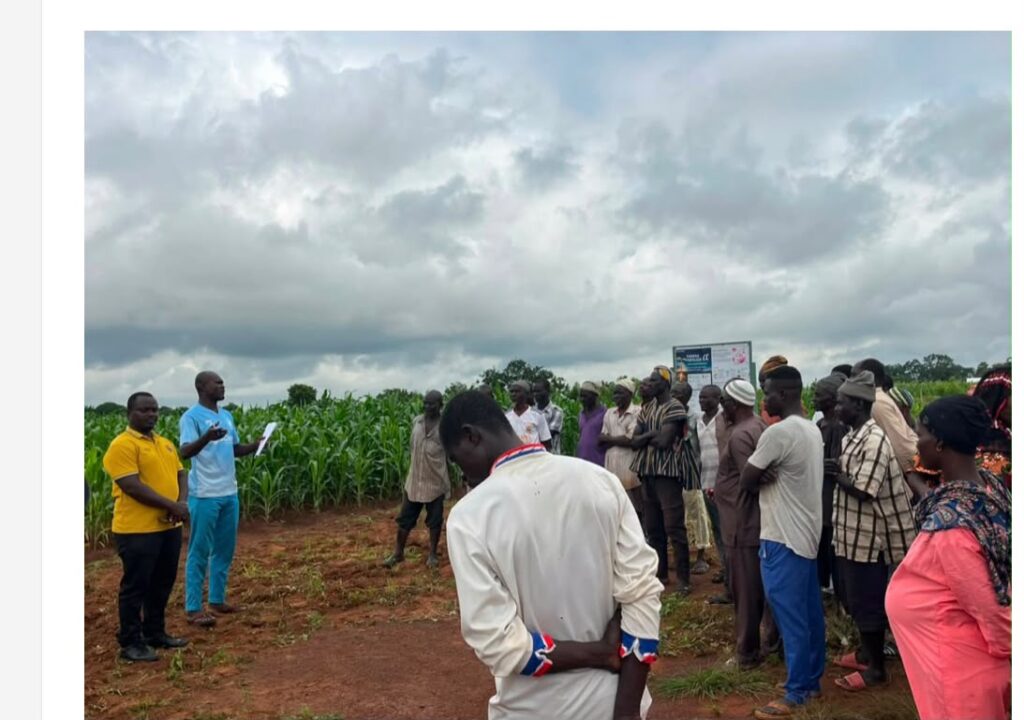
The approach could help reduce production costs for farmers. The trial is also farmer-participatory. For the Japanese manufacturers and its Ghanaian partner, the Nyankpala field day is about local validation.
Mr Kekeli Klu, Sales and Marketing Manager for KANEKA products, said the demonstration was part of efforts to assess the product’s viability under local conditions.
‘’Farmers are not just spectators; they are involved in observing, assessing and comparing the technology before deciding whether to adopt it. Final evaluation will be done jointly with them during harvesting.’’
Mr. Klu
He explained that TBIG and KANEKA aim to reduce farmers’ production costs through the introduction of the bio-stimulant, which does not directly supply nutrients but rather stimulates the plant’s own mechanisms to use available nutrients better and respond more effectively to stress.
“The product is especially relevant for drought prone areas in the Northern part of the country,” Mr Klu said, adding that it can be stored for up to one and a-half years without refrigeration, making it suitable for rural Ghana where cold chain storage is limited.
He also revealed that the product has already been tested at irrigation centres in the Greater Accra Region and performed well, but the Savanna zone, where soils are poorer and rainfall is more erratic, is the real litmus test.
Farmers want availability and affordability
For the farmers present, the prospect of using less fertilizer for the same yield was attractive. Mr Ibrahim Shaibu, a farmer from Cheshegu, said he was pleased to have witnessed the demonstration and expressed interest in trying the product on his own farm next season.
He, however, appealed to the manufacturer and distributor to ensure that if the product proves effective, it is made readily available and affordable for smallholder farmers to access.
CSIR-SARI says the October harvest will provide the first concrete data on whether KANEKA can help close the yield gap in northern Ghana. If successful, the bio-stimulant could become part of an integrated soil fertility management package for maize, soybean and groundnut – three crops critical to food security, nutrition and incomes in the five northern regions.
For now, the trials continue under close monitoring by researchers, with farmers watching keenly for results that could change how they prepare their seeds before the next planting season.
READ ALSO :Government Pushes GNPC Toward A More Commercial Future