Ghana’s banking sector is stepping deeper into the country’s vast informal economy as financial institutions seek to bring more micro and small businesses into the digital payments ecosystem.
The push comes as electronic transactions continue to expand rapidly, driven by mobile money, instant payment platforms and digital banking services. Yet, despite the remarkable growth recorded across the payments industry, thousands of small merchants still depend heavily on cash.
That gap is increasingly becoming a target for banks and financial technology providers looking to expand payment acceptance while helping informal businesses build stronger financial footprints.
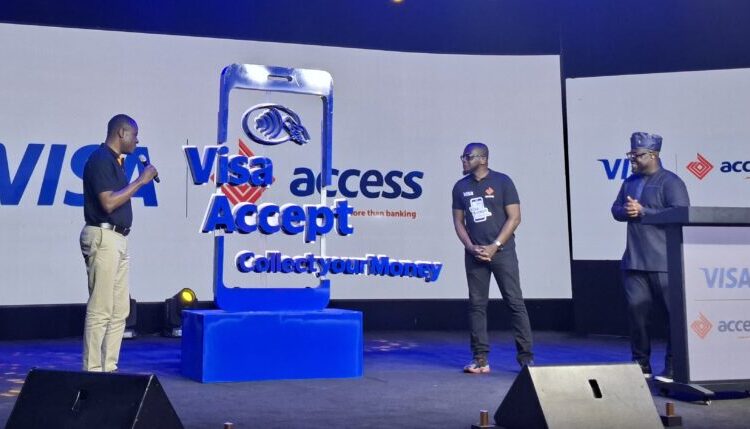
The latest development emerged at the launch of Visa Accept in Accra, where Visa Ghana and Access Bank Ghana highlighted the challenges preventing many micro-merchants from participating fully in the formal financial system.
Visa Targets Ghana’s Cash-Heavy Micro-Merchants
Visa Accept is a smartphone-based payment acceptance technology that allows merchants to receive contactless card payments directly through compatible mobile phones.
The technology eliminates the need for traditional point-of-sale terminals, commonly known as POS devices, potentially lowering the barriers that have prevented many small businesses from accepting electronic payments.
Mr Fabrice Konan, the Country Head of Visa Ghana, said the initiative was designed to tackle the persistent payment challenges confronting small businesses.
“We know that this country has thousands of micro merchants who currently are not accepting digital payments,” he said.
The situation creates a significant commercial gap. Customers who increasingly expect convenient electronic payment options may turn away when merchants only accept cash.
A simple inability to accept digital payments can therefore translate into lost transactions, particularly as Ghanaian consumers become increasingly accustomed to mobile and electronic payment channels.
Visa’s latest initiative seeks to close that gap by putting payment acceptance technology directly into the hands of merchants through devices they already use.
Mobile Money Growth Highlights The Opportunity
Ghana’s digital payments market has expanded dramatically over the past decade, with mobile money remaining one of the biggest drivers of the transformation.
The Bank of Ghana’s Payment Systems Oversight Annual Report 2025 showed that mobile money transaction values increased by 50.8% to GH¢4.54 trillion in 2025, up from GH¢3.01 trillion in 2024.
Active mobile money accounts also increased to 26.7 million during the year.
The growth was not limited to mobile money. The central bank also recorded substantial increases in mobile banking, internet banking and instant payment transactions.
These figures point to a financial system undergoing a major digital shift. However, the continued reliance on cash among small and informal businesses shows that the transformation remains uneven.
The Bank of Ghana reported that POS terminals increased by 16.2% to 18,117 devices in 2025. Despite this expansion, cash remained widely used, particularly among small and informal enterprises.
The report also indicated that Ghana had about 80 POS terminals per 100,000 adults, underscoring the need to expand payment acceptance infrastructure.
Banks See Digital Payments As Gateway To Formalisation
Beyond making transactions easier, banks increasingly view digital payments as a route into the formal financial system.
Mr Eugene Ocansey, Executive Director, Retail and SME Banking at Access Bank Ghana, said many SMEs remained outside the formal economy, creating difficulties when they sought financial support.
“One critical challenge we have when it comes to SMEs is that many of them are outside the formal economy. The only way we can support them to grow is to find a way to formalise them.”
Mr Eugene Ocansey
Digital payments could help address part of that challenge by creating verifiable transaction histories.
A micro-business that receives payments digitally can begin building a record of its sales activity. Such records can potentially provide financial institutions with better information about the business, particularly where traditional financial records are limited.
That could become important when merchants seek banking services, financing or other forms of financial support.
Merchant Education Becomes Critical
Technology alone, however, may not be enough to change the payment habits of Ghana’s informal businesses.
Many micro-merchants have operated on cash for years, making trust, awareness and education important components of the digital transition.
Mr Ocansey stressed the need to convince merchants about the practical benefits of adopting digital payment tools.
“We need to convince the micro-merchant. We need to show them that accepting digital payments can help them make more sales and become part of the formal economy.”
Mr Eugene Ocansey
The argument goes beyond convenience. Digital acceptance could help small businesses serve customers who do not carry cash while simultaneously creating transaction records that can strengthen their engagement with formal financial institutions.
The broader impact could extend to consumers, banks and the economy as more businesses become visible within the formal financial system.
Informal Sector Moves Into Banking Spotlight
Ghana’s informal sector has long represented a major part of commercial activity, yet many businesses operating within it remain difficult for formal financial institutions to reach.
The expansion of digital payments is changing that equation.
As mobile money and other electronic payment channels continue to grow, banks now have a stronger incentive to reach merchants who have traditionally relied on cash.
The introduction of smartphone-based acceptance tools could further accelerate that shift by reducing dependence on conventional POS infrastructure.
The challenge now will be turning technology into widespread adoption.
Merchant education, customer awareness, reliable connectivity and confidence in digital transactions will all influence how quickly informal businesses embrace the new payment environment.
If adoption gathers momentum, Ghana’s digital payment transformation could move beyond consumers and larger formal businesses to reach the thousands of micro-merchants who form the backbone of everyday commerce.
READ ALSO: Manhyia South MP Takes a Dig At GFA, Okraku Responds