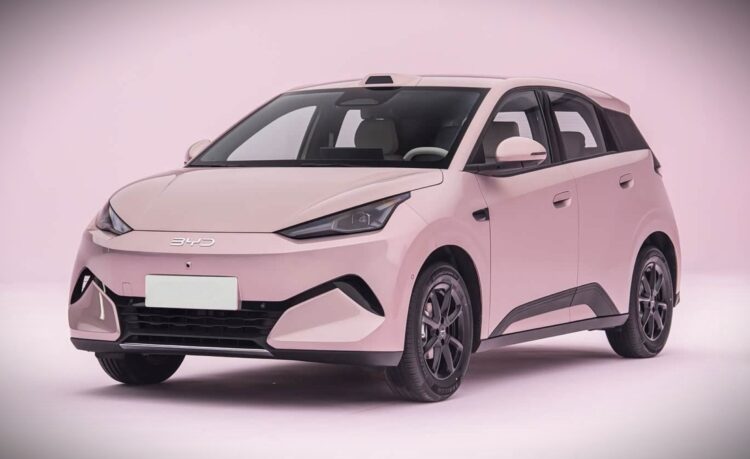
The second-generation BYD Seagull has arrived with a major engineering transformation that could reshape expectations for affordable electric hatchbacks in China.
The redesigned model, also known as the Great Seagull, has switched from front-wheel drive to rear-wheel drive, while gaining a more powerful motor, independent rear suspension and a front trunk. The overhaul gives the compact electric vehicle a substantially different mechanical character from its predecessor.
The latest reveal in China, first reported by Chinese automotive outlet Autohome, follows regulatory filings with the country’s Ministry of Industry and Information Technology (MIIT), as well as earlier exterior design sketches.
Beyond the sharper styling, the biggest surprise sits underneath the body. BYD has moved the electric drive unit from the front axle to the rear, creating additional space beneath the bonnet and opening the door to a more sophisticated chassis setup.
BYD Seagull Ditches Front-Wheel Drive
The first-generation Seagull was equipped with a front-mounted 55 kW motor that powered the front wheels. BYD has now taken a different approach with the second generation.
According to MIIT regulatory information reported by Autohome, the new Seagull uses a motor identified as TZ164XYB, manufactured by Zhengzhou BYD Auto Co., Ltd. The motor is rated at 95 kW, equivalent to about 127 horsepower.
That represents a significant increase over the outgoing model’s 55 kW unit. The additional output also lifts the Seagull’s listed top speed to 150 km/h.
Moving the motor to the rear axle also gives the small EV a different weight distribution and driving configuration. Rear-wheel drive is relatively unusual among affordable small electric hatchbacks, making the change one of the most notable features of BYD’s overhaul.
The mechanical transformation does not stop with the motor.
Independent Suspension Adds Another Twist
BYD has also replaced the outgoing Seagull’s rear torsion beam with an independent multi-link suspension system.
The move could give the new model a more sophisticated chassis setup, particularly when dealing with uneven roads, corners and changes in road surface. It also brings the Seagull closer to hardware configurations increasingly associated with more expensive vehicles.
The redesigned EV now rides on wider 205/60 R16 tyres fitted to 16-inch dual four-spoke alloy wheels.
That is a substantial departure from the outgoing Seagull, which used narrower 165 mm and 175 mm tyres. The wider rubber gives the new model a more substantial road presence while complementing its revised suspension architecture.
The changes suggest that BYD is not simply refreshing the Seagull’s appearance. The company appears to have used the second generation as an opportunity to rethink several fundamental elements of the vehicle.
New Front Trunk Changes the Package
One of the most visible benefits of moving the motor rearward is the creation of additional storage space under the front bonnet.
The second-generation Seagull gains a front trunk, commonly known as a frunk, adding another practical storage area to the compact EV.
Dedicated front trunks remain relatively uncommon among electric vehicles priced below 100,000 yuan in China. BYD, however, has yet to disclose the official volume of the Seagull’s new front storage compartment.
The feature could strengthen the vehicle’s practicality, particularly for urban drivers who already value the compact dimensions of small electric hatchbacks.
The cabin has also received a significant redesign. The vehicle features a flat-bottom, two-spoke multifunction steering wheel and a floating central touchscreen. Physical toggle switches sit beneath the air vents, while the redesigned centre console incorporates a wireless phone charger and vertically positioned dual cupholders.
Earlier cabin sketches had indicated that the traditional instrument cluster would be removed, pointing toward a cleaner and more screen-focused interior.
Seagull Gains More Advanced Technology
The technology package could also become another important differentiator.
Engineering test vehicles spotted in China have been seen with an optional roof-mounted LiDAR pod. This hardware is associated with BYD’s DiPilot 300, also referred to as God’s Eye B, Level 2 driving-assistance package.
There has also been speculation that higher-trim versions could support BYD’s second-generation Blade Battery and Flash Charging technology.
However, BYD has not yet announced official charging rates or charging times, meaning those capabilities remain unconfirmed.
Externally, the new Seagull also moves away from several design elements found on the current model. Semi-hidden mechanical door handles replace the flush pop-out units, while the rear incorporates split taillights beneath a large roof spoiler and an integrated lower diffuser.
New Seagull Enters Fiercer EV Battle
The redesign places the Seagull in an increasingly competitive part of China’s electric vehicle market.
The new model shares several important hardware characteristics with the Geely EX2, known as the Xingyuan in China. Both vehicles feature rear-wheel drive, independent rear suspension, front trunks and identical 2,650 mm wheelbases.
The Seagull, however, stretches 4,205 mm in length, making it 70 mm longer overall than the Geely model.
The competitive pressure is already visible in sales figures. In August, retail registrations for the outgoing Seagull reached 10,103 units in China. During the same month, the Geely Xingyuan recorded 39,651 retail registrations and 60,955 wholesale deliveries, according to China EV DataTracker.
Those numbers highlight the challenge awaiting BYD’s redesigned hatchback.
With a more powerful motor, rear-wheel drive, independent suspension and a new front trunk, the second-generation Seagull arrives with a dramatically different proposition.
BYD has yet to announce official pricing or the launch date for the new model. Until those details emerge, the biggest question will be whether the extensive mechanical upgrades can be delivered without pushing the Seagull too far beyond the affordable price territory that helped make its name.
READ ALSO: Enterprise Profit Surges 35.10% as Cost Discipline Pays Off