Ghana and India are strengthening cooperation in agriculture and agribusiness as the 2nd West Africa Agri Show (WAAS) and the 3rd Annual National Livestock Day open in Accra, creating a platform for investment, technology transfer and partnerships across the agricultural value chain.
The two-day event, which opens on Tuesday, September 29, 2026, brings together farmers, agribusiness operators, investors, technology providers, policymakers and industry stakeholders from Ghana, India and other parts of the West African region.
The exhibition is organised by Azalix Business Media in partnership with the Ghana National Association of Farmers and Fishermen and seeks to connect agricultural producers and businesses with investment opportunities, modern technologies and markets.
Speaking at the opening ceremony on behalf of President John Dramani Mahama, the Deputy Minister for Trade, Agribusiness and Industry, Sampson Ahi, says government continues to position agriculture as a major driver of economic transformation, industrialisation and employment creation.
He says agriculture is also central to the government’s 24-Hour Economy agenda, which seeks to expand production and economic activity while creating opportunities for businesses and workers.
According to him, government is therefore working to create an enabling environment for investment in agriculture and agribusiness, including incentives that can reduce the cost of investing in production and processing.
Government to Create Enabling Environment for Investment
According to him, government is therefore working to create an enabling environment for investment in agriculture and agribusiness, including incentives that can reduce the cost of investing in production and processing.
“Government is creating an enabling environment for investment through tax incentives on agro-processing machinery and innovative financing mechanisms to de-risk investment across the agricultural value chain.”
Deputy Minister for Trade, Hon. Sampson Ahi
The Deputy Minister says such interventions are intended to encourage private-sector participation while supporting businesses to move beyond primary production into processing, manufacturing, packaging and marketing.
He also highlights Ghana’s strategic position within the African Continental Free Trade Area (AfCFTA), describing the country as a gateway to a continental market of about 1.3 billion people.
The development, he says, presents opportunities for Ghanaian agribusinesses to expand beyond the domestic market and serve consumers across Africa.
The Deputy Minister notes that Africa’s food and agriculture market is projected to reach US$1 trillion by 2030, supported by population growth, urbanisation, changing consumer preferences and expanding regional trade.
However, he says the continent continues to depend significantly on food imports despite its considerable agricultural resources.
He therefore calls for a stronger focus on value addition, investment and partnerships that enable African countries to transform their agricultural potential into sustainable economic prosperity.
A Significant Opportunity for Investors
The growing demand for food, according to him, creates significant opportunities for investors and businesses across areas including crop production, livestock, agro-processing, logistics, storage, packaging, irrigation and agricultural technology.
The partnership between Ghana and India is expected to contribute to this transformation by facilitating the exchange of technologies, expertise and investment.
The High Commissioner of India to Ghana, Surinder Bhagat, reaffirms India’s readiness to deepen its collaboration with Ghana in agriculture, livestock and agro-processing.
He identifies several areas where Indian businesses and their Ghanaian counterparts can develop mutually beneficial partnerships.
These include animal health and veterinary services, dairy production, poultry development, agro-processing, post-harvest management, agricultural machinery and irrigation technologies.
Mr. Bhagat encourages Indian exhibitors participating in the exhibition to look beyond short-term commercial transactions and develop long-term relationships with Ghanaian businesses. He stresses the importance of local value addition, skills transfer and job creation in strengthening the partnership between the two countries.
Modern Technology and Machinery to Improve Agricultural Productivity
The livestock component of the event also provides an opportunity for stakeholders to explore investment opportunities in animal production, veterinary services, feed production, breeding, dairy and poultry.
The focus on technology and machinery is particularly significant as Ghana seeks to improve agricultural productivity and reduce post-harvest losses.
‘’Modern machinery and irrigation systems can support farmers and agribusinesses to improve production efficiency, while improved post harvest technologies can help preserve food quality and increase the value of agricultural commodities.’’
High Commissioner to India to Ghana, H.E Surinder Bhagat
The ‘’3rd Annual National Livestock Day’’ complements the broader agricultural exhibition by drawing attention to the role of livestock in food security, household incomes and employment.
For Ghana, strengthening the livestock sector can also support the development of local value chains involving animal feed, veterinary pharmaceuticals, processing, cold storage, transportation and retail.
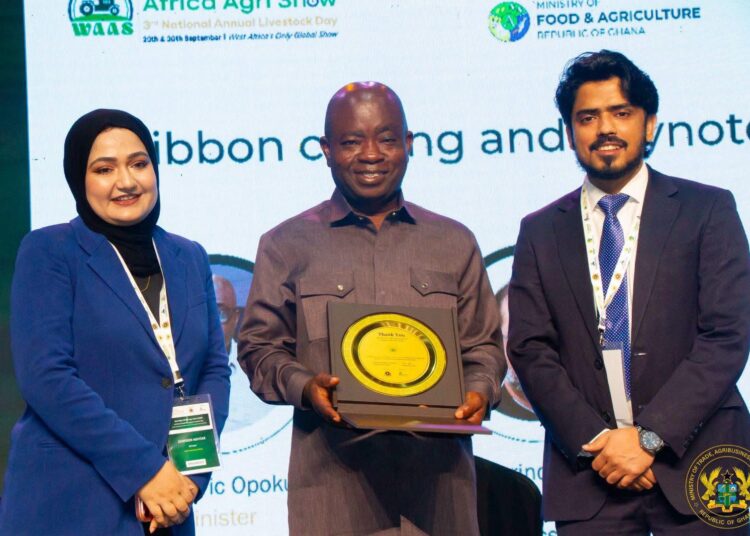
The opening ceremony features a ribbon-cutting ceremony involving Mr. Ahi, the Indian High Commissioner and other dignitaries, marking the official commencement of the exhibition.
The officials subsequently tour selected exhibition stands, where they engage exhibitors and observe agricultural machinery, technologies and other solutions designed to improve productivity and business operations.
The exhibition provides businesses with an opportunity to showcase products and services while enabling farmers and investors to explore technologies that can improve efficiency across the agricultural value chain.
The engagement between Ghanaian and Indian stakeholders also comes at a time when stronger private-sector investment is increasingly being identified as necessary to transform agriculture from predominantly primary production into a competitive agribusiness sector.
With Africa’s food market expanding, the continent has an opportunity to increase local production, strengthen processing capacity and develop regional supply chains.
Opportunity for Ghanaian Businesses to Unlock Potential
For Ghanaian businesses, access to technology, finance, expertise and regional markets remains important to unlocking that potential.
The WAAS therefore serves as a platform for connecting investment opportunities with practical agricultural solutions, while strengthening commercial relationships between Ghana and India.
As the event continues, attention is expected to remain on how partnerships can translate agricultural opportunities into investments, stronger businesses, increased value addition and sustainable jobs.
The collaboration between Ghana and India consequently provides a framework for expanding cooperation across agriculture and agribusiness, with emphasis on technology, investment, skills development, livestock, agro-processing and access to markets.
The broader objective is to ensure that Africa’s agricultural potential increasingly generates value within the continent, supports food security and contributes to inclusive economic growth.
READ ALSO:Debt Treatment Palliative, Mahama Pushes For Fairer Financial Architecture