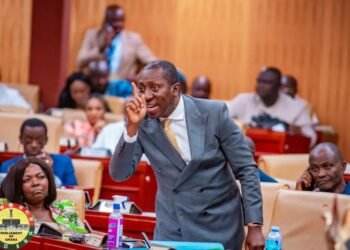

Prof. Kwadwo Appiagyei-Atua, a renowned legal expert and a lecturer at the university of Ghana law school has flagged severe legal gaps in a recent controversial comment by Ghana Gold Board (GoldBod) Chief Executive Officer, Sammy Gyamfi, who suggested that individuals mining outside protected zones should be allowed to mine, register, and regularize their operations regardless of licensing.
The University of Ghana School of Law lecturer argued that this directive blatantly subverts statutory laws, bypasses criminal liability frameworks, and threatens the nation’s ongoing campaign against illegal mining.
“The CEO cannot claim not to know the law. This is not a slip of tongue. This is a deliberate strategy to test the resolve of Ghanaians in fighting against the galamsey menace, which constitutes an existential threat to the State.”
Prof. Kwadwo Appiagyei-Atua
The commentary follows immense public backlash over assertions attributed to the GoldBod boss, which critics argue greenlights unlawful extraction under the guise of administrative regularisation.
Legal analysts note that the declaration risks turning state institutions into accomplices of illegal small-scale mining, locally known as galamsey, by encouraging unpermitted operations contrary to established legislative controls.
The Statutory Fallacy and Criminal Implications
Under Ghanaian legislation, specifically Section 9 of the Minerals and Mining Act, 2006 (Act 703), conducting mining, prospecting, or exploration without a valid mineral right is strictly prohibited, even for landowners. Section 82 further dictates that small-scale mining requires explicit licensing from the sector minister.
As Prof. Appiagyei-Atua pointed out, “Mining without that licence is not merely irregular; it is a crime.”
The Minerals and Mining (Amendment) Act, 2019 (Act 995) heightened these consequences, prescribing 15 to 25 years of imprisonment for Ghanaians engaging in unlicensed mining, alongside heavy fines and mandatory equipment forfeiture.

The narrative that unprohibited zones are open for informal exploitation reverses the statutory permission-based framework.
Section 18 of Act 703 demands explicit environmental and forestry clearance for any mineral right holder, meaning no site can be legitimately mined without comprehensive regulatory permits. Allowing operators to bypass this stage creates a dangerous legal vacuum.
As noted by legal observers, regularisation cannot retroactively expunge a completed offence, as “once unlicensed mining has occurred, the offence under section 99 is complete.”
The Imperative of Lawful Formalization and Institutional Safeguards
While formalizing artisanal and small-scale mining remains a valid objective bolstered by Ghana’s commitments under the Minamata Convention on Mercury the procedural sequence matters immensely.
Formalization must follow a “register first, then mine” approach through structured channels like the Community Mining Scheme or designated district-level licensing frameworks.

Attempting to reverse this order exposes vulnerable miners to severe legal jeopardy while officials granting blanket verbal assurances remain insulated from individual prosecution.
Furthermore, state actors who endorse unauthorized mining risk personal liability as abettors under Section 20 of the Criminal Offences Act, 1960 (Act 29), alongside potential breaches of constitutional provisions including Article 284 on conflict of interest and Article 36(9) on environmental stewardship.
The assertion that GoldBod’s regularisation strategy accommodates unlicenced practices directly undermines national environmental duties.
Combating the Galamsey Menace Amid Policy Ambiguities
The debate highlights a critical crossroads in Ghana’s environmental governance, where systemic threats to water bodies, forest reserves, and local ecosystems demand absolute policy coherence.

Civil society groups and legal experts emphasize that lax administrative pronouncements threaten to brand the country a “galamsey-state,” nullifying hard-won legislative reforms.
Safeguarding the nation’s natural heritage requires absolute adherence to the rule of law, ensuring that economic formalization initiatives never compromise statutory prohibitions or condone environmental degradation.
Citizens and regulatory bodies must maintain vigilance to ensure that state-backed institutional frameworks uphold the law rather than weaken it.
READ ALSO: Mbappé Double Ends Barcelona’s Perfect LaLiga Start