
The Ghana Publishing Company Limited has strengthened its financial management systems and introduced tighter revenue controls to address longstanding leakages that contributed to liquidity challenges at the state-owned publishing institution as announced by its Managing Director, Nana Kwesi Boaitey, ESQ.
Speaking at the Government Accountability Series, Mr Boaitey outlined measures implemented to improve financial accountability, including the introduction of direct banking arrangements and a campaign against fraudulent gazettes, which has enabled unauthorised individuals to collect money from unsuspecting customers.
“So, all money that is coming to Ghana Publishing now goes straight to the bank. And which means that all expenditure also came from the bank.”
Nana Kwesi Boaitey, ESQ
The Managing Director explained that, before the intervention, the company operated a system in which cashiers collected revenue and transported the proceeds to the bank, while some expenditures could also be made directly in cash. He identified these arrangements as weaknesses in the financial control framework, creating opportunities for funds to be diverted without adequate oversight.

To address the problem, The Ghana Publishing Company engaged Consolidated Bank Ghana (CBG), whose premises are within the company’s business centre, to introduce teller implants that enabled revenue to flow directly into the banking system. Consequently, the institution could monitor “its income and expenditure more effectively” while limiting opportunities for financial irregularities.
Mr Boaitey also identified fraudulent gazettes as another source of revenue loss, explaining that unauthorised intermediaries, commonly referred to as “goro boys” collected money from customers under the pretence of obtaining official publications. These individuals subsequently altered gazettes themselves and handed the falsified documents to applicants, leaving the company without the corresponding revenue.
In response, management embarked on “a public education campaign to alert customers to the circulation of fake gazettes” and discourage transactions through unauthorised intermediaries. The initiative, he indicated, helped block another channel through which the institution had been losing income.
The Managing Director characterised the interventions as essential to resolving the company’s liquidity difficulties, which constrained its operations. He emphasised that restoring financial discipline is necessary to create the resources required for subsequent investments and institutional improvements.
Ghana Publishing Company Invests €1.5 Million In Security Press
Beyond its financial reforms, the Ghana Publishing Company Limited is investing in specialised equipment to establish a security printing press, as part of efforts to expand its production capacity and compete in higher-value printing services.
Addressing the progress of the publishing company, Mr Boaitey outlined the institution’s modernisation programme, which includes the establishment of a digital press, improvements to its operational infrastructure and the introduction of online platforms for accessing government publications.
“This year, we have invested 1.5 million euros in equipment that is yet to arrive. Maybe, it will in the course of this month to commence the establishment of our security press.”
Nana Kwesi Boaitey, ESQ
The Managing Director explained that the proposed facility would complement the company’s “existing digital and offset printing capabilities” allowing it to explore specialised services such as cheque book and passport printing. He identified the investment as a strategic move to position the institution within segments of the printing industry with commercial potential.
Mr Boaitey further recounted that, before the modernisation programme, the country’s premier publishing and printing institution did not have a digital press, placing it at a disadvantage in an increasingly competitive market. Management consequently channelled resources into establishing a digital printing centre, which was inaugurated by President John Dramani Mahama in January 2026.
In addition to the equipment investment, The Ghana Publishing Company has introduced digital services to improve access to its publications. The e-Gazette platform, launched in 2025, allows customers to apply for gazettes online without travelling to the company’s offices, including applicants living in distant communities such as Nandom and Nkwanta.

The institution has also launched an electronic bookshop through its website, enabling customers to purchase Acts of Ghana digitally, with the publications subsequently delivered by courier. Mr Boaitey identified these services as measures designed to improve customer experience and adapt the company’s operations to changing technological demands.
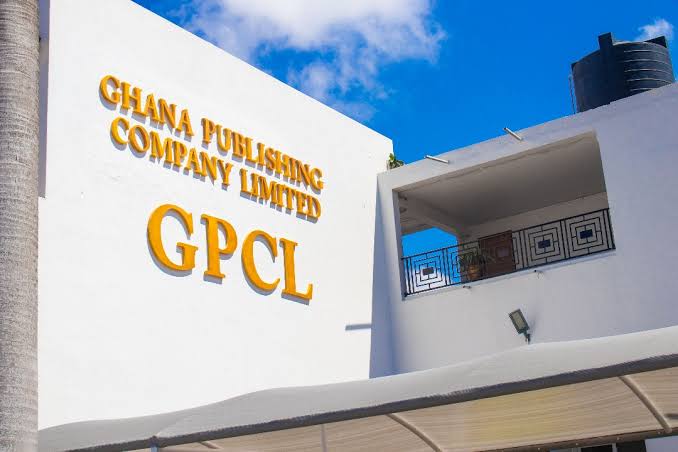
Meanwhile, management has undertaken improvements to the company’s physical image, including “renovations to its frontage and updated signage, while expanding its operational fleet.” The Managing Director listed the acquisition of a Land Cruiser V6, two new Jetour vehicles and motorbikes between 2025 and 2026 as part of efforts to strengthen marketing and operational capacity.
READ ALSO: Two Techiman SHS Teachers Arrested Over Alleged Assault of Student