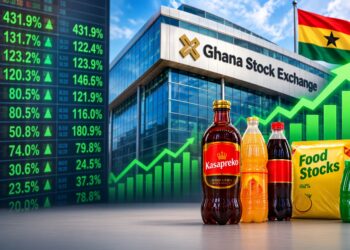
The Ghana Stock Exchange (GSE) has opened the new trading week with a dramatic slowdown in market activity, as trading turnover plunged by 66% and the volume of shares exchanged declined by 62%, raising fresh questions about investor participation and the strength of trading momentum on the local bourse.
Data from the exchange’s latest trading session shows that investors traded 503,067 shares valued at GH¢2.95 million, a significant decline from the activity recorded during the previous trading session on Friday, October 30.
The sharp contraction in both trading volume and turnover represents a notable reduction in market activity, particularly at a time when the Ghanaian equities market continues to enjoy substantial year-to-date gains.
Although the decline does not necessarily signal a broad loss of investor confidence, the figures suggest that market participants approached the opening session of the week with considerably less trading intensity.
The development also comes against the backdrop of a market valuation of GH¢267.9 billion, equivalent to approximately US$23 billion, highlighting the contrast between the exchange’s impressive overall growth and the weaker daily trading activity.
Trading Activity Takes a Dramatic Hit
The latest session saw 503,067 shares change hands, generating a total market value of GH¢2,954,318.17.
Compared with Friday’s trading performance, the volume of shares exchanged declined by 62%, while the total value of transactions fell by an even steeper 66%.
Such a reduction indicates that fewer shares were changing hands and the overall value of transactions had weakened considerably.
The decline is particularly significant because trading activity remains an important indicator of market participation. While rising share prices and market capitalisation can reflect improving valuations, sustained trading activity is necessary to demonstrate the depth of investor interest and the ability of market participants to enter and exit positions.
A weaker trading session, however, does not automatically mean investors are abandoning Ghanaian equities. Market activity can fluctuate from one session to another depending on investment strategies, available liquidity, price expectations and the willingness of shareholders to sell.
Nevertheless, the latest figures provide a reminder that the impressive performance of the GSE in 2026 has not necessarily translated into consistently strong daily trading volumes.
MTN Ghana Commands the Trading Floor
Despite the sharp decline in overall market activity, MTN Ghana maintained its position as the dominant stock by trading volume.
The telecommunications giant recorded 406,216 shares, representing the overwhelming majority of the 503,067 shares traded during the session.
Its performance placed it significantly ahead of the other actively traded equities, reinforcing its importance to overall activity on the Ghanaian stock market.
Intravenous Infusions followed with 39,306 shares traded, while Ecobank Transnational recorded 29,031 shares.
SIC Insurance Company also attracted trading interest, recording 9,187 shares during the session.
The concentration of trading in MTN Ghana is particularly noteworthy. Its 406,216 shares accounted for approximately 80.7% of total market volume, demonstrating the extent to which activity in a single listed company influenced the overall trading figures.
This concentration also highlights the varying levels of liquidity across listed equities, with some stocks attracting considerably more investor attention than others.
For investors monitoring the exchange, the distribution of trading volumes offers an important perspective on where market participation is concentrated.
Kasapreko Emerges as the Only Loser
The price performance of listed equities presented a relatively calm picture despite the substantial decline in trading activity.
Out of the 19 listed equities that participated in the session, only one recorded a share price depreciation.
Kasapreko emerged as the sole loser, declining by 2.7%.
The absence of additional declining stocks suggests that the weaker trading session was not accompanied by widespread selling pressure across the equities market.
However, the limited number of losers should not be mistaken for a strong bullish session. A market can record relatively stable share prices while experiencing a significant reduction in the number and value of transactions.
The performance also reflects the importance of distinguishing between price movements and trading activity when assessing the health of the stock market.
Composite Index Slips as Investors Assess Market Direction
The benchmark GSE Composite Index (GSE-CI) experienced a marginal decline during the session, shedding 15.38 points, representing a 0.11% depreciation, to close at 14,286.89 points.
Despite the daily decline, the index maintained positive returns across its broader performance periods.
The GSE-CI recorded a one-week gain of 1.95% and a four-week appreciation of 1.21%. Its year-to-date return also remained impressive at 62.9%.
This means that despite the latest setback, the benchmark index has continued to deliver substantial gains to investors since the beginning of the year.
The GSE Financial Stocks Index (GSE-FSI), meanwhile, remained unchanged at 7,388.15 points.
The financial stocks benchmark recorded a one-week gain of 0.47%, although it remained down 1.76% over four weeks. Its year-to-date performance stood at a positive 58.98%.
The contrasting movements of the two indices suggest that the broader equities market continues to enjoy considerable annual gains, even as individual trading sessions produce weaker results.
GH¢267.9 Billion Market Faces a Liquidity Test
The Ghana Stock Exchange currently commands a market capitalisation of GH¢267.9 billion, equivalent to approximately US$23 billion.
This valuation underscores the significant expansion of the local equities market and the growing importance of listed companies within Ghana’s financial system.
However, the latest trading figures raise an important question about the relationship between rising market valuations and actual investor participation.
A growing market capitalisation is encouraging, but the sustainability of market growth also depends on liquidity, trading depth and the ability of investors to transact without significantly affecting share prices.
The 66% decline in turnover therefore deserves attention, even though one trading session is insufficient to establish a lasting trend.
Investors will be watching subsequent sessions to determine whether trading activity rebounds or whether the slowdown represents a more persistent moderation in market participation.
With the GSE Composite Index still delivering a 62.9% year-to-date return, Ghana’s equities market remains one of the notable performers of 2026.
The immediate challenge, however, is sustaining investor interest and ensuring that the impressive gains reflected in market valuations are supported by healthy and consistent trading activity.
READ ALSO: Ambassador Smith Calls for Better Opportunities to Retain Ghanaian Youth