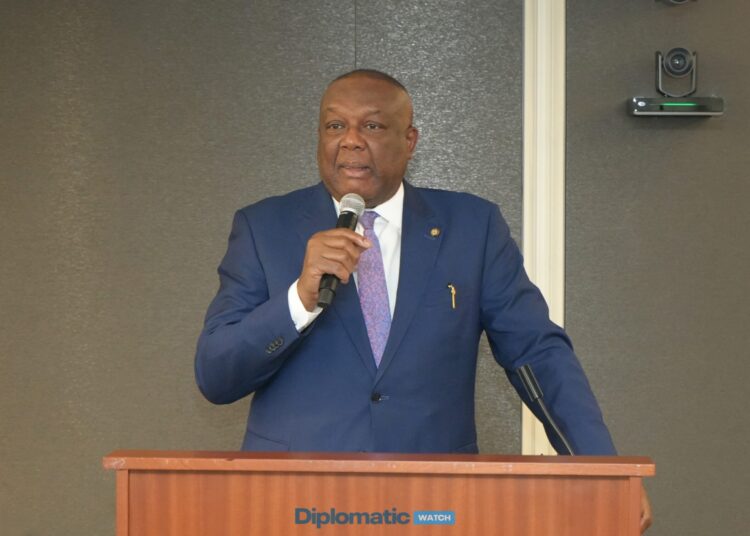
Ghana’s Ambassador to the United States, His Excellency Victor Emmanuel Smith has called for deliberate efforts to make the country a more attractive place to live, work and study, warning that the appeal of opportunities abroad continues to draw young Ghanaians towards migration.
The Diplomat believes that improving conditions at home requires sustained commitment from political leadership and strategic partnerships to create jobs and expand opportunities for the country’s youth.
“We must work hard at making Ghana more attractive for people to want to have Ghana visas to come to Ghana and stay there.”
H.E. Victor Emmanuel Smith
Ambassador Smith articulated this position while discussing the realities of life in the United States and the need to challenge the perception that living abroad automatically guarantees a better future. He acknowledged that America offers what many people regard as “greener pasture” but cautioned that the experience is “not uniformly favourable” particularly for immigrants whose residency status remains uncertain.
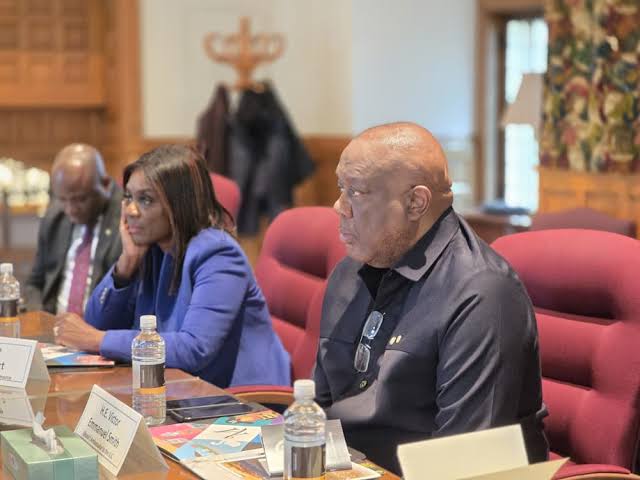
The Ghanaian envoy pointed to the difficulties faced by some undocumented immigrants, including the anxiety of living under the possibility of arrest and deportation by United States Immigration and Customs Enforcement (ICE).
He questioned whether such insecurity represented the improved quality of life that prospective migrants often associate with settling in the West.“How can you live like that?” he remarked, describing the fear experienced by people who worry that they could be picked up and deported whenever they leave their homes.
Against this backdrop, H.E. Smith identified the creation of a more enabling economic environment in Ghana as a critical response to the migration challenge. The Ambassador believes that such collaborations could support productive industries, generate employment and give young people stronger incentives to build their futures in Ghana.
“My message, as I have travelled around the country over the last year, has been to encourage strategic partnerships and bring our brothers and sisters in the diaspora together with serious investors. They should not just sit here and enjoy their wealth but should partner with serious investors who want to add value to cocoa, gold and other resources in Ghana.”
His Excellency Victor Emmanuel Smith
The Ambassador also connected this ambition to the extension of the African Growth and Opportunity Act (AGOA), which provides “eligible African countries with preferential access to the United States market.” He described the extension to the end of 2028 as a welcome development for Ghanaian businesses, particularly textile manufacturers whose exports depend on access to the American market.
He identified DTRT, a textile manufacturing company in Accra employing close to 6,000 young people, as one of the businesses that could benefit from the continuation of the trade arrangement.
Ghana Coordinates Diplomatic Assistance After Javits Frimpong’s Death
Turning to the death of 15-year-old Javits Frimpong in the Bronx, Ghana’s Ambassador to the United States, Victor Emmanuel Smith recounted reports that the teenager was bullied by some of his schoolmates before he was fatally attacked.
The Ambassador also outlined the Ghanaian diplomatic mission’s engagement with the bereaved family and efforts to facilitate the mother’s travel to the United States.
“So within a couple of days, they’re already looking for his life. But that is really sad. Why do you want to kill a 15-year-old?”
His Excellency Vctor Emmanuel Smith
Ambassador Smith explained that the teenager’s father informed him that his son experienced bullying at school. Drawing on his own family’s experience, the diplomat recounted that his son also encountered harassment, particularly through taunts directed at African children because of their accents.
He observed that such treatment could make young people feel “isolated and lonesome” as well as reluctant to participate in activities outside their homes. The Ambassador was particularly troubled by the fact that some of the hostility occurred between young people of colour, describing the situation as “distressing for African families living in the United States.”
Regarding the circumstances preceding Javits’s death, Mr Smith indicated that the school suspended the students involved after the teenager defended himself during an attack. He also clarified that the fatal attack did not take place on the school premises but while the teenager was on his way to school. He suggested that the attackers might have traced the boy to his home, although he cautioned that he could not determine what further protection the school or relevant authorities could have provided.
On the family’s situation, Ambassador Smith explained that the Ghanaian Embassy in Washington oversees diplomatic matters across the United States, while the Consulate General in New York handles consular affairs involving New York, New Jersey and Connecticut. He confirmed that he has personally contacted the father to commiserate with him over the loss.
Furthermore, H.E. Smith indicated that United States authorities are prepared to fast-track a visa for Javits’s mother and, as he presumed, other family members to travel to the Bronx and join the bereaved father. A neighbourhood vigil has also been planned for Thursday, although the Ambassador clarified that it is a community gathering and not a Ghanaian one-week funeral observance.
READ ALSO: GRIDCo Faces Reliability Test After Kumasi Upgrade