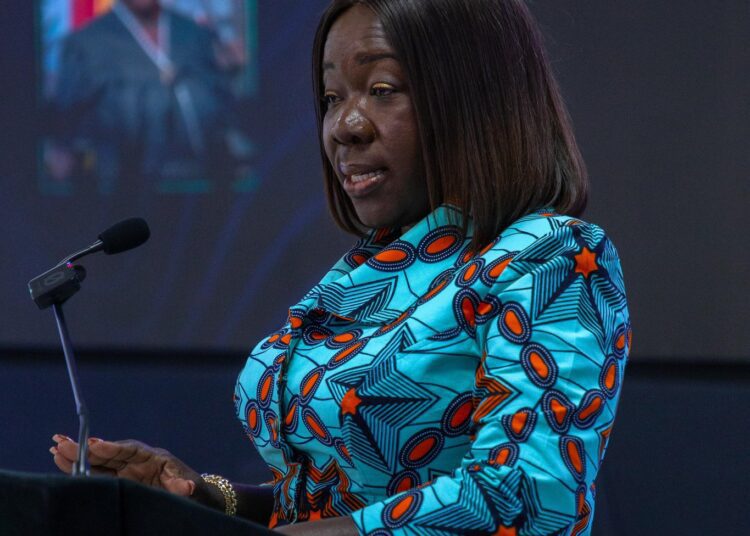
In a major diplomatic victory for the Mahama administration, the Minister for Trade, Agribusiness and Industry, Hon. Elizabeth Ofosu-Adjare, has officially welcomed the one-year extension of the African Growth and Opportunity Act (AGOA).
The extension, signed by the U.S. Government, provides a critical lifeline for Ghana’s industrial sector, effectively shielding local businesses from the full impact of the aggressive “Reciprocal Trade,” policies recently enacted in Washington.
“The extension will safeguard thousands of Ghanaian jobs, particularly within the garments, agro processing, cocoa derivatives, and light manufacturing sectors, while reinforcing Ghana’s position as a reliable trading partner in the U.S market”
Hon. Elizabeth Ofosu-Adjare, Minister for Trade, Agribusiness and Industry
The Minister noted that the extension comes at a precarious time for West African trade. Over the past year, the U.S. had moved toward a more protectionist stance, including the imposition of a 10% universal tariff in April 2025 and a targeted 15% tariff on Ghanaian exports in August 2025.
Hon. Ofosu-Adjare’s direct engagement with her U.S. counterparts has been instrumental in securing this reprieve, which ensures that Ghanaian goods maintain duty-free and quota-free access to the American market.

The Ministry of Trade, Agribusiness and Industry (MoTAI) observed that the garment and light manufacturing sectors are central pillars of the government’s 24-Hour Economy strategy.
Without the AGOA extension, these industries faced a sharp decline in competitiveness due to the cumulative 25% tariff burden accumulated throughout 2025. By securing this one-year window, the Ministry has protected the livelihoods of thousands of factory workers and preserved the investment attractiveness of Ghana’s industrial parks.
Hon. Ofosu-Adjare emphasized that the Government of His Excellency John Dramani Mahama remained proactive throughout the crisis.
Through a combination of WTO-level advocacy and bilateral diplomatic missions, the Ministry successfully argued that Ghana’s exports – specifically cocoa derivatives and processed agricultural goods – are essential to the U.S. supply chain and do not contribute to the trade deficits Washington seeks to curb.
A West African Achievement
Minister Ofosu-Adjare was quick to point out that this victory was not won in isolation. The extension is the result of a coordinated effort involving the Ministry of Foreign Affairs, the World Trade Organization (WTO), and a unified front of West African nations and commended their efforts.

According to MoTAI, this collective lobbying effort proved to the U.S. administration that AGOA remains a cornerstone of regional stability and economic growth in Sub-Saharan Africa.
The Trade Minister noted that since AGOA’s inception in 2000, it has been the primary vehicle for non-reciprocal trade, allowing 32 eligible African countries to compete on a global stage. The 2026 extension ensures that the “Export Ghana,” agenda remains on track, despite the shifting sands of international trade policy.
While the one-year extension provides immediate relief, the Ministry urged Ghanaian exporters not to become complacent. Hon. Elizabeth Ofosu-Adjare encouraged the exporting community to aggressively utilize the Accelerated Export Development Programme (AEDP) to scale their operations.
The goal is to maximize export volumes during this period of duty-free access, “effectively building a war chest of foreign exchange and market share before the next review cycle.”
The AEDP is specifically designed to provide technical support and export financing to small and medium enterprises (SMEs) in the agro-processing sector and by aligning these local supports with the AGOA framework, the government aims to turn the current trade reprieve into long-term industrial resilience.
The announcement has already begun to stabilize the investment climate within Ghana’s Free Zones and industrial enclaves.

Many international firms had stalled expansion plans due to the uncertainty surrounding U.S. trade tariffs. With the extension confirmed, the Ministry noted its expectation of a resurgence in capital expenditure as companies look to fulfill U.S. orders for the 2026/2027 fiscal years.
Hon. Ofosu-Adjare concluded by reaffirming her commitment to avoiding trade disruptions, stating that her “open-door policy,” for the exporting community remains the Ministry’s top priority.
READ ALSO: New START Treaty Expires