The Ministry of Trade, Agribusiness, and Industry (MoTAI) has formally validated the decade-long operational footprint of CIMAF Ghana Limited, positioning the pan-African cement manufacturing giant as an indispensable catalyst within the state’s industrial transformation agenda.
At a recent ceremony commemorating the company’s tenth anniversary at its manufacturing base within the Tema Industrial Enclave, the sector Minister, Hon. Elizabeth Ofosu-Adjare, highlighted the critical role of sustained private industrial capital in de-risking the nation’s infrastructural future.
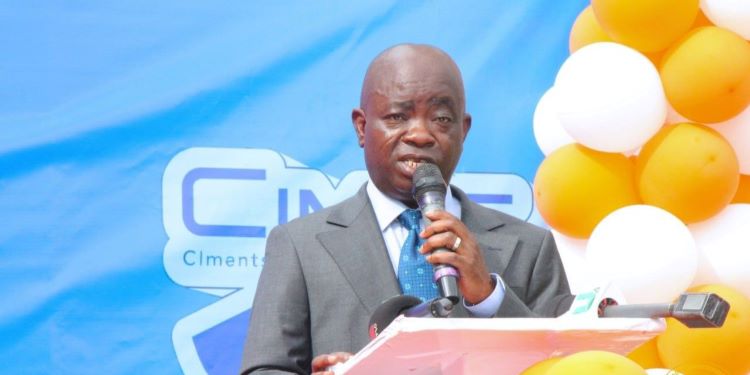
Delivered on her behalf by the Deputy Minister for Trade, Agribusiness, and Industry, Hon. Sampson Ahi, the state’s executive address framed CIMAF’s expansion not merely as a corporate milestone, but as an empirical proof-of-concept for the government’s ongoing economic stabilization initiatives.
“The Minister commended CIMAF Ghana for a decade of outstanding contribution to Ghana’s industrial and construction sectors, describing the company as a key partner in the country’s industrial transformation agenda”
Ministry of Trade, Agribusiness, and Industry
The public endorsement signaled a deep-seated alignment between the executive directorate and large-scale industrial processors, emphasizing that domestic value addition is the primary defense against import-driven inflation and supply chain volatility.
The anniversary assembly gathered senior executive leadership, heavy industrial stakeholders, and regulatory authorities to assess the long-term impact of the commercial grinding factory, which has served the domestic construction ecosystem since its entry into the Ghanaian market.
MoTAI’s localized strategy relies significantly on companies that transition away from pure commodity importing toward permanent capital expenditure inside Ghana’s specialized industrial zones.

Through anchoring production within the country, corporations like CIMAF absorb technical domestic labor, generate secondary economic activities for local supply chains, and contribute significantly to the country’s internal revenue generation.
Downstream Infrastructure Inputs
According to the Trade Minister, the domestic processing of cement stands as a primary structural pillar for any sovereign industrial expansion, but for decades, West African economies have been vulnerable to international commodity price shocks due to an over-reliance on imported finished building materials.
The establishment of deep operational roots in Tema has altered this dynamic for CIMAF, injecting competitive tension into a market historically dominated by a limited number of players.
This market diversification directly protects the construction sector from artificial supply shortages and unexpected pricing spikes, ensuring that public works projects, housing developments, and industrial facilities can progress with predictable budgetary forecasts.
“Hon. Ofosu-Adjare stated that since establishing operations in Ghana a decade ago, CIMAF has grown into a strong pillar within the country’s industrial landscape through the consistent production and supply of high-quality cement, while also contributing significantly to infrastructure development and local growth”
Ministry of Trade, Agribusiness, and Industry
The industrial framework promoted by the ministry positioned structural inputs like cement as foundational economic multipliers. When local production capacity matches or exceeds localized demand, it decreases the demand for foreign exchange required to fund heavy imports, thereby easing pressure on the national currency.
Furthermore, the localized refinement of construction products allows downstream sectors, including commercial real estate and civil engineering firms, to optimize their inventory models, minimizing the capital locked up in long-distance shipping delays and custom bottlenecks.
The Ministry’s analysis of CIMAF’s growth emphasized the critical importance of private direct investment that actively adapts to national development blueprints. MoTAI noted that it is focused on transforming the country into an industrialized export hub capable of supplying the wider West African sub-region.

The state recognized that public financing alone cannot fund the extensive infrastructure required for this transition. Consequently, the government called on private actors who are willing to commit substantial capital to long-term industrial projects, matching corporate growth with state development goals.
This structural synergy is particularly evident in the company’s continuous investments in modern production technology and energy-efficient grinding systems within its Tema factory.
These technological advancements ensure that industrial growth does not come at the expense of national environmental targets, aligning corporate operations with modern international standards of sustainable manufacturing.
For MoTAI, this model represents the ideal standard for foreign direct investment: commercially viable, technologically advanced, and structurally integrated into the host nation’s economic ecosystem.
The 10th-anniversary celebration also served as an important forum for assessing value chain integration, featuring solidarity messages from prominent industry groups such as the Ghana Real Estate Developers Association (GREDA) and the Ghana Chamber of Construction Industry (GCCI).
The active participation of these associations highlighted the deep structural ties between raw material producers and downstream construction operators.
MoTAI noted that in an era where urbanization is driving unprecedented demand for residential and commercial infrastructure, the availability of high-grade, locally manufactured structural inputs determines the overall execution speed and affordability of national housing portfolios.
As the Ministry and industry stakeholders look toward the next decade of industrial growth, the focus remains on enforcing strict quality standards and regulatory compliance across the manufacturing landscape.
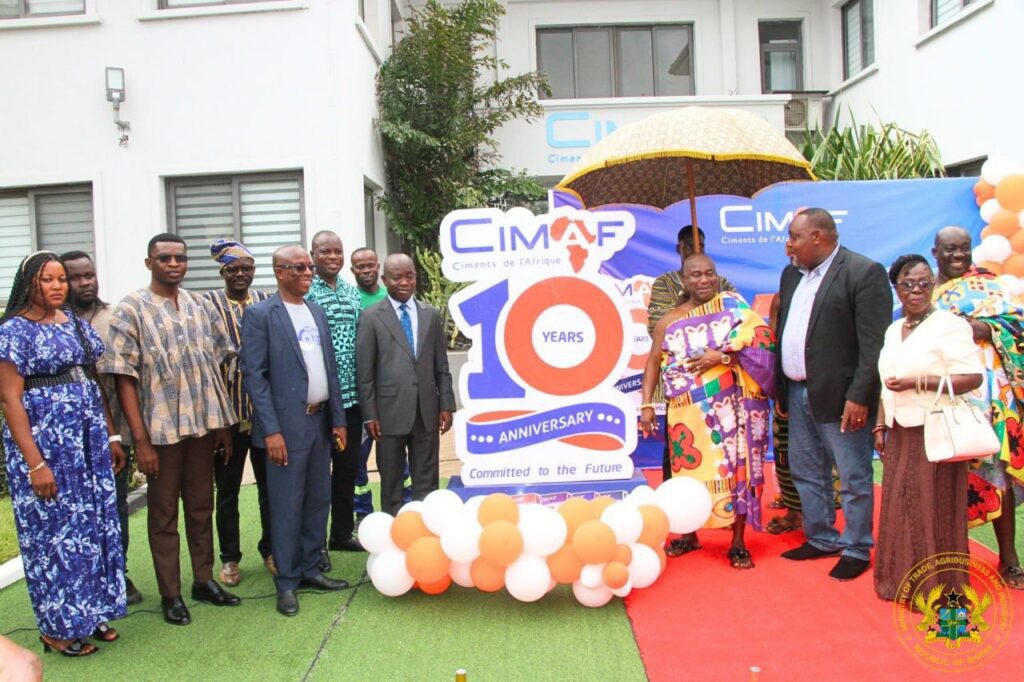
Hon. Ofosu-Adjare’s commendation of CIMAF’s decade of excellence serves as an explicit message to the broader industrial market: state support is tied directly to quality consistency and regulatory compliance.
MoTAI’s ongoing partnership with proven industrial investors ensures that Ghana continues to strengthen its domestic production capacity, protect its internal infrastructure pipeline, and build a modern, resilient industrial foundation capable of sustained economic performance.
READ ALSO: Rent Control Halts Proposed Student Hostel Fee Increases