The Ghana Investment Promotion Authority (GIPA) and the Ghana Union of Traders Association (GUTA) have agreed on a collaborative roadmap aimed at strengthening protections for Ghana’s informal retail sector, a space reserved exclusively for Ghanaian citizens under the Ghana Investment Promotion Authority Act, 2026 (Act 1173).
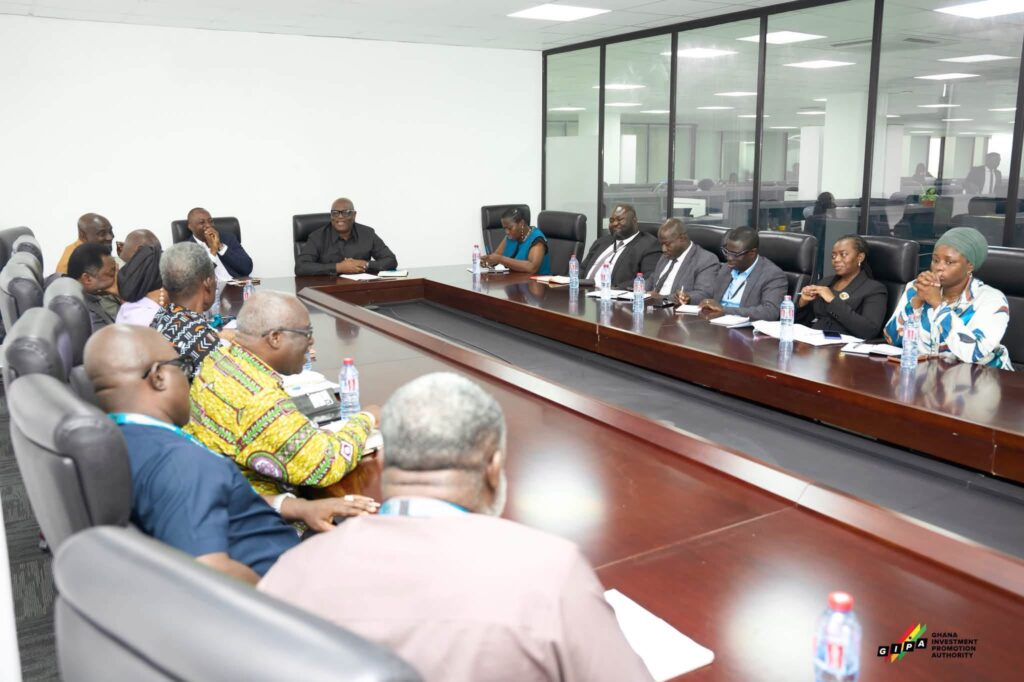
The agreement was reached during a strategic engagement convened under the directive of the Ministry of Trade, Agribusiness and Industry (MoTAI) in Accra. The meeting brought together leadership from both institutions to address growing concerns about the penetration of foreign-owned businesses into retail spaces legally reserved for Ghanaians.
Speaking at the meeting, GIPA Chief Executive Officer Mr. Simon Madjie reaffirmed the Authority’s mandate to enforce the provisions of Act 1173 and to ensure a business environment that is fair, orderly, and compliant with national laws.
“We are committed to strengthening oversight and preventing unauthorised participation in reserved activities. Certain sectors of our economy, particularly retail trading in markets, are reserved for Ghanaians. Our responsibility is to ensure that this provision is respected and that the livelihoods of Ghanaian traders are protected.”
Mr. Madjie
A central issue discussed was the practice of fronting, where Ghanaian nationals or companies are used as proxies to conceal foreign ownership or control of businesses operating in restricted sectors. Both GIPA and GUTA described fronting as a major threat to local traders, as it undermines competition and erodes the intent of the law.

GUTA officials at the meeting presented evidence and complaints from members across major markets in Accra, Kumasi, Takoradi and other commercial hubs, citing instances where foreign retailers were allegedly operating behind Ghanaian names. Traders argued that this practice has led to market distortions, unfair pricing, and the displacement of local businesses that lack the same capital base.
In response, Mr. Madjie acknowledges the concerns and stressed that GIPA cannot act in isolation. He called for stronger collaboration between regulatory bodies, market associations, and security agencies to identify and sanction offenders.
A Four-Point Collaborative Roadmap
To address the challenges, GIPA and GUTA jointly proposed a four-point roadmap to be rolled out in the coming months.
1. Strengthen the Inter-Agency Task Force. Both parties agreed to revitalize and expand the existing inter-agency task force. The team will include representatives from GIPA, GUTA, the Ghana Revenue Authority, the Registrar General’s Department, the Ghana Police Service, and the Ministry of Trade. The task force will be mandated to conduct regular market inspections, verify business ownership structures, and ensure compliance with Act 1173.2. Establish a Dedicated Monitoring and Enforcement Mechanism.
2. A specialized unit within GIPA will be set up to focus solely on monitoring reserved sectors. This unit will work closely with GUTA’s regional executives to receive intelligence, carry out due diligence on suspicious businesses, and recommend sanctions where violations are confirmed.
3. Introduce a Direct Reporting Channel for Suspected Violations to encourage whistleblowing, GIPA and GUTA will launch a direct reporting channel accessible to traders and the public. The channel will allow individuals to report suspected cases of fronting and unauthorized retail operations confidentially via phone, email, and a dedicated online portal. GUTA will also serve as a first point of contact for its members who witness breaches in the markets.
4. Undertake Public Education and Sensitization Recognizing that many traders and foreign investors may not fully understand the provisions of Act 1173, both organizations will embark on a nationwide public education campaign. The campaign will explain which business activities are reserved, the penalties for violations, and the legal pathways for foreign investment in other sectors of the economy. GIPA will lead investor education while GUTA will focus on member sensitization in the markets.
Mr. Madjie emphasized that the goal is not to drive away legitimate foreign investment, but to ensure that such investment flows into sectors open to foreigners under the law. For years, tensions have flared in Ghana’s markets over the participation of non-Ghanaians in retail. Previous attempts to enforce the law were met with resistance and claims of harassment. This new collaborative approach, both parties say, is designed to be more systematic, transparent, and law-based.
Both organizations reaffirmed their commitment upholding Ghana’s investment laws
The Ghana Investment Promotion Authority Act, 2026 (Act 1173) restates and clarifies the sectors reserved for Ghanaian participation. Under the Act, the sale of goods and provision of services in markets and petty trading remain the exclusive preserve of Ghanaian citizens. Foreign investors are encouraged to enter other sectors such as manufacturing, agro-processing, and large-scale services, where they can bring capital, technology, and jobs.
The Act also provides GIPA with expanded powers to investigate, monitor, and collaborate with other agencies to ensure compliance. Penalties for violations include fines, closure of businesses, and possible prosecution.
GUTA has pledged to mobilize its regional and market executives to support data gathering and to educate members on how to use the new reporting channel.
The Ministry of Trade, Agribusiness and Industry, which convened the meeting, has thrown its weight behind the initiative. A ministry spokesperson said the government remains committed to ensuring that Ghana’s investment regime is both investor-friendly and protective of local enterprise.
As Ghana continues to position itself as a gateway for trade and investment in West Africa, the enforcement of Act 1173 is expected to be a key test of policy coherence — balancing openness to foreign capital with the need to safeguard domestic livelihoods.
READ ALSO :GEA’s New Offensive Targets Southern Africa With Angola Trade Pact