
Head, Public Relations for the Ghana Education Service (GES), Daniel Fenyi, has called for the complete abolition of the notional date and substantive date system governing teacher promotions, arguing that the arrangement continues to create confusion and financial uncertainty for teachers regardless of which administration is in power.
Weighing in on the ongoing engagement between GES Management and teacher unions over the issue, Mr Fenyi explained that his intervention was not meant to prejudge the outcome of the discussions, but rather to elevate the conversation by examining the structural roots of the controversy.
Mr Fenyi cited specific cases illustrating the scale of the gap between notional and substantive dates under previous administrations. He referenced one teacher promoted under the previous NPP government whose notional date was recorded as September 2022, while the substantive date was set at July 2023, a gap of approximately ten months, with the promotion letter itself dated December 2023.
He noted that further inquiry revealed even larger discrepancies, including one teacher whose notional date was 2021 while the substantive date was set at 2023, representing a gap of over one year between when the promotion was recognised and when its financial benefits actually took effect.
He was emphatic that this controversy has existed under both the NPP and NDC administrations, cautioning against reducing the issue to partisan politics.
“Anyone who reduces it to a single political party is simply doing politics, and no one should fall for it, because that is how we reduce important issues to mere banters and throw the substance into the gutter.”
Head, Public Relations for the Ghana Education Service (GES), Daniel Fenyi

Explaining The Origins Of The Current Dispute
Mr Fenyi explained that the current administration had inherited a distorted promotion cycle from its predecessor, noting that the previous administration had turned what should have been a four-year promotion cycle into a five-year cycle, resulting in the 2020 batch of teachers missing their due promotion examinations in 2024.
He explained that the current administration, acting in good faith, decided to revert to the established four-year cycle, a decision that required combining the 2020 and 2021 batches to sit promotion examinations together in 2025, resulting in the largest number of promotion applications and successful promotions recorded in the past decade.
He noted, with some irony, that this correction of a longstanding administrative backlog went largely unacknowledged despite its scale.
Mr Fenyi explained that when the 2025 promotion results were released, the 2020 batch of teachers was assigned a notional date of 2024, while the 2021 batch received a notional date of 2025, even though both cohorts sat the same examinations. He explained that this distinction reflected differences in seniority and ranking between the two batches, despite their shared examination year.
However, he noted that since both batches underwent the promotion exercise within the same year, their substantive dates, which determine when the financial benefits of promotion take effect, fall within the same 2025 budget year, meaning both groups would receive payments based on what that year’s budget allocation permits.
Root Question, Why Maintain Two Dates at All
Rather than focusing solely on whether the 2020 batch’s payments should be backdated to 2024, Mr Fenyi raised a more fundamental question about why the two-date system exists in the first place.
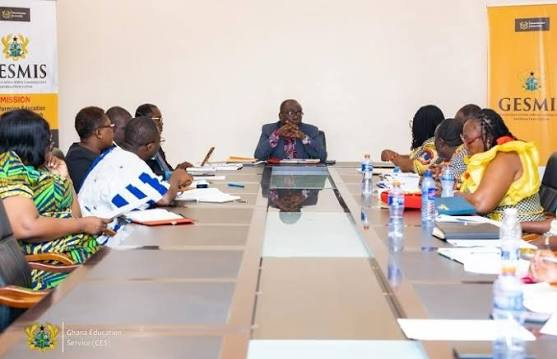
“If you are promoted, you are promoted. Which one too is notional date and substantive date? The date you were promoted must be the date your promotion takes effect.”
Head, Public Relations for the Ghana Education Service (GES), Daniel Fenyi
He argued that having separate dates for when a promotion is formally recognised and when its financial benefits begin creates unnecessary bureaucratic complexity, particularly given that the gap between these dates can stretch to nearly a full year in some cases.
Call for Teachers to Push For Permanent Reform
Mr Fenyi urged teachers and their unions to use the current momentum surrounding the 2025 promotion dispute to negotiate for a permanent solution, rather than focusing solely on securing backdated payments for the immediate grievance at hand.
He argued that as long as the notional and substantive date system remains in place, any administration, regardless of political affiliation, could apply it in ways that leave teachers financially disadvantaged within the constraints of a given budget year.

He maintained that the more strategic approach would be to eliminate the structural possibility of such discrepancies altogether, rather than repeatedly negotiating around their consequences after the fact.
He concluded by encouraging teachers to take advantage of what he described as a more open and dialogue-friendly administration to press for lasting reform, framing the current engagement as an opportunity to ensure that teachers do not have to contend with this same recurring dispute in future promotion cycles.
READ MORE: UNICEF Urges Data-Driven Teacher Deployment to Close Regional Gaps