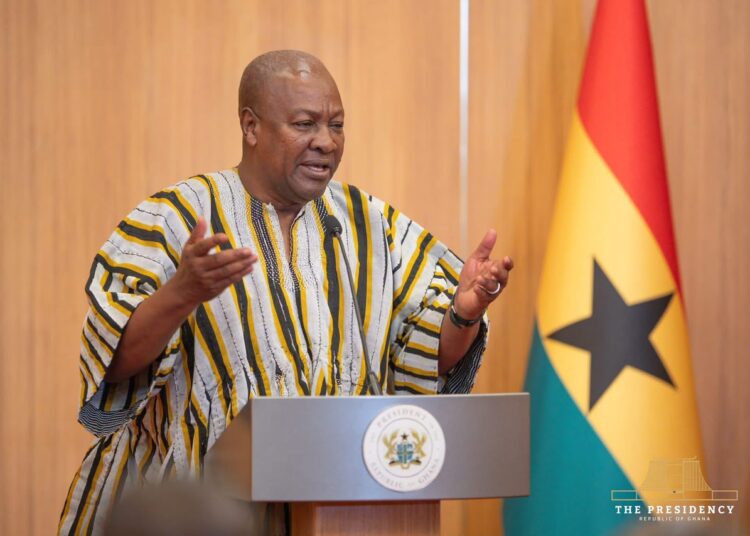
President John Dramani Mahama has called for a renewed economic partnership between Ghana, Germany and the wider African continent, urging businesses to prioritise trade, investment, industrial cooperation and technology transfer over traditional donor-dependent relationships.
Addressing the opening of the 6th German-African Business Summit at the Kempinski Hotel Gold Coast City, President Mahama argued that Africa’s growing markets, natural resources and regional integration initiatives present significant opportunities for German businesses seeking to expand their investment and production activities across the continent.
“The summit marks an important moment to redefine the terms of our economic engagement between Africa and Germany. Shifting from traditional donor dependence to trade, investment, industrial cooperation, technology transfer, value addition, and shared prosperity.”
President John Dramani Mahama
Mahama Calls for a New Ghana-Germany Economic Partnership
President Mahama described the summit as an important platform for strengthening the longstanding relationship between Ghana and Germany while creating opportunities for a more commercially driven partnership between Africa and Europe.
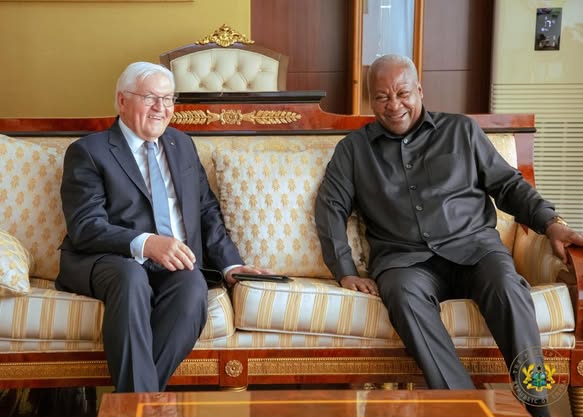
Welcoming German President Frank-Walter Steinmeier and other distinguished guests, he highlighted the significance of Germany’s continued engagement with Ghana, particularly following President Steinmeier’s previous visit to the country in November 2025.
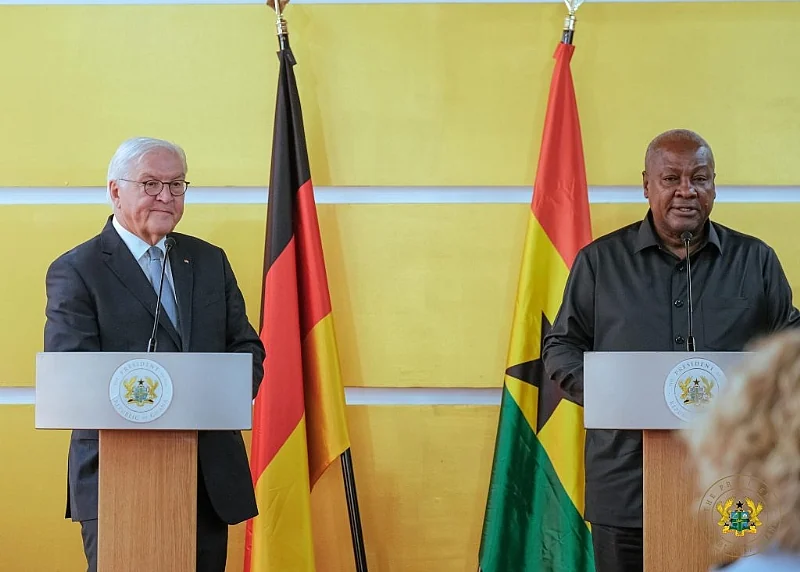
He maintained that the relationship between the two countries, built on enduring friendship and mutual respect, should evolve into a strategic economic partnership capable of delivering measurable benefits to businesses and citizens.
According to President Mahama, the changing global economic environment presents an opportunity for African countries to reposition themselves as competitive destinations for investment, manufacturing, innovation and sustainable industrial development.
He identified geopolitical uncertainty, technological transformation, changing trade patterns and the reorganisation of global supply chains as developments reshaping international economic relationships.
Although these changes present challenges, the President believes they also create opportunities for countries and businesses willing to adapt to emerging economic realities.
Africa, he observed, possesses considerable natural resources, a youthful population, expanding consumer markets and investment opportunities across agriculture, energy, infrastructure, manufacturing and digital technology.
However, he stressed that the continent must move beyond exporting raw materials and develop productive enterprises capable of generating employment and competing internationally.
“Our future must be built at the edge of transformation. We must process what we produce. We must manufacture what we consume and compete effectively in regional and global markets.”
President John Dramani Mahama
Germany’s Industrial Expertise and Africa’s Development Priorities
President Mahama identified Germany’s established capabilities in engineering, advanced manufacturing, technological innovation and vocational training as important resources for accelerating Africa’s industrial transformation.
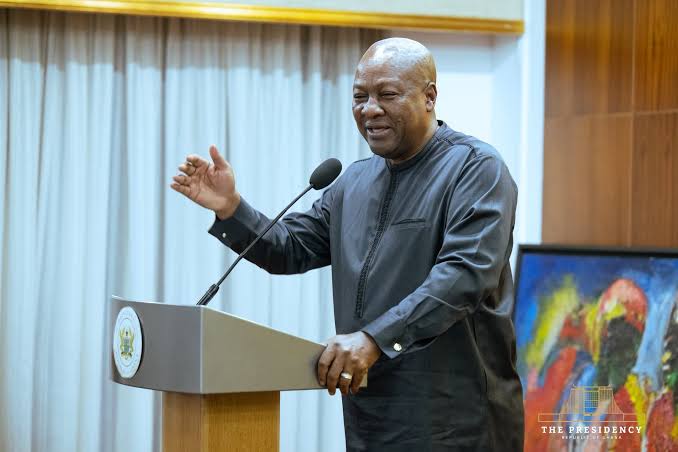
He argued that combining German technology, expertise and investment with Africa’s natural resources, entrepreneurial capabilities and expanding markets could establish commercially viable enterprises that benefit both economies.
He further emphasised that successful economic cooperation must reflect mutual respect and shared responsibility, with investments generating commercial returns while supporting the development priorities of host countries.
In this regard, President Mahama commended the European Union’s Global Gateway Strategy, including its €850 billion Africa-Europe investment package, for providing a framework to address infrastructure, energy, transport and digital connectivity gaps across the continent.
He maintained that such initiatives could translate the shared economic ambitions of Africa and Europe into practical development outcomes.
AfCFTA Presents German Investors With a Continental Market
The President also urged German companies to reconsider how they approach Africa’s investment landscape, particularly in view of the opportunities emerging from the African Continental Free Trade Area (AfCFTA).
With its secretariat headquartered in Accra, the AfCFTA seeks to integrate approximately 1.4 billion people into a continental market with a combined gross domestic product exceeding US$3.5 trillion.
President Mahama described the agreement as one of the most significant developments in Africa’s recent economic history, providing a framework for facilitating trade, strengthening investment cooperation and developing an integrated African market.
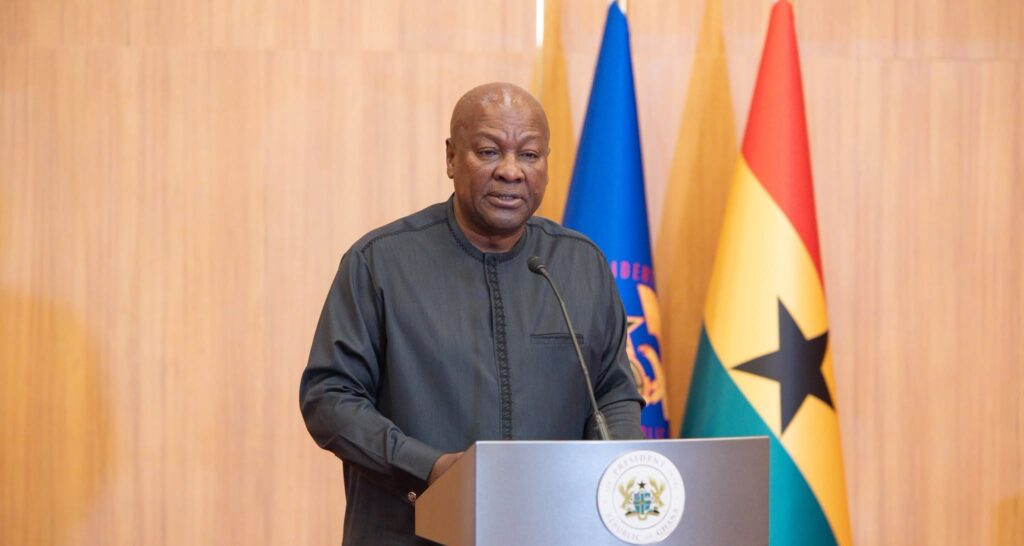
He cited World Bank estimates indicating that comprehensive implementation of the agreement, alongside complementary trade facilitation measures, could increase African incomes by approximately US$450 billion by 2035.
The agreement could also lift approximately 30 million people out of extreme poverty, highlighting its potential contribution to economic transformation and poverty reduction. However, the President acknowledged that achieving these projections would require African governments to address practical obstacles affecting cross-border commerce.
These include weaknesses in border administration, transport infrastructure, customs procedures, payment systems and regulatory coordination. He therefore urged African leaders to translate the promise of continental integration into improvements that businesses and ordinary citizens could experience.
“I therefore wish to invite German companies to consider Africa not as a collection of isolated markets but as a crystallizing network of interconnected investment and production opportunities and to consider Ghana as one of your strategic entry points into that market.”
President John Dramani Mahama
Ghana Positions Itself as Germany’s Strategic Investment Gateway
President Mahama’s appeal placed Ghana at the centre of his broader argument for stronger commercial engagement between Germany and Africa. He encouraged German investors to view Ghana not simply as a standalone national market but as an entry point into the opportunities emerging from continental economic integration.
The President maintained that the practical benefits of AfCFTA would become increasingly visible as implementation advances, creating opportunities for companies to establish production networks serving multiple African markets.
He also highlighted the importance of developing partnerships that extend beyond the exchange of goods to include manufacturing, infrastructure development, technology transfer and industrial skills development.
For Ghana, such cooperation would support the country’s ambition to process more of its agricultural and mineral resources locally while strengthening domestic production capacity. The President’s remarks also reflected a broader effort to reposition Ghana’s relationship with Germany from development assistance towards investment-led economic cooperation.
Bilateral Cooperation Must Deliver Measurable Results
President Mahama concluded his economic cooperation argument by stressing that the success of the summit should be determined by the practical outcomes it generates.
He encouraged participants to pursue structured business-to-business engagements, investment matchmaking, project development and follow-up arrangements capable of translating discussions into commercial partnerships.
He maintained that the next chapter of German-African relations should be built around economies that reward enterprise, welcome innovation and provide a stable environment for responsible investment.

The President also called on African leaders and businesses to strengthen policy consistency, institutional reforms, democracy, accountability, regional integration and infrastructure development. He argued that Africa must demonstrate through its policies and institutions that it is ready to attract investment and convert economic opportunities into shared prosperity.
The 6th German-African Business Summit, therefore, represents an opportunity to strengthen commercial relations between Germany and Africa while advancing Ghana’s ambition to become a competitive investment and production destination.
President Mahama expressed optimism that the engagements would produce lasting partnerships capable of accelerating industrialisation, expanding trade and strengthening economic cooperation between the two regions.
READ ALSO: US$10bn New Economy Agenda to Drive Industrialisation