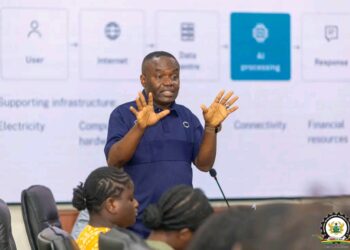
Educator and researcher Dr Matthew Nyaba has called for an artificial intelligence (AI) education roadmap to translate Ghana’s AI ambitions into practical classroom readiness.
Presenting a study at the National Education Week, Dr Nyaba, a Postdoctoral Research Associate in K–12 STEM and Artificial Intelligence at the AI4STEM Education Center, University of Georgia, argued that although Ghana’s National AI Strategy identifies education as its first pillar, it focuses more on workforce development than on using AI to improve teaching and learning.
“We do not have issues when it comes to ambition. However, we need an education-centred pathway that translates national priorities into meaningful classroom readiness.”
Educator and researcher Dr Matthew Nyaba
His presentation, “From National AI Ambition to Classroom Readiness: A Critical Analysis of Ghana’s AI Strategy for Education”, examined the strategy’s direction for classroom AI integration on behalf of an international team of educators.

Dr Nyaba noted that debate about AI has shifted from fears of student misuse and lost competencies towards policies and governance for responsible use.
AI Strategy Prioritises Skills and Employability
He observed that many national AI policies concentrate on workforce development, productivity and job creation, while giving less attention to education. Ghana’s strategy, launched in April this year, reflects aspects of that trend.
However, its decision to place education first among eight pillars prompted the researchers to examine whether this priority translated into classroom readiness.
The team set out to develop and apply an education-centred framework, assess the position of education in the national strategy, and identify its strengths and gaps.
The team conducted a critical qualitative policy analysis using a framework of 36 education-specific dimensions. Deductive coding and comparison between readers examined teacher agency, curriculum, cultural responsiveness, learner protection and stakeholder participation.
Research, Gaps in Classroom Implementation
According to Dr Nyaba, the analysis found strong emphasis on AI skills, talent development and employability, including a target of preparing one million young people to become AI-ready by 2030.
However, the strategy gives limited attention to classroom pedagogy and assessment. Education is framed largely as preparation for the AI economy rather than as a means of using AI to support teachers, improve student learning and strengthen educational outcomes.
He summarised the distinction as “education for AI and not AI for education”. The first approach trains people to become coders, developers and AI professionals, while the second examines how the technology can improve teaching and learning.

“It was more about education for AI and not AI for education.”
Educator and researcher Dr Matthew Nyaba
The study questioned stakeholder representation, noting that the Ministry of Education was absent from the engagement process.
Teachers, learners, parents, colleges of education and school communities were also inadequately involved, despite their central role in implementation. Dr Nyaba maintained that their participation was necessary to reflect classroom realities.
Digital Divide and Learner Protection
The researchers acknowledged that Ghana’s strategy recognises disparities in digital infrastructure between rural and urban communities. However, Dr Nyaba argued that identifying the digital divide without providing a clear roadmap to address it leaves an implementation gap.
It found limited guidance on pedagogy, assessment, teacher agency and pre-service teacher preparation, despite references to curriculum reform and teacher training.
The researchers nevertheless called for stronger attention to local languages and culturally responsive teaching.
Dr Nyaba further observed that the policy acknowledges responsible AI but provides limited detail on child-specific safeguards. He argued that an education-focused framework must explain how schools can prevent learners from accessing harmful content, guide their use of AI and monitor learning outcomes.
The study also flagged errors in the document, urging stronger quality assurance to protect policy credibility and public confidence.
Researchers Urge National AI Education Roadmap
The research team acknowledged the strategy’s strengths in AI literacy, skills development and workforce preparation, as well as its recognition of education as a priority. Nevertheless, it identified gaps in equity, cultural responsiveness and classroom implementation.

Dr Nyaba stressed that Ghana’s strategy is an overarching national policy covering several sectors, not a comprehensive education policy. The analysis was therefore intended to prevent institutions from misinterpreting it as a complete guide for adopting AI in schools.
The team is calling for a national AI education roadmap to provide dedicated priorities and practical guidance for the education sector. Such a document, he argued, should give teachers, learners, parents, training institutions and school communities a role in implementation.
Dr Nyaba maintained that Ghana’s ambition was commendable, but the priority now was to ensure that national commitments translated into equitable, safe and effective AI use in classrooms.
READ MORE: Poget Herbal Warns Chemical Spraying Threatens Medicinal Plants