Ghana’s proposed US$10 billion New Economy agenda for 2027–2030 is expected to accelerate industrialisation, attract strategic investments and expand the country’s productive capacity, as government seeks to reposition the economy towards domestic production, value addition and export growth.
The initiative is expected to open new investment opportunities across agriculture, energy, critical minerals, manufacturing, technology and tourism, with the private sector expected to play a central role in driving the transformation.
Chief Executive Officer of the Ghana Investment Promotion Authority (GIPA), Simon Madjie, said the programme was designed to move Ghana towards a production-led, industrialised and export driven economy.
“The programme is aimed at transforming Ghana into a production-led, industrialised and export driven economy.”
Chief Executive Officer of GIPA, Mr. Simon Madjie
The agenda, which will run from 2027 to 2030, represents a major government investment commitment towards strengthening the productive sectors of the economy, creating employment and reducing dependence on imported goods.
According to the 2027 Budget Statement, government plans to mobilise US$10 billion over the four year period, with GH¢30 billion earmarked for the first year of implementation in 2027.
Investment Across Strategic Sectors
The New Economy programme is structured around eight interconnected pillars: macroeconomic stability and affordable finance, commercial agriculture, energy infrastructure, critical minerals value addition, tourism and creative arts, textiles and garments, pharmaceuticals and biomanufacturing, and the technology economy.
Mr. Madjie highlighted agriculture as one of the major areas offering investment opportunities, particularly in oil palm plantations, cereal production, livestock farming and agro-processing.
The agricultural sector remains central to Ghana’s economy, providing employment and supporting livelihoods across rural communities.
However, limited processing capacity, post-harvest losses and dependence on imported food products continue to constrain the sector’s potential.
Expanding commercial agriculture and processing could help bridge the gap between primary production and industrial demand, while creating opportunities for investors in storage, logistics, processing machinery, packaging and distribution.
“Producing and processing more goods locally would strengthen manufacturing, create jobs, reduce reliance on imports and increase Ghana’s export capacity.”
Chief Executive Officer for GIPA, Mr. Simon Madjie
A Value Addition and Export
Critical minerals and natural resource processing are expected to receive significant attention under the investment programme, with approximately US$1.5 billion earmarked for critical minerals exploration and value addition.
The strategy seeks to ensure that Ghana derives greater economic benefits from its mineral resources through domestic processing rather than exporting raw materials with limited value captured locally.
Government targets increased local refining of gold and processing of manganese and bauxite, with plans to expand domestic value addition across the minerals sector.
The emphasis on value addition also extends to agricultural commodities, particularly cocoa, alongside other raw materials that could support local manufacturing.
Ghana’s export structure demonstrates the importance of diversifying beyond primary commodities.
According to Ghana Statistical Service data, gold bullion accounted for approximately 62.9 per cent of merchandise export value in 2025, while cocoa beans contributed 8.6 per cent and crude petroleum 8.3 per cent.
“Local processing of raw materials will enable Ghana to retain more economic value, strengthen industrial capacity and expand the range of products available for export markets.”
Chief Executive Officer for GIPA, Mr. Simon Madjie
The New Economy programme is also expected to support textiles and garments, pharmaceuticals, biomanufacturing and technology businesses, creating opportunities for domestic enterprises to participate in regional and international supply chains.
Private Sector Opportunities and GEXPO Partnerships
The investment agenda is expected to complement Ghana’s efforts to position itself as a competitive destination for foreign direct investment and international business partnerships.
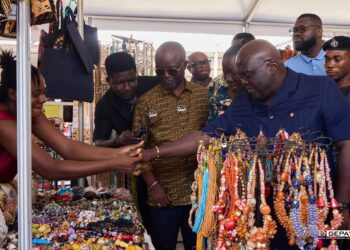
GEXPO 2026 is expected to provide a platform for businesses, investors, exporters, policymakers and development partners to explore commercial opportunities, establish partnerships and showcase Ghanaian products and services.
The GC100 initiative is also expected to contribute to discussions around investment mobilisation, enterprise development and strengthening Ghanaian businesses to compete in international markets.
Small and medium sized enterprises could benefit from increased demand for locally produced inputs, services, packaging, logistics, machinery maintenance and other business support activities.
Tourism, culture and creative arts are also identified as strategic sectors, with investments expected to support tourism infrastructure, heritage attractions, hospitality services and creative industries.
The government’s broader objective is to encourage private capital to complement public investment, with businesses expected to drive production, innovation, technology transfer and sustainable employment.
“The agenda is expected to create new opportunities for businesses and strengthen Ghana’s position as an investment destination.”
Chief Executive Officer for GIPA, Mr. Simon Madjie
The success of the US$10 billion programme will, however, depend on effective implementation, transparency, investor confidence, access to affordable financing and the timely completion of critical infrastructure projects.
READ ALSO:Mahama Calls for More Ghanaian-Owned Processing Factories Nationwide