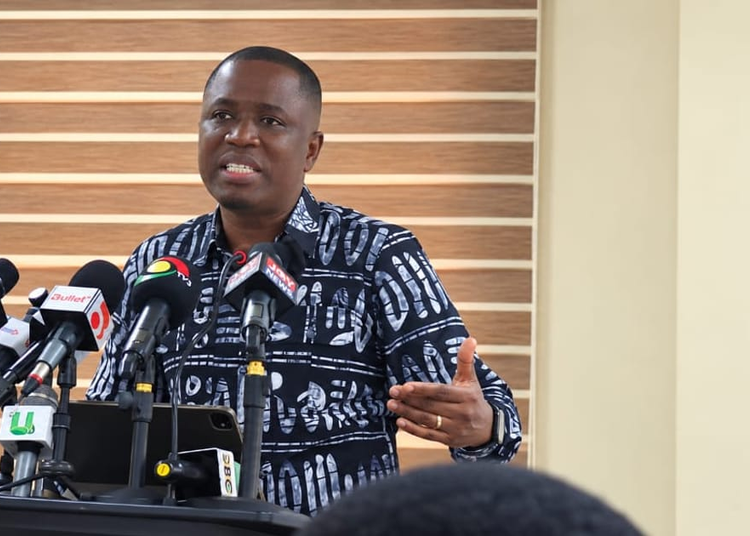
The NPP Spokesperson, Dr Frank Bannor, has accused the NDC government of restricting money supply and public expenditure, arguing that the measures used to contain inflation have weakened consumer demand and deepened economic hardship.
Assessing the government’s economic performance, Dr Bannor attributed the reported decline in inflation to tight monetary conditions and reduced spending, particularly on capital projects. He also questioned the quality of the reported 6.8 per cent growth, citing rising youth unemployment in Greater Accra and pressure on household purchasing power.
“The government has deliberately tightened liquidity in the economy by limiting the amount of money in circulation.”
NPP Spokesperson, Dr Frank Bannor
Dr Bannor explained that limiting local currency in circulation reduces the purchasing power of households and businesses, weakening demand for goods and services and easing pressure on prices.
He described the restriction as a policy choice but argued that its effects extend beyond price stability to the ability of businesses to attract customers and sustain activity.
However, he argued that the Bank of Ghana had engaged in excessive open market operations by withdrawing what it considered excess liquidity from the financial system.
Government underspending affects businesses
He linked the extensive use of the instrument to the Bank of Ghana’s reported financial losses, arguing that interest payments required to attract subscriptions add to its obligations.
Turning to fiscal policy, Dr Bannor argued that the government had also restrained expenditure, pointing to a 16.3 per cent underspending against planned expenditure in the first half of 2026, from January to June. He emphasised capital expenditure, which finances infrastructure such as roads, hospitals, schools and bridges.

“When government increases capital expenditure, it injects money into the pockets of the private sector,” he explained, noting that manufacturers of cement and iron rods, retailers and other businesses benefit when public projects advance.
He argued that reduced capital spending denies businesses the liquidity and customer demand public investment can generate. He linked this to complaints from traders who struggle to make sales despite positive national economic indicators.
Growth figures questioned over youth unemployment
He cited a television interview in which a businessman operating in Kasoa reportedly complained that he had been unable to make sales worth even GH¢100 throughout the day.
Dr Bannor challenged the government’s presentation of economic stability, particularly the reported 6.8 per cent growth rate.
Using Greater Accra’s youth unemployment figures, he compared the 2024 rate of 21 per cent, which he described as the base year inherited by the NDC government, with the 2026 figure of 49.3 per cent.
“Clearly, this indicates a gap between the economic growth being reported on paper and the realities on the ground,”
NPP Spokesperson, Dr Frank Bannor
Cost of living continues to erode purchasing power
The NPP spokesperson also pointed to inflationary pressures affecting rent, transportation and basic food items, including tomatoes. He cited Ghana Statistical Service data which, according to his account, showed these items contributing 37.2 per cent to the broader inflation basket.
Dr Bannor argued that higher housing and transport costs reduce workers’ disposable income, particularly when salaries do not rise at a corresponding pace.

Dr Bannor used a makeup analogy to challenge the government’s portrayal of economic stability, arguing that favourable figures could conceal weaknesses that become apparent in everyday economic conditions.
He maintained that the government’s focus on inflation and growth should not overshadow the impact of its policy choices on businesses, workers and young people.
“Why would you pursue cosmetic economic growth at the expense of the well-being of the people?” he asked, arguing that economic performance should be assessed by whether it improves people’s welfare.
READ MORE: Ghana Must Align Education With Industry Needs – Mr. Owusu