
The Speaker of Parliament, Rt. Hon. Alban Kingsford Sumana Bagbin, has called for comprehensive reforms to Ghana’s political financing framework, urging stronger contribution limits, mandatory disclosure, independent audits and effective enforcement to prevent money from undermining democratic processes.
In a statement read on his behalf by First Deputy Speaker Bernard Ahiafor at an engagement between Parliament’s Open Partnership and the United Nations Office on Drugs and Crime (UNODC), Speaker Bagbin argued that existing regulations and enforcement arrangements require critical review to address emerging challenges and close gaps in the system.
“Let us therefore collectively resolve to ensure that money serves democracy rather than democracy serving”.
Speaker of Parliament, Rt. Hon. Alban Kingsford Sumana Bagbin
Speaker Bagbin’s call places the regulation of money in politics at the centre of efforts to protect democratic governance in Ghana. He maintained that the country faces a compelling need for comprehensive reform, pointing to weaknesses in the existing regulatory and enforcement framework.
The statement identified four priority areas: reasonable limits on contributions to political parties and campaign expenditure, mandatory disclosure of political parties’ resources, independent auditing of party accounts and effective enforcement mechanisms.

The measures, Speaker Bagbin indicated, should form part of a broader framework for regulating the financial resources available to political parties and the costs associated with electoral campaigns.
Contribution and Campaign Spending Limits
Among the key considerations outlined was the establishment of reasonable limits on contributions made to political parties and expenditure incurred during campaigns.
The proposal places political fundraising and campaign spending at the centre of the reform discussion. It points to the need for rules that define acceptable contribution and expenditure levels, providing a framework for managing the financial resources used in political activities.
Speaker Bagbin did not propose specific monetary thresholds in the statement. Instead, he identified reasonable limits as an issue requiring critical consideration as part of the comprehensive reform process.
The design of such limits therefore remains a matter for stakeholders and institutions involved in reviewing Ghana’s political financing arrangements.
Mandatory Disclosure of Party Resources
The Speaker also identified mandatory disclosure of political parties’ resources as a key component of the proposed reforms.The measure would make transparency about party resources a central requirement of the regulatory framework.
Speaker Bagbin placed disclosure alongside contribution limits, campaign expenditure controls and independent auditing as complementary safeguards. Mandatory reporting, under the proposal, would provide a basis for examining the resources available to political parties.
However, the statement did not outline a disclosure format, reporting schedule or the specific categories of resources that parties should declare. Those details remain to be considered in developing a comprehensive framework capable of strengthening transparency in political financing.

Independent Audits and Enforcement
Speaker Bagbin further called for independent auditing of political parties’ accounts, identifying it as a critical measure for strengthening financial oversight. Independent audits would allow party accounts to be examined against applicable financial requirements. The Speaker presented this proposal as part of a wider effort to address regulatory and enforcement gaps.
He also stressed the need for effective enforcement mechanisms to regulate political financing in Ghana. Rules governing contributions, expenditure, disclosure and auditing, he argued, require mechanisms capable of securing compliance.
The statement did not identify which institution should lead enforcement, prescribe penalties for breaches or outline how compliance should be monitored. It nevertheless placed effective enforcement among the central considerations for reform.
The emphasis on enforcement means the proposed changes are not limited to introducing additional reporting or accounting requirements. They also involve ensuring that political parties are held to the rules governing their financial activities.
Parliament and UNODC Engagement
The remarks were delivered in a statement read by Ahiafor during the engagement between Parliament’s Open Partnership and UNODC. Speaker Bagbin used the occasion to call for a collective commitment to reforming political financing.
His proposals centred on four areas: reasonable limits on party contributions and campaign spending, mandatory disclosure of party resources, independent audits of party accounts and effective enforcement.
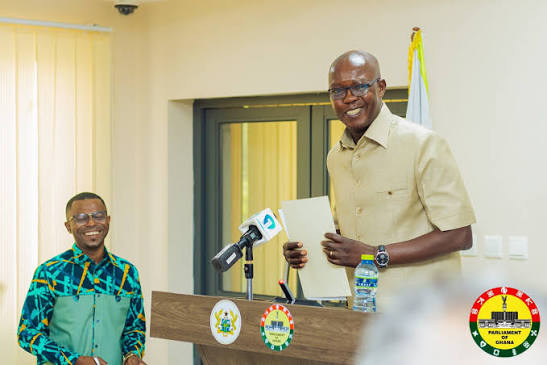
The statement did not announce that specific reforms had been adopted or provide a timetable for legislative action. Rather, it urged stakeholders to consider the identified measures and work towards a framework that can better regulate political party financing.
The Speaker’s closing appeal underscored the principle guiding his proposals: money should serve democracy, not control it. By calling for comprehensive reform, he placed transparency, accountability and enforcement at the centre of the debate on political financing in Ghana.
Further work would be needed to define reporting obligations, audit arrangements and enforcement responsibilities under any revised political financing framework.
READ ALSO: ISSER Exposes Capital Spending Failures, Pushes for Urgent Reforms